

University of Colorado wins using TRNSYS PowerPoint PPT Presentation
1 / 20
Title: University of Colorado wins using TRNSYS
1
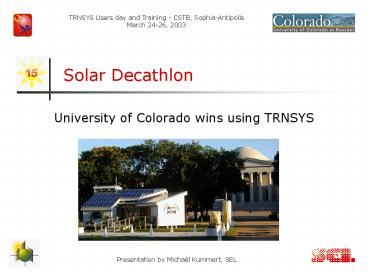
Solar Decathlon
- University of Colorado wins using TRNSYS
2
Acknowledgements
- This presentation is based on the following
information - Solar Decathlon Website
- University of Colorado Boulder website
- Detailed Simulation report,
- kindly communicated by Mike Wassmer
3
Presentation Overview
- The Solar Decathlon
- University of Colorado project
- BASE
- Reduced environmental impact
- Systems
- TRNSYS Simulations
- Simulation approach
- Energy performance
- Other simulation tools
4
What Is The Solar Decathlon?
- Competition to design, build and operate the most
effective and efficient solar-powered house - The 3 phases are evaluated!
- Self-sufficient (PV system batteries)
- Open to Students from US universities
- Some funding from DOE but mostly sponsors
- Houses are operated on the National Mall in
Washington, D.C. - First assembled in each university
- Must be easy to move
- No basement
5
The 10 contests
- Design and Livability
- Innovation aesthetics
- Presentation Simulation report
- Graphics Communication
- Web site, newsletters, live tours
- The Comfort Zone
- Consumer appeal of HVAC system
- Performance of HVAC system (T, RH, Energy)
- Refrigeration
- Hot Water
- Shower/Laundry/Dishes
- Cons. appeal/Performance
- Energy Balance
- In/Out Batteries
- Lighting
- Innovation, Integration
- Performance
- Home Business
- Office space / equipment
- Getting Around
- Extra energy for transportation (elec. car)
6
The BASE Design
- Adaptability through a modular approach
- Basic Module
- constructed from systematized wall, floor, and
ceiling components called Structural Insulated
Panels (SIP) - Solar Decathlon 2 Basic modules (bed/bath and
office/living areas) - Spec Module
- Architectural customization
- Solar Decathlon Kitchen/Entry, high glazing
fraction - Tech Pod
- Utility module, metal frame
7
The BASE Design
- What does it look like?
8
Building
- More an every-day American home than a perfectly
designed experimental solar house - Roof is not at the perfect angle for solar
cells17.5 and 25 - Not the 70s conventional passive design
- Environment-friendly building
- Materials
- Low embodied energy, sustainably harvested,
recycled, recyclable, non-toxic, local suppliers - E.g. fast-growing aspen wood, sheep wool,
recycled plastic - Construction
- Recycling, reducing waste
9
Glazing
- SouthWall Superglass Quad-TC
- Double glazing 2 suspended films
- Krypton-filled
- weightless cavity constructionSame weight as
double-pane window - U-Value 0.57 W/m²/K
- Visible transmittance 52
- SHGC (Solar Heat Gain Coefficient) 41
- Glazing area
- 21 m², 50 in South façade
10
Solar Thermal System (DHW only)
- Thermal collectors
- Evacuated Tubes placed on a flat surface
(TechPod roof). Absorber is tilted - 4.4 m², 300 l storage tank
- Electrical auxiliary heater 6kW
11
PV System
- AstroPower mono-crystalline Si
- 60 m², 7.2 kWc
- Electrical System (48V DC)
- Maximum Power Point Tracker
- Lead-Acid batteries
- 4 parallel strings of 8 batteries
- 67.2 kWh total storage capacity
- Estimated cost 400 / month
- 30 years mortgage, 7 interest
12
HVAC System
- All-electric
- Heat-pump
- 7kWth
- 5kW resistance for peak heating
- Ventilation system
- Energy Recovery
- Temperature
- Humidity
13
TRNSYS Simulation study
- 3 independent simulations
- Solar Thermal system
- Usual SDHW system simulation
- Average Draw 135 l/day
- PV System
- Batteries were removed (perfect storage)
- Space conditioning Building
- Type 56 for building (1 zone)
- Different hypotheses on gains (home - home office)
14
Solar Thermal System Simulation
- Parametric studies
- Collector area
- Location (CO, DC)
- Storage tank location
- Collector slope
15
PV System Simulation
- Parametric studies
- Location (CO, DC)
- PV Array Azimuth
- PV Array slope
16
Space Conditioning Simulation
17
Building model
- Type 56 with some simplifications
- Tech Pod not modeled
- Windows approximated by existing model in US
library - Very low infiltration (0.05 ACH)
- Simplified shading simulation (lumped windows)
- Internal gains default values for Solar
decathlon - Setpoints
- Heating 20.6C
- Auxiliary electrical resistances 21.4C
- Cooling 24.7C
- ERV
- Constant effectiveness
- Schedule always ON for home office
18
Space conditioning results
19
Other simulations
- Early parametric studies
- Energy-10
- SIP thickness
- Glazing options
- Electric lighting design
- AGI32
- Solar Shading strategy
- Ecotect 5
- Daylighting
- Radiance
20
More information
- Solar Decathlon website
- http//www.eere.energy.gov/solar_decathlon/
- University of Colorado Boulder Solar Decathlon
Team website - http//solar.colorado.edu/
Recommended

