

S. S. Babu, S. A. David and J. M. Vitek PowerPoint PPT Presentation
1 / 14
Title: S. S. Babu, S. A. David and J. M. Vitek
1
Thermo-Chemical-Mechanical Effects on
Microstructure Development in Low-Alloy Steel
Welds.
- S. S. Babu, S. A. David and J. M. Vitek
- Oak Ridge National Laboratory,
- Oak Ridge, TN 37831
- Solid-Solid Phase Transformations 99
- Kyoto, Japan, May 24-28, 1999
- Research sponsored by the Basic Energy Sciences
Division of the Department of Energy.
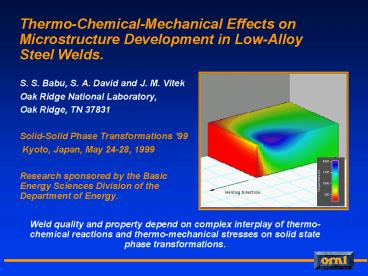
Weld quality and property depend on complex
interplay of thermo-chemical reactions and
thermo-mechanical stresses on solid state phase
transformations.
2
1. Role of thermo-chemical reactions in liquid
steel
In self-shielded flux cored arc welds (FCAW-S),
large amounts of aluminum are added to the filler
wire. Aluminum reacts with dissolved oxygen to
form Al2O3. Excess aluminum, reacts with
dissolved nitrogen to form AlN compound. After
these reactions, substantial amount of residual
aluminum remains in solid solution depending upon
the amount of aluminum in the wire.
What does residual aluminum in solid solution do?
3
Residual aluminum modifies the microstructure
development.
- High aluminum leads to skeletal d ferrite which
leads to low levels of weld metal toughness. - By reducing aluminum in the weld, one can
eliminate the d ferrite. - Reduced aluminum leads to inefficient deoxidation
and increases risk of porosity. - How can we optimize the aluminum addition to
improve weld quality, as well as microstructure?
0.53 wt. Al
4
Pseudo-binary Fe-C-Si-Mn-Al phase diagram may be
used to investigate the stability of d ferrite.
- The phase diagram shows the relation between d
ferrite stability and aluminum concentration and
supports the experimental weld microstructure.
5
Thermodynamic calculations do not consider the
process effects. Therefore, we need to calculate
the effects of weld cooling rate.
Liquid
Austenite(FCC)
d Ferrite (BCC)
- Diffusion controlled growth calculations were
carried out for both high and low-aluminum weld
metal compositions using DicTra software for a
cooling rate of 10 C/s.
6
Calculations support the presence of residual d
ferrite in high-aluminum welds.
High-Al
Low-Al
- The above analyses are being used to optimize the
aluminum content in welds.
7
2. Role of oxide inclusion composition on the
transition from bainite to acicular ferrite
- In conventional shielded metal arc welds,
titanium is also added as deoxidizer. - Weld metal with small additions of titanium (10
to 30 wt.ppm) can improve the impact properties. - This is because the titanium rich inclusions
promote acicular ferrite. - All the steels have similar hardenability. The
only difference is the titanium concentration in
the inclusions.
Weld B - 32 wt.ppm Ti
8
Kinetic measurements during cooling showed rapid
transformation below Bs temperature for welds
with Ti-rich inclusions.
Weld A - 7 wt.ppm Ti
50 C/s
Weld B - 32 wt.ppm Ti
- This is related to nucleation potency of
inclusions and allotriomorphic ferrite at the
austenite grain boundaries.
9
Indication of competition between bainite and
acicular ferrite can be seen while cooling at 80
C/s.
Weld A - 7 wt.ppm Ti
Weld B - 32 wt.ppm Ti
- Therefore, simultaneous transformation kinetic
theories need to be coupled with inclusion models
to describe this competition between grain
boundary and intragranularly nucleated
transformations.
10
3. Role of thermo-mechanical conditions on
austenite decomposition during welding
? 116 MPa
No Stress
- Elastic stresses affect the acicular ferrite
microstructure. - Babu and Bhadeshia, Mat. Sci. Eng.., A156, 1992,
1-9. - How does this affect the stress-relaxation
kinetics? - How does allotriomorphic ferrite formation react
to stresses?
11
An elastic load was applied after reaching an
isothermal temperature and the stress relaxation
and transformation kinetics were monitored
simultaneously.
Transformation strains
s
s
- The above information will be important for
estimating the residual stress development in
steel welds.
12
Stress-relaxation is greater during
allotriomorphic ferrite formation than during
acicular ferrite formation.
Fe-0.1C-0.8Si-1.6Mn-0.015Al-0.084O (wt.) steel
weld
- This is related to creep-relaxation of austenite
before and during transforming to allotriomorphic
ferrite. - Further work is necessary to evaluate this in
detail.
13
Microstructural details for stress-relaxation
experiments
- Small alignment of acicular ferrite plates was
observed. - Large amount of residual austenite exists after
allotriomorphic ferrite formation. This
transforms to martensite on cooling from
isothermal temperature.
14
Summary and Conclusions
- Large concentration of residual aluminum in
solid-solution leads to residual d ferrite in
self-shielded flux cored arc welds. The above
phenomenon was described with thermodynamic and
diffusion controlled growth calculations. - Titanium-rich inclusions promoted the transition
from bainite to acicular ferrite, as well as, the
transformation rate below bainitic start
temperature. - Large stress relaxation occurs during
allotriomorphic ferrite formation compared to
that of acicular ferrite formation. - Results illustrate the complex thermo-chemical-mec
hanical interactions on solid-state phase
transformations in steel welds.
Recommended

