

AMSRE Evidence for Changes in Precipitation Microphysics During Tropospheric Warming PowerPoint PPT Presentation
1 / 22
Title: AMSRE Evidence for Changes in Precipitation Microphysics During Tropospheric Warming
1
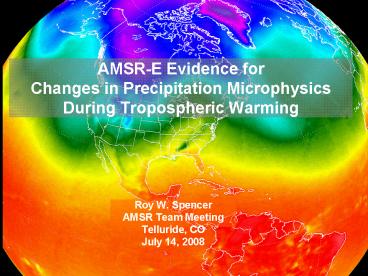
AMSR-E Evidence for Changes in Precipitation
MicrophysicsDuring Tropospheric Warming
- Roy W. Spencer
- AMSR Team Meeting
- Telluride, CO
- July 14, 2008
2
BackgroundThere is increasing evidence of net
negative radiative feedback in the real climate
system.
- Spencer, Braswell, Christy, Hnilo, 2007 Cloud
and Radiation Budget Changes Associated with
Tropical Intraseasonal Oscillations, Geophysical
Research Letters, August 9. - A composite of 15 tropical intraseasonal
oscillations show a stong negative radiative
feedback on tropospheric temperature - Spencer, R.W., and W.D. Braswell, 2008 Potential
Biases in Cloud Feedback Diagnosis An Energy
Balance Model Demonstration. J. Climate, in
press. - Internally-generated radiative forcing due to
stochastic cloud fluctuations has caused a
positive bias in satellite diagnoses of feedback. - Spencer, R.W., 2008 Chaotic radiative forcing,
feedback stripes, and the overestimation of
climate sensitivity. Bull. Amer. Met. Soc.,
submitted. - A simple model is used to explain 6-years of
satellite data, and show why previous satellite
estimates have overestimated climate sensitivity.
3
Cloud and water vapor feedbacks must ultimately
be connected to precipitation system behavior
1. Free-tropospheric vapor (Earths main
greenhouse gas) is largely governed by
precipitation efficiency (even in the
Arctic). 2. Many clouds are governed by -
detrainment from precipitation systems (middle
upper trop.), or - temperature inversions (lower
trop., due to subsidence forced by latent heat
release in precipitation systems)
4
Cooling (loss of IR radiation) by dry air to space
Precipitation Processes One Key to Climate
Sensitivity? The atmosphere is being
continuously recycled by precipitation systems,
which then determines the strength of the global
Greenhouse Effect.
Heat released through condensation causes air to
rise, rain falls to surface
Sunlight absorbed at surface
Boundary layer
warm, humid air
cool, dry air
evaporation removes heat
Ocean or Land
5
.a quick review.
Satellite observations support Lindzens
Infrared Iris Hypothesis of climate
stabilization (Spencer et al., Aug. 9, 2007 GRL)
With 4 instruments from 3 satellites, we studied
a composite of 15 tropical intraseasonal
oscillations (ISO) in tropospheric temperature.
Compositing done around day of Max. tropospheric
temperature (AMSU ch. 5)
2 Separate Satellites (NOAA-15 NOAA-16)
6
Composite of 15 Major ISOs, March 2000 through
2005
Tair (AMSU) SST, Vapor, Sfc. Wind speed
(TRMM TMI) (increasing wind speed and
vapor during tropospheric warmingexpected)
Rain Rates (TRMM TMI) (rain rates above normal
during tropospheric warmingexpected)
SW and LW fluxes (Terra CERES) (reflected SW
increase during rainy periodexpected..
BUTincreasing LW during rainy period UNEXPECTED)
SW and LW fluxes normalized by rain rate (rain
systems producing less cirroform cloudiness
during warming?)
7
MODIS Verifies Decreasing Ice Cloud Coverage
During Peak Tropospheric Temperatures
Tair (tropospheric temperature)
Cirroform clouds decrease during tropospheric
warmth
MODIS Ice and liquid cloud coverages
8
Cirrus Changes with Tropospheric WarmingThe
Necessary Connection to Precipitation Processes
- Tropics Cirroform clouds represent detrained
water that did not precipitate - Extratropics Same as tropics OR synoptic-scale
lift of water vapor which was previously
detrained by precipitation systems
AMSR-E V18-H18 lt 33 deg. C (Rainiest 1 of
Tropical Oceans)
Less Large Ice During Tropospheric Warmth
Thus AMSR-E suggests that thinning cirroform
cloudiness with tropical warming is connected to
microphysical changes in precipitation cores.
9
IF SATELLITE MEASUREMENTS SUGGEST NEGATIVE
FEEDBACK, WHY DO CLIMATE MODELS PRODUCE POSITIVE
FEEDBACK? With a Very Simple Model of Temperature
Variability around an Equilibrium State
dT/dt (F - l T)/Cp
Heat Capacity (well assume 50 m swamp ocean)
Forcing (radiative imbalance from CO2, aerosols,
volcanoesinternally-generated radiative
forcings, OR non-radiative imbalances generated
internally)
Feedback (well assume l 4 W m-2K-1)
feedback parameter l 3.3 Wm-2K-1 lvap
lcld ..
If l lt 3.3, then positive feedback, If l gt 3.3,
then negative feedback, If l lt 0, then climate is
potentially unstable to perturbations (Hansen
Effectonly 3.3 Watts of positive feedback from
disaster)
10
If this simple model is run with NON-Radiative
Forcing (daily random heat flux vars e.g. from
evaporation)
then diagnosed Feedback is Accurate
11
But if simple model is run with RADIATIVE
Forcing only (e.g. daily random
cloud variations, 1-year smoothing)
..then, diagnosed Feedback is near-Zero
12
Now, lets put 4-year smoothing on the
Radiative forcing ( Non-Radiative Forcing)
..now the model is starting to look like the
satellite data (high freq. non-radiative forcing
low-freq. radiative forcing)
and do 90-day smoothing of model output to allow
time-evolution to be seen
13
So, in the general case, Feedback stripes (from
non-radiative forcing) are superimposed
upon Radiative Forcing Spirals
But, how do we separate the two signals?
14
AnswerLocal Slopes Analysis to isolate the
feedback signal
1. Compute 2-month local slopes every
day throughout 90() day low-pass filtered time
series.
2. Look for a peak in the frequency distribution
of those slopes
Correct Feedback Diagnosed
15
Even with radiative forcing only (radiative
forcing spirals, but no feedback stripes) the
feedback signature is revealed by Local Slopes
analysis
Correct Feedback Again Diagnosed
16
Local Slopes Analysis of Satellite
Measurements CERES vs. AMSU 60N-60S Oceans Mar
2000 thru Dec 2005
LWSW
Local Slopes Method peak in LWSW freq.
distribution 7 W m-2 K-1 (strong negative
feedback)
(same peak found for avg. periods from 10 days
to 2 years ..feedback independent of
timescale?)
17
Now, what do the IPCC models show? Local Slopes
Analysis of NCAR-CCSM3.0 (least sensitive of IPCC
models analyzed by FT 2006)
Note the models also have chaotic radiative
forcing spirals, too.
18
Test w/ Simple model
ANOTHER potential technique to isolate the
feedback signal
6 (specified)
Reappraisal of Forster Gregory (2006) Feedback
Parameter Diagnoses from Earth Radiation Budget
Satellite (ERBS) vs. Tsfc (1985-1996)
(FG results)
Since the radiative forcing signal is
UN-correlated and the feedback signal is highly
correlated, can we extrapolate FGs diagnoses
from different time periods to a correlation of
1.0?
4.7
So, even previously published feedback estimates
are supportive of negative feedback!
(FG results)
3.4
19
Strongly neg. feedback means incr. CO2 cant
explain warming over last 100 yrs So, what Could
Have Caused Past Warming?
What if the atmospheric oceanic circulation
changes associated with known modes of climate
variability cause cloud changes? (internal
radiative forcingnot feedback)
Tsfc
SOI
Or nonlinear interactions? (e.g. - SOIPDO)
PDO
20
Lets force our Simple Climate Model with Natural
Cloud variations proportional to PDO and El
Nino/La Nina (SOI)
1,000 m deep ocean (top 27) l 4.0 W m-2 K-1
a(0.64-SOI 0.36PDO)
In same model, CO2 forcing to 1.4 W/m2 / 100
years provides remaining warming (0.25 deg. C)
21
But is there any evidence that the PDO SOI
have associated cloud variations?
YES, 0.8 W m-2 K-1 per PDO unit
our 20th Century Warming model? 0.7 W m-2
K-1 per PDO unit
22
Conclusions
- New ways of interpreting satellite data suggest
that the behavior of clouds - in the climate system has been misinterpreted
- - cause and effect have been confused
- - as a result, climate models have cloud
parameterizations that - make the models far too sensitive.
- AMSR-E data, along with other satellite
instrument datasets will continue to provide new
physical insight into the processes which govern
feedbacks (climate sensitivity).
Recommended

