

The History of Jazz PowerPoint PPT Presentation
1 / 51
Title: The History of Jazz
1
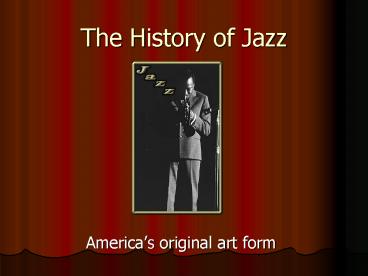
The History of Jazz
- Americas original art form
2
Jazz Music
- Originated in the 1920s in New Orleans
- Characterized by blue notes, syncopation, swing,
call and response, and improvisation - Picture is of Bourbon Street in New Orleans
3
Origins of jazz
- West African Folk Music
- European Classical Form and Harmonies
- New Orleans Marching Bands
- The Blues
- Influences of other styles of modern music
4
Jazz Instruments
5
Styles ( Eras) Of Jazz Music
- 1880s to 1910
- 1910-1920
- 1920-1945
- 1943-1952
- 1955-1969
- 1970-1986
- 1987-present
6
Ragtime Music
- 1897 Harlem Rag
- 1899 Maple Leaf Rag
- 1902 The Entertainer
- 1906 Frog Legs Rag
- 1919 Bohemia Rag
- Tom Turpin
- Scott Joplin
- James Scott
- Joseph Lamb
7
Ragtime Music
- 1897 starts the influence of Ragtime
- Ragtime predated the availability of sound
recordings so its popularity was by word of
mouth. - Was distributed by sheet music
- With industrialization, railroad construction its
popularity quickly spread - Piano rolls and player pianos play an important
role with ragtime music
8
Ragtime Music
- Invention of the phonograph helped spread ragtime
music and helped the music industry - Stride piano is an important aspect of Ragtime
music that had a direct influence on modern music
today
- Primarily written for piano but towards the mid
1910s, some songs were arranged for different
ensembles thus leading the way into Dixieland
music
9
Styles of Ragtime Music
- Cakewalk-popular in 1904, music is intended to
represent of dance contests where the prize is a
cake - Two-Step-Popular in 1911, dance craze that was
popular in the early 1900s
- Ragtime Song- version of ragtime music that was
influential to Irving Berlin, American composer,
influential in early Hollywood and Broadway
10
Styles of Ragtime Music
- Classic Rag- Style made popular by Scot Joplin,
main style of ragtime music - Fox-Trot- dance style started in 1913, became
popular in 1920s
- Stride Piano- emerged after WW1 fast paced moving
bass line, direct influence on early Rock Roll
11
Ragtime Revivals
- 1950s better recording devices were invented so
older songs were recorded on record and published
causing a revival in popularity - 1970s- Joshua Rifkin recorded a series of Scott
Joplin music and won a Grammy, re-introduced
Joplins music to the public - New York Public Library released a 2 volume set
of Scott Joplin music which introduced a new
audience to his music - 1974- the movie The Sting staring Robert Redford
and Paul Newman used Scott Joplin songs as its
theme songs.
12
Scott Joplin
- Father Of Ragtime
- 1899 Maple Leaf Rag
- Most Famous Ragtime Song
- 1902 The Entertainer
13
Scott Joplin
- Best known ragtime musician and composer
- Father of Ragtime music
- 1891-Part of a minstrel troupe
- 1895 started selling his music
- Worked as a pianist in Maple Leaf and Black 400
gentlemen clubs - 1899 Sold his most famous piece Maple Leaf Rag to
John Stark - Boosted his popularity and made ragtime famous
- Treemonisha- opera based on ragtime music
14
The Maple Leaf Rag
- Named after a bar Joplin worked at in Sedalia
Missouri - ragtime's biggest hit
- The success of the Maple Leaf Rag sparked a
nationwide ragtime craze.
- 1899 Publication of the Maple Leaf Rag
- becomes a nationwide best-seller
- 1903 The first recording of Maple Leaf Rag is
made, in Minneapolis
15
The Entertainer
- 1902 The Entertainer
- Featured in the 1973 movie the sting featuring
Paul Newman and Robert Redford
- Helped to launch a ragtime revival which
increased the popularity of ragtime music - Song influenced John Williams to write the
cantina song in Star Wars
16
Joseph Lamb
- Influential Composer
- 1908 Met Joplin
- 1908 Sensation
- 1919 Bohemia Rag
17
Joseph Lamb
- White influential ragtime musician and composer
- Self taught musician
- Big fan and influenced by Joplin
- 1908- New York, was purchasing Scott Joplin music
in record store when he met Scott Joplin - Introduced to John Stark
- Lambs music was published for the next decade
- 1908- Sensation
- 1914- Cleopatra Nightingale
- 1919 Bohemia Rag
- When popularity of Ragtime faded, decided to work
as an accountant - 1950s revival had him come out of retirement and
start performing again
18
James Scott
- 1902 worked for Charles Dumars and met Joplin
- 1903 A summer Breeze
- 1906 Frog Legs Rag
19
James Scott
- One of the big three composers of ragtime music
- Born in Neosho Missouri
- 1902 worked in music store of Charles Dumars as
menial labor - Showed musical ability so Dumars published his
music - A Summer Breeze in 1903
- 1906 moved to St. Louis
- Met Scott Joplin and John Stark
- 1906 Frog Legs Rag
- 1914 moved to Kansas City
- Married, taught music, directed theater orchestra
- Talking movies began so he lost his first
fortune. Wife died, bad health - Continued to compose until Starks retirement in
1922
20
Tom Turpin
- Father of St. Louis Ragtime
- 1896 Harlem Rag
- First Politically Powerful African Americans in
St. Louis
21
Tom Turpin
- Ragtime composer and businessman
- Opened saloon in St. Louis which became a meeting
place for musicians - First African American to publish a ragtime song
Harlem Rag in 1897 - Other famous song was St. Louis Rag
- Owned several businesses in St. Louis, theater,
saloons, gambling houses - Was a deputy sheriff and one of the first
politically powerful African Americans in St.
Louis. - His influence on local music earned him the
nickname Father of St. Louis Ragtime.
22
John Starks
- Was the publisher of the most famous ragtime
composition from the 1900s-1920s - Money he earned by publishing Maple Leaf Rag
enabled him to increase his publishing company - Moved from Sedalia Missouri to St. Louis and
finally to New York - He and Scott Joplin moved together
- One of the first music Promoters and Advertisers
- persistently challenged the musical (and racial)
prejudices that prevented true ragtime from
receiving its due. - Competed against Tin Pan Alley Producers
23
Tin Pan Alley
24
Tin Pan Alley
- Was the popular music publishing center of the
world from around 1885 to the 1920's - Before it was established, publishers were
scattered all over the country - these early publishers played important roles in
the printing and distribution of sheet music.
Most music publishers also published church
music, music instruction books, study pieces and
classical items for home and school use.
- After the Civil War, people started to play the
piano. - By 1887 500,00 young Americans were learning the
piano - The demand for sheet music was great.
- Publishers decided to consolidate in New York.
- New York was becoming a cultural center in the
United States. - Performers lived there, music thrived there,
musical trends happened there
25
Tin Pan Alley
- Thomas B. Harms (Harms, Inc. started in 1881)
- Isadore Witmark. M. Witmark Sons published
their first sheet music I'll Answer That Question
Tomorrow in 1885. - Soon every major music publisher in America had a
presence in what would become Tin Pan Alley - Irving Berlin, Inc., Remick Music Co., Robbins
Music Corp, and E. B. Marks Music Company
- These visionaries concentrated almost exclusively
on popular music, and the key to their success
was their use of market research to select music
and the use of aggressive marketing techniques to
sell the product. - Song composers were hired under contract giving
the publisher exclusive rights to popular
composer's works
26
Tin Pan Alley
- The market was surveyed to determine what style
of song was selling best - Then the composers were directed to compose in
that style. - a song was actually tested with both performers
and listeners to determine which would be
published and which would go to the trash bin
- music was becoming an industry more than an art
- Song pluggers (performers who worked in music
shops playing the latest releases,) were hired - Performers were persuaded to play the new songs
in their acts to give the music exposure to the
public
27
Tin Pan Alley
- 28th street between 5th Avenue and Broadway. This
street (28th) became known as "Tin Pan Alley. - the first to establish themselves in the area
known as Tin Pan Alley was most probably Leo
Feist, a corset salesman who had a penchant for
writing catchy lyrics
- In 1897 Feist rented a room at 1227 Broadway and
with a piano and a partner began the music
publication business with his first song, Does
True Love Ever Run Smooth. - The name symbolizes the sound of the many pianos
being pounded in publisher's rooms which was
characterized as sounding as though hundreds of
people were pounding on tin pans.
28
Tin Pan Alley
- vaudeville replaced the minstrel show as the most
popular form of stage entertainment - enormous amounts of money were to be made from
the sale of songs popularized by these shows - In the first two decades of its existence, Tin
Pan Alley produced a succession of songs,
remarkable from a commercial standpoint and for
their endurance in American culture.
- Large numbers of songs from this period became
widely known and are a part of our traditions
even today. - Give My Regards To Broadway (1904), Shine on
Harvest Moon (1908,), Down by the Old Mill Stream
(1910) and Let Me Call You Sweetheart
29
Tin Pan Alley
- The lyrics of music from this period suggest that
the USA was a peaceful, happy and prosperous
place. - The many songs about the past describe warm
memories of happy and innocent times in rural or
small town settings. - The persistent image of one of the happiest and
least troubled times in American history has been
derived largely from these songs. - Compare those images to today's music which is
mostly in an urban setting with very disturbing
and violent images.
- Tin Pan Alley was not about love peace and
happiness, it was about selling songs. - There were no altruistic desires on the part of
the publishers to solve the problems of society
nor were they attempting to create a happy world - provide musical entertainment that allowed people
to escape the realities of the hardships of life
and their own life's troubles.
30
Tin Pan Alley
- the publishers of Tin Pan Alley not only
established an industry that continues in grand
tradition but they also are responsible for the
beautiful music and covers we enjoy today - what remains of Tin Pan Alley was put up for sale
and the buildings will most probably be razed to
make way for "progress."
- The buildings, at 47, 49, 51, 53 and 55 West 28th
Street, are being sold as a group for - hold on
to your hat in these cacophonous economic times -
a mere 44 million."
31
The Minstrel Show
32
The Minstrel Show
- a theatrical entertainment consisting of songs,
dances, comic turns, etc., performed by a troupe
of actors wearing black face make-up - troupe, company - organization of performers and
associated personnel - corner man, end man - a man at one end of line of
performers in a minstrel show carries on
humorous dialogue with the interlocutor
- interlocutor, middleman - the performer in the
middle of a minstrel line who engages the others
in talk - minstrel - a performer in a minstrel show
33
The Minstrel Show
- The most popular musical stage shows of the early
and mid 19th Century, - In the US they began in the 1840s
- Both white and black performers donned blackface,
and audiences of all colors loved it. - minstrel shows were the first form of musical
theatre that was 100 American-born and bred.
- performing songs and skits that sentimentalized
the nightmare of slave life on Southern
plantations - By the end of the Civil War the minstrel show had
become world famous and respectable - Between 1750 and 1843, over 5,000 theater and
circus productions included blackface.
34
The Minstrel Show
- Some of the most famous songs in American
history--Dixie, Camp town Races, Oh Susannah, My
Old Kentucky Home--began as minstrel songs. - Thomas "Daddy" Rice caused a nationwide sensation
by donning burnt cork to perform the song "Jump
Jim Crow" on stage. - "Jim Crow" turned out to be more than a popular
song. It became the name of one of minstrelsy's
stock comedy characters, and a by-word for
legalized racial oppression.
- three stock characters were among several that
reappeared in minstrel shows throughout the
nineteenth century. - "Jim Crow" was the stereotypical carefree slave
- "Mr. Tambo" a joyous musician,
- Zip Coon" a free black attempting to "put on
airs" or rise above his station
35
The Minstrel Show
36
The Minstrel Show
- Dan Emmett, Frank Bower, Frank Pelham and Billy
Whitlock became the first troupe to offer a full
evening of blackface variety entertainment. - Most historians mark this production as the
beginning of minstrelsy.
- Most of the entertainment was improvised
- They insulted each other, they baited each other,
they made mincemeat of the language, they took
the audience into their fun, and, in one night,
they added a new form to show business in America
37
The Minstrel Show
- in the twentieth century, several of the most
famous minstrels were actually black me who wore
makeup--the most famous being Bert Williams, who
performed in blackface into the 1920s. - The first talking picture, "The Jazz Singer,"
(1927) was a blackface film
- Minstrel shows continued to be popular well into
the 1950s, - High schools, fraternities and local theater
groups would often perform minstrel shows in
blackface. - It became unpopular as African Americans
asserted more political power in the 1950s.
38
The Minstrel Show
- The long-running radio series Amos n' Andy
featured two white actors impersonating
contemporary black characters that were direct
descendants of "Zip Coon" and "Jim Crow. - Stephen Foster- American song writer of Camp town
Races," "My Old Kentucky Home," "O Susanna
- Minstrel star Dan Emmett composed the unofficial
Southern anthem "Dixie. - George M. Cohan and Irving Berlin.
- Al Jolson- most famous actor who got his start in
a minstrel show - Jolson immortalized blackface in several films,
including the talking landmark The Jazz Singer
(1928).
39
The Minstrel Show
- Jolson said that blackface gave him the emotional
freedom he needed to take risks as a performer - In the first half of the 20th Century, he was
billed as "The World's Greatest Entertainer - last star of minstrelsy
- legend in vaudeville,
- Al Jolson had dozens of top selling recordings
- Became the first talking film star
- Was a popular presence on network radio.
40
The Minstrel Show
- The bizarre minstrel show might be easier to
understand in modern terms. - Think of white rappers, or white rock musicians
who play blues-derived music. - When they imitate black musicians, are they
expressing admiration, or are they just stealing?
- Are they sincerely trying to come to some
understanding of cultural difference, or are they
just engaging in minstrel parody without the make
up - Similarly, are black musicians who play to a
predominantly white audience, particularly those
produced by Sean "Puffy" Combs, doing something
similar to what Bert Williams did?
41
Vaudeville
- In the 1880s after the Industrial Revolution,
people started to concentrate in cities and towns
instead of rural communities - Looking for higher paying jobs and more
opportunities of success - Worked hard and long hours and wanted to be
entertained after hours - variety shows were too coarse for women or
children to attend,
- minstrel shows were already declining in
popularity - In a world where phonographs, film, radio and
television did not yet exist, something new was
needed to fill the gap. - Vaudeville also tried to bridge a social gap that
had divided American audiences - Vaudeville was developed by entrepreneurs seeking
higher profits from a wider audience.
42
Vaudeville
- Tony Pastor-Invented Vaudeville in 1881
- music and comedy" designed for family audiences
- Pastor showcased the finest talents on the
variety stage, giving crucial opportunities to
future stars - Pastor never expanded beyond his small theatre
near Union Square.
- A place families could call home for their
entertainment - Pastor's "clean" variety show was an instant
success, drawing an enthusiastic audience from
all age groups and classes including some of
the most influential people in New York.
43
Vaudeville
- Benjamin Franklin Keith and Edward F Albee made a
quick fortune with unauthorized productions of
Gilbert and Sullivan operettas. - started build a chain of ornate theatres across
the northeastern United States - they instituted a policy of continuous multiple
daily performances, which they called
"vaudeville."
- vaudeville spread through the United States,
major theatre chains or circuits were built - By 1907 Vaudeville was earning 30 million a year
- A successful act toured for forty or more weeks a
year, doing "one nighters," split-weeks or weekly
stands depending on a theatres size
44
Vaudeville
- In 1919, when the average factory worker earned
less than 1,300, a small time circuit performer
playing a forty-two week season at 75 per week
earned 3,150 a year. - The most celebrated vaudeville house of the early
1900s was New York's Victoria
- The Orpheum Circuit- The Palace Theatre
- An act could be anything that was inoffensive and
entertaining. A performer's gender, race and
appearance were no barrier to success, - While singers and dancers were part of every
bill, the specialty acts set vaudeville apart
45
Vaudeville
- mind readers
- instrumentalists
- escape artists
- flash acts - any "showy" act boasting its own
lavish set, a large chorus, special effects, etc.
- high divers
- quick-change artists
- strong men
- living statuary
- contortionists
- balancing acts
- freak acts - anyone acting crazy or silly -
eccentric dancers, etc.
46
Vaudeville
- Houdini
- Hadji Ali would swallow water kerosene, then
spew kerosene onto open flames, followed by the
water to put the flames out. Not pretty, but
audiences were fascinated. - W.C. Fields
- Will Rogers
- Babe Ruth
- Douglas Fairbanks
- Judy Garland
- George Burns
- Abbot Costello
- The Three Stooges
- Kate Smith
- Mickey Rooney
47
Vaudeville
- As stars got more popular they went on to bigger
projects - Movies started to gain popularity
- audiences tastes changed and vaudeville theaters
started to change over to movie theaters - 1930s talking movies
- Great Depression
- vaudeville singers and comics found a new home on
radio, where "variety shows" offered something
like audio vaudeville - Vaudeville led to the immergence of family
friendly entertainment on radio, television, and
movies - Ed Sullivan Show
- Leave it to beaver
- Carol Burnet show
- Vaudeville was precursor to Broadway and Motion
Pictures
48
TOBA
- Theater Owners and Booking Agency
- Black version of Vaudeville
- vaudeville had black and white performers sharing
the same stage as early as the 1890s - Most southern states did not allow blacks and
whites to sit in the same theatre
- the only venues below the Mason-Dixon Line that
welcomed "colored" customers in the early part of
the 20th Century - offered all-black bills for all-black audiences
- It was the only way they could reach the
appreciative black audiences of the deep South
49
Mason Dixon Line
50
TOBA
- Ethel Waters - who went on to Broadway and film
stardom - Ma Rainey - jazz vocalist
- Bert Williams - Ziegfeld Follies star
- Bessie Smith - jazz vocalist
- Bill "Bojangles"Robinson - tap dance legend
- Many jazz artists got their start in TOBA
- black audiences saw the same kinds of acts found
in standard vaudeville - Faded in popularity due to the Great Depression
51
Jim Crow Laws
- 1865- Period called reconstruction Government
provided civil right protection for African
Americans - 1877- End of reconstruction and withdraw of
federal troops from the south - Legislature of the south passed the Jim Crow Laws
- Prohibited African Americans from using same
facilities as whites - Supported racial segregation
- Jim Crow comes from minstrel song called Jump Jim
Crow written in 1828 performed by Thomas
Dartmouth Daddy Rice - 1896-Plessy vs. Ferguson-resulted in 58 years of
legal discrimination - 1954 Brown vs. Board of Education - Thurgood
Marshal - 1954- Supreme court overturned Plessy vs Ferguson
- 1964-Modern Civil Rights Act
Recommended

