

Collecting HighRate Data Over LowRate Sensor Network Radios PowerPoint PPT Presentation
1 / 1
Title: Collecting HighRate Data Over LowRate Sensor Network Radios
1
Collecting High-Rate Data Over Low-Rate Sensor
Network Radios
Center for Embedded Networked Sensing
Ben Greenstein, Alex Pesterev, Chris Mar, Eddie
Kohler, Jack Judy, Shahin Farshchi, Deborah
Estrin CENS Systems Lab http//lecs.cs.ucla.edu
Introduction Collecting High-Rate Data with
Motes is Hard!
Acquisition Challenges
Data Processing Challenges
- High-rate data must be processed before
transmission - When a system is bandwidth limited, better to
plan which sets are lost rather than leave it to
chance - Motes provide limited support for signal
processing - 8MHz MCU, 10KB RAM, no FPU
- Sensor networks have limited debugging visibility
- Heavy MCU load interferes with other subsystem
tasks
- High interrupt load interferes with other
application subsystems - Delayed interrupt handling induces sampling
jitter - Limited memory forces a quick turnaround (at
8kHz, cannot store 1 second of data in RAM)
Communication Challenges
- Shared radio channel cannot support aggregate
data traffic produced by neighborhood - Lack of flow/congestion control overwhelms
network - Limited RAM shortens forwarding queues
- Data traffic collides with data processing
tasking messages
Heterogeneity Challenges
- Mote/ µserver platform diversity complicates
programming - Collaborative processing among motes and µservers
difficult to coordinates
Problem How do we process high-rate data to
overcome bandwidth limitations?
Interactive Control over Data Processing
Engineering Systems Need Tuning, Calibration
- Researchers don't know best way to filter data
because they haven't seen such spatially dense
data before - Interesting data is application- and
environment-dependent and time varying - Spatial correlation is not always well understood
- For calibration, hypothesis tests, and pattern
searches, its best to collect representative
waveform data for back-end processing - Given bandwidth limitations, best to transfer
data processing to sensor nodes to return as much
interesting information as possible
VanGo Software Architecture for High-Rate Data
Collection
Cross-Platform Software Architecture
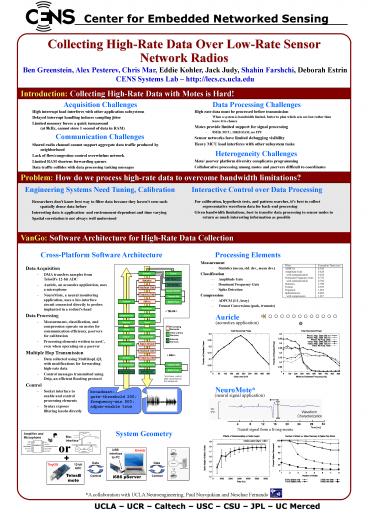
Processing Elements
- Measurement
- Statistics (mean, std. dev., mean dev.)
- Classification
- Amplitude Gate
- Dominant Frequency Gate
- Spike Detection
- Compression
- ADPCM (31, lossy)
- Format Conversions (pack, truncate)
- Data Acquisition
- DMA transfers samples from TelosBs 12-bit ADC
- Auricle, an acoustics application, uses a
microphone - NeuroMote, a neural monitoring application, uses
a bio-interface circuit connected directly to
probes implanted in a rodents head - Data Processing
- Measurement, classification, and compression
operate on motes for communication efficiency,
µservers for calibration - Processing elements written in nesC, even when
operating on a µserver - Multiple Hop Transmission
- Data collected using MultihopLQI, with
modifications for forwarding high-rate data - Control messages transmitted using Drip, an
efficient flooding protocol - Control
- Socket interface to enable and control
processing elements - Syntax exposes filtering knobs directly
Auricle
(acoustics application)
NeuroMote
(neural signal application)
System Geometry
Amplifier and Microphone
Bio-Interface
or
Emstar
USB Interfaceto PC
Data
Data
Control
Control
i686 µServer
A collaboration with UCLA Neuroengineering, Paul
Nuyujukian and Neschae Fernando
UCLA UCR Caltech USC CSU JPL UC
Merced
Recommended

