

Images of Wildlife from the Southern Hemisphere Part II: S'A' PowerPoint PPT Presentation
1 / 61
Title: Images of Wildlife from the Southern Hemisphere Part II: S'A'
1
- Images of Wildlife from the Southern
Hemisphere- Part II S.A.
Alan Journet and Kathy Conway
2
To S.A. via Mauritius the other choice was via
Singapore and Dubai
3
(No Transcript)
4
(No Transcript)
5
Arriving in Johannesburg (Jobug) weather
conditions smoke
6
British High Commission Housing Allowance
7
The road to Kruger National Park
8
High Velt to Low Velt
9
(No Transcript)
10
Arriving at Kruger the excitement mounts
Malelane Gate
11
The drive in first sitings
12
Berg en Dal Camp Neat cabins.
The humans are in the cage
But its a peasant cage!
13
Of course there were RULES
Dwarf mongoose (mongooses) Helogale parvula
14
Safari Wagon night safari no photos.hyaena,
elephant, owl,
15
We also saw and identified birds. Like this
lilac breasted roller Coracias caudata Seen here
with buffalo weaver (Bubalornis niger) nests.
16
And then the Southern yellow-billed hornbill
Tockus leucomelas
17
(No Transcript)
18
Greater Kudu Tragelaphus strepciseros woodlands
and thickets disperse during wet
seasonconcentrate durin dry in favorable locales.
19
(No Transcript)
20
White (Square-lipped) Rhinocerus Ceratotherium
simumWoodland inhabitant.
21
(No Transcript)
22
Girafe Giraffa camelopardalis
23
(No Transcript)
24
Scenery Tropical/sub-tropical dry forest Low,
caducifolious (loses leaves in dry season)
25
So now we have a sampling transect through the
park.
It was 100 meters wide, so every kilometer we
drove, we sampled 100,000 sq meters and thus
one sq. km. for every 10 km driven.
26
Kruger National Park (19,685 km2) combined with
Zimbabwes Gonarezhou N. P. and Mozambiques
Limpopo N.P. to form the Limpopo Transfrontier
Park with a total of 35,000 km2 ( 22,000 m2).
27
4 hourson the Motorway Interstatefrom Joburg
28
Using our transect design, we decided we
couldestimate the animal populations in the
region.
When other tourists were zipping past impala
herds bemoaning just another million
lion-burgerswe stopped to count.and as a
result saw hidden in the impala herds many
animals we otherwise would not have seen.
29
Gnu Black Wildebeest Connochaetes gnou we
thought -Grassy plains with nearby water
30
Not just a pretty face.
31
Burchells Zebra Equus burchelli from grassland
woodland.
32
Dwarf or is it a SlenderMongoose?
Galarellasanguinae
33
Dawn Safari
34
Lion Panthera leo
35
(No Transcript)
36
Later the same day probably the same group.
37
Time for some more birds.How about some
starlings.
Lamprotornis spp.
38
African Fish Eagle Haliaeetus vocifer the voice
of Africa
Crested Francolin Francolinus saphaena
Swainsons Francolin Francolinus swainsonii
39
Verreauxs (Giant) Eagle Owl Bubo lacteus
Saddle-billed Stork Ephippiorhynchus
senegalensis
40
and then there were crocodiles Crocodylus
niloticus
both in the water..
.and out
41
Water buck Kobus ellypsiprymnusAfrican savannah
of Sahara
42
Wart hog Phacochoerus aethiopicus
africanusAfrica S. of Sahara
43
More Loxodonta africana
And how do we know its elephant?
44
(No Transcript)
45
Bush Buck Tragelaphus scriptus
46
There must be something out there.
Hippopotamus Hippopotamus amphibius
We counted 15 in this pond.
47
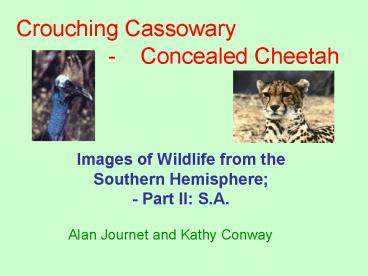
At last the Concealed cheetah Acinonyx jubatus
48
Hippos also enjoy rivers.
White-tailed swallows Hirundo smithii
Another blind must be something here as well
49
Are those rocks out there?
Another empty pond?
50
Afsaal Picnic Area
Spotted Hyaena Crocuta crocuta
But sometimes the wildlife comes to join you
51
Vervet Monkey Cercopithecus aethiops
Skukuza Camp
52
Chacma Baboon Papio ursinus
53
Other hornbills first, the African grey
hornbill Tockus nasutus
Then, the Ground hornbill Bucorvus caffer
A cute little bird standing 1 meter high
54
Grey Lourie / Grey Go-Away bird Corythaixoides
personata
Laughing Dove Streptopelia senegalensis
Black Korhaan Eupodotis afra
55
More..
Kudu from the Berg en Dal compound
56
Monument to Paul Kruger Boer, Lion-hunter
President of the Transvaal, now South African
Republic
Kruger Sunset
57
Termite Nest
Numbit Gate - departure
Tree Squirrel Sciurus sp
58
Impala.and
59
(No Transcript)
60
Thus we drove 232.4 km and sampled 23.24 km2.
In 23.24 km2 we saw 821 Impala for an ave. of
35.33 Impala per km2.
Since the Kruger Park Area is 19,685 km2 there
must be 695,471.05 Impala. Meanwhile, since the
total tri-park area is 35,000 km2, there must be
app.
12,326,550 Impala.
Kruger Count in 2002 reported 150,000
61
Sterkfontein Caves the birthplace of mankind
Recommended

