

GOES Cloud Products and Cloud Studies PowerPoint PPT Presentation
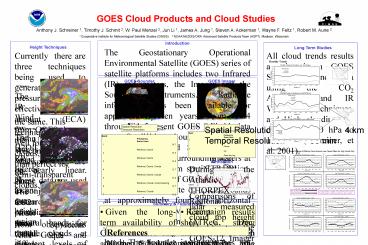
Title: GOES Cloud Products and Cloud Studies
1
GOES Cloud Products and Cloud Studies
Anthony J. Schreiner 1, Timothy J. Schmit 2, W.
Paul Menzel 2, Jun Li 1, James A. Jung 1, Steven
A. Ackerman 1, Wayne F. Feltz 1, Robert M. Aune
2 1 Cooperative Institute for Meteorological
Satellite Studies (CIMSS) 2 NOAA/NESDIS/ORA
Advanced Satellite Products Team (ASPT) Madison,
Wisconsin
Introduction
Height Techniques
Long Term Studies
The Geostationary Operational Environmental
Satellite (GOES) series of satellite platforms
includes two Infrared (IR) radiometers, the
Imager and the Sounder instruments. Radiance
information has been available for approximately
ten years. From 1994 through the present GOES
Sounder data are available hourly over the
CONtinental United States (CONUS) and the
immediate surrounding waters at approximately 10
km spatial resolution. In 2001 the launch of
GOES-12 offered a slightly different suite of
spectral bands at approximately four km
horizontal resolution. This new Imager instrument
replaced the 12.0 µm IR dirty window band with
a 13.3 µm CO2 absorption band. The Sounder
instrument has not modified its suite of 18 IR
bands and 1 Visible band since the launch of
GOES-8 in 1994. Due to its length of service (ten
plus years to date), routine data availability
(hourly information for the Sounder and thirty
minute hemispherical coverage for the Imager),
and spatial resolution (10 and 4 km at the
sub-point, respectively for the Sounder and
Imager) it is now possible to examine cloud
trends over that period of time. To some extent
this has already been done for the GOES Sounder
and will be shown over several regions within
the GOES Sounder coverage. Additional diurnal of
characteristics of high clouds will also be shown.
- Currently there are three techniques being used
to generate cloud top pressure (CTP) and
effective cloud amount (ECA) from GOES data at
the University of Wisconsin Madison. They are
the - IR Window (or IR Look Up)Technique
- H2O/IRW Intercept Technique
- CO2 Absorption Technique.
- Each is briefly described below and a sample CTP
derived image is shown for each case. For a more
thorough explanation of these techniques please
see Nieman, et al (1993).
All cloud trends results are based on GOES
Sounder radiance data using the CO2 Absorption
and IR Window Techniques, and High cloudiness is
defined as 300 hPa to 100 hPa (Schreiner, et al.
2001).
Monthly Trends
IR Window The IR Window Technique is based on a
simple assumption that the all clouds have an ECA
of 1.0 (or are infinitely thick), and therefore
the radiating temperature of the cloud, Tbc, in
the 11.0 µm region corresponding atmospheric
temperature at the top of the cloud are
GOES Sounder
GOES Imager
the same. This technique works well for thick
clouds, but is less than perfect for
semi-transparent clouds.
Fig. 4. Sample GOES Imager CTP DPI.
Fig. 5. Sample GOES Sounder CTP DPI.
Spatial Resolution 4 km Temporal Resolution 30
min
Spatial Resolution 10 km Temporal Resolution 60
min
H20/IRW Intercept The H2O/IRW Intercept
technique height assignment is predicated on the
fact that the radiances for two spectral bands
vary linearly with cloud amount. Thus a plot of
H2O (6.5 µm or 6.7 µm) radiances versus IRW (10.7
µm or 11.0 µm) radiances in a field of varying
cloud amount will
Band Frequency Some Uses 1 Vis Clouds
2 3.9 Snow, fire, fog 3 6.7 Winds
(3 6.5 Winds) 4 10.7 Retrieval, Clouds,
Snow, Cloud-Clearing 5 12.0 Retrieval, Clouds,
Cloud-Clearing (6 13.3 Clouds) For
GOES-12 Band 3 has been modified, Band 5
eliminated, and Band 6 added.
Band Frequency Some Uses 1 14.7 Retrieval,
Ozone 2 14.4 Retrieval, Ozone
3 14.0 Retrieval, Ozone, Clouds
4 13.7 Retrieval, Ozone, Clouds
5 13.4 Retrieval, Clouds, Cloud-Clearing
6 12.7 Retrieval, Clouds 7 12.0 Retrieval,
Clouds, Cloud-Clearing 8 11.0 Retrieval,
Clouds, Snow, Cloud-Clearing 9 9.7 Ozone
10 7.5 Retrieval 11 7.0 Retrieval
12 6.5 Retrieval, Ozone 13 4.6 Retrieval,
Ozone 14 4.5 Retrieval, Ozone 15 4.4
Retrieval, Ozone 16 4.1 Retrieval, Ozone,
Snow 17 4.0 Snow, Cloud-Clearing
18 3.8 Snow
Diurnal Trends
Diurnal Change of Effective Cloud Amount over
Central Plains for High Clouds Only
Winter 1997/98 (obs. 9,400)
Spring 1998 (obs. 9,167)
Verification
Frequency of Occurrence
During the Atlantic THORPEX Regional Campaign
(ATReC, Dec. 2003) cloud top information was
measured using a Cloud Physics Lidar.
be nearly linear. These data are used in
conjunction with forward calculations of radiance
for both spectral bands for opaque clouds at
different levels of the atmosphere specified by a
numerical weather prediction of temperature and
humidity. The intersection of measured and
calculated radiances will occur at clear sky
radiances and opaque cloud radiances (i.e. the
height of the cloud).
Time (LST)
Time (LST)
Summer 1998 (obs. 12,267)
Fall 1998 (obs. 10,058)
Frequency of Occurrence
CO2 Absorption The CO2 Absorption technique uses
a ration of deviations in observed cloudy
radiances from corresponding clear air radiances
for IRW and CO2 bands (for the GOES-12 Imager and
two adjacent CO2 bands for the GOES Sounder). The
clear and cloudy radiance differences are
determined
Thin (0ltECAlt50) Thick (50ltECA?95) Opaque
(95ltECA?100)
- Central Plains includes 31N to 45N and 92W to
107W. - High Clouds is defined as layer from 300 to 100
hPa
Comparisons of lidar measured cloud top height
(black) to the GOES-12 Imager Cloud Product (red)
and GOES-12 Sounder Cloud Product (blue) along a
5 December 2003 flight track.
Winter 1998/99 (obs. 7,305)
Spring 1999 (obs. 8,420)
Summary Future Work
Frequency of Occurrence
- Given the long-term availability of GOES
radiance data and the techniques for generating
cloud product information it is now possible to
examine long term trends on various time scales.
Differing climatic regimes can be investigated. - From the GOES Sounder approximately ten years of
CONUS data is available (approximately 10 km 1
hr resolution). - From the GOES-12 Imager approximately three
years of hemispheric data is available
(approximately 4 km 30 min resolution).
- Recent results show a strong annual trend of
high clouds over the CONUS using GOES Sounder
radiance information. - Annual max of high clouds during the late
summer/early fall over the CONUS is driven by the
increased frequency of high clouds in the Gulf of
Mexico region. - Diurnal trends can be seen in both the effective
cloud amount for high clouds. - It is now possible to determine the change in
diurnal cloud trends using either the GOES
Sounder or Imager or both radiance information.
Time (LST)
Time (LST)
Summer 1999 (obs. 18,526)
Fall 1999 (obs. 4,658)
from observations with GOES and radiative
transfer calculations. It assumes the
emissivities are the same for both bands so the
ratio of the clear and cloudy radiances
differences yields a solution for the CTP within
the field of view. The observed differences are
compared to a series of radiative transfer
calculations with different cloud pressures the
CTP belongs to the calculation that best
satisfies the observations.
Frequency of Occurrence
References Nieman, S.J., J. Schmetz and W.P.
Menzel, 1993 A comparison of several techniques
to assign heights to cloud tracers. J. Appl.
Meteor., 32, 1559-1568. Schreiner, A.J., T.J.
Schmit and W.P. Menzel, 2001 Observations and
trends of clouds based on GOES sounder data. J.
Geophys. Res., 106, 20349-20363.
Recommended

