

Handout PowerPoint PPT Presentation
1 / 4
Title: Handout
1
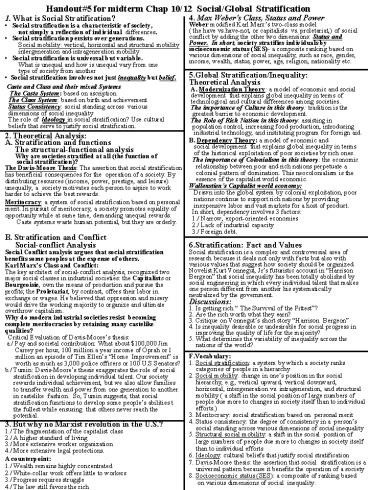
Handout5 for midterm Chap 10/12 Social/Global
Stratification
- 1. What is Social Stratification?
- Social stratification is a characteristic of
society, not simply a reflection of
individual differences. - Social stratification persists over
generations. Social mobility
vertical, horizontal and structural mobility - intergeneration and intrageneration
mobility - Social stratification is universal but
variable. What is unequal and
how is unequal vary from one type of
society from another - Social stratification involves not just
inequality but belief.
4. Max Webers Class, Status and Power Weber
modified Karl Marxs two-class model ( the have
vs.have-not, or capitalists vs. proletariat,) of
social conflict by adding the other two
dimensions Status and Power. In short, society
stratifies individuals by socioeconomic status
(SES)- a composite ranking based on various
dimensions of social inequality, such as race,
gender, income, wealth, status, power, age,
religion, nationality etc.
5.Global Stratification/Inequality Theoretical
Analysis A. Modernization Theory a model of
economic and social development that explains
global inequality in terms of technological and
cultural differences among societies. The
importance of Culture in this theory tradition
is the greatest barrier to economic
development. The Role of Rich Nation in this
theory assisting in population control,
increasing food production, introducing
industrial technology, and instituting program
for foreign aid.
Caste and Class and their mixed Systems The
Caste System based on ascription The Class
System based on birth and achievement Status
Consistency social standing across various
dimensions of social inequality The role of
ideology in social stratification? Use cultural
beliefs that serve to justify social
stratification.
2. Theoretical Analysis A. Stratification and
functions The structural-functional
analysis Why are societies stratified at
all (the function of social
stratification)? The Davis-Moore Thesis
The assertion that social stratification has
beneficial consequences for the operation of a
society. By distributing resources (income,
power, prestige, and leisure) unequally, a
society motivates each person to aspire to work
harder to achieve the best rewards. Meritocracy
a system of social stratification based on
personal merit. In pursuit of meritocracy, a
society promotes equality of opportunity while at
same time, demanding unequal rewards.
Caste systems waste human potential, but they are
orderly.
B. Dependency Theory a model of economic and
social development that explains global
inequality in terms of the historical
exploitation of poor societies by rich ones.
The importance of Colonialism in this theory the
economic relationship between poor and rich
nations perpetuate a colonial pattern of
domination. This neocolonialism is the
essence of the capitalist world
economic.Wallenstiens Capitalist world economy
Drawn into the global system by colonial
exploitation, poor nations continue to support
rich nations by providing inexpensive labor
and vast markets for a host of product. In
short, dependency involves 3 factors 1./
Narrow, export-oriented economies 2./ Lack of
industrial capacity 3./ Foreign debt.
B. Stratification and Conflict
Social-conflict Analysis Social Conflict analysis
argues that social stratification benefits some
peoples at the expense of others. Karl Marxs
Class and Conflict The key architect of
social-conflict analysis, recognized two major
social classes in industrial societies the
Capitalists or Bourgeoisie, own the means of
production and pursue the profits the
Proletariat, by contrast, offers their labor in
exchange or wages. He believed that oppression
and misery would drive the working majority to
organize and ultimate overthrow capitalism. Why
do modern industrial societies resist becoming
complete meritocracies by retaining many
castelike qualities? Critical Evaluation of
Davis-Moores thesis a./ Pay and societal
contribution What about 100,000 Jim
Carrey per hour, 100 million a year income of
Oprah or 1 million an episode of Tim
Ellens Home Improvement is worth as
much as 3,000 police officers or 100 U.S
Senators? b./ Tumin Davis-Moores thesis
exaggerates the role of social
stratification in developing individual talent.
Our society rewards individual achievement,
but we also allow families to transfer
wealth and power from one generation to another
in castelike fashion. So, Tumin suggests,
that social stratification functions to
develop some peoples abilities t the
fullest while ensuring that others never reach
the potential. 3. But why no Marxist
revolution in the U.S.? 1./ The fragmentation of
the capitalist class 2./ A higher standard of
living 3./ More extensive worker organization 4./
More extensive legal protections.
6.Stratification Fact and Values Social
stratification is a complex and controversial
area of research because it deals not only with
facts but also with various values that suggest
how society should be organized. Novelist Kurt
Vonnegut, Jrs futuristic account in Harrison
Bergeon that social inequality has been totally
abolished by social engineering in which every
individual talent that makes one person different
from another his systematically neutralized by
the government.Discussions 1. Is getting rich
The Survival of the Fittest? 2. Are the rich
worth what they earn? 3. Critique on Vonneguts
short story Harrison Bergeon 4. Is inequality
desirable or undesirable for social progress in
improving the quality of life for the
majority? 5. What determines the variability of
inequality across the nations of the world?
vast majority of people? 3. Are there
thresholds in the disparities between the
haves and have-nots that lead to social
revolution? 4. Is inequality, at least in
terms of income and wealth, really a
social problem? 5. Can there be economic
inequality and yet political equality?
Can, for instance, capitalism coexist with
democracy? 6. In capitalist economies, who
should provide the safety nets for those
unable to compete, such as because of age
or physical or mentally disabilities?
F.Vocabulary 1. Social stratification a system
by which a society ranks categories of people
in a hierarchy 2. Social mobility change in
ones position in the social hierarchy, e.g.,
vertical upward, vertical downward,
horizontal, intergeneration vs. intrageneration,
and structural mobility ( a shift in the
social position of large numbers of people
due more to changes in society itself than to
individual efforts.) 3. Meritocracy social
stratification based on personal merit 4. Status
consistency the degree of consistency in a
persons social standing across various
dimensions of social inequality 5. Structural
social mobility a shift in the social position
of large numbers of people due more to
changes in society itself than to individual
efforts 6. Ideology cultural beliefs that
justify social stratification 7. Davis-Moore
thesis the assertion that social stratification
is a universal pattern because it benefits
the operation of a society 8. Socioeconomic
status (SES) a composite of ranking based
on various dimensions of social inequality.
A counterpoint 1./ Wealth remains highly
concentrated 2./ White-collar work offers little
to workers 3./ Progress requires struggle 4./ The
law still favors the rich
2
Chap 9 Social Stratification
Social stratification is characteristic of
society, not simply a reflection of individual
differences.
What is unequal and how unequal are vary from one
type of society from another
Characteristics of Social Stratification
Social stratification persists over generations.
Social stratification is universal but variable.
Social stratification involves not just
inequality but belief.
What is ideology? Cultural beliefs that
serve to justify social stratification
Social mobility change in ones position in the
social hierarchy, e.g., vertical upward,
vertical downward,horizontal, intergeneration
vs. intrageneration, and structural mobility
(a shift in the social position of large numbers
of people due more to changes in society
itself than to individual efforts.
3
Caste and Class Systems The Caste System
based on ascription The Class System based on
birth and achievement Status Consistency
social standing across various dimensions
of social inequality
Paradigm-Analysis
The FUNCTIONS of social stratification Why are
societies stratified at all? -benefit the
operation of a society in a more efficient
way. The Davis-Moore Thesis The assertion that
social stratification has beneficial consequences
for the operation of a society. By distributing
resources (income, power, prestige, and leisure)
unequally, a society motivates each person to
aspire to work harder to achieve the best
rewards. Meritocracy a system of social
stratification based on personal merit. In
pursuit of meritocracy, a society promotes
equality of opportunity while at same time,
demanding unequal rewards. Caste systems
waste human potential, but they are orderly.
The CONFLICT in social stratification Social
Conflict analysis argues that social
stratification benefits some peoples at the
expense of others. Karl Marxs Class and
Conflict The key architect of social-conflict
analysis, recognized two major social classes in
industrial societies the Capitalists or
Bourgeoisie, own the means of production and
pursue the profits the Proletariat, by
contrast, offers their labor in exchange or
wages. He believed that oppression and misery
would drive the working majority to organize and
ultimate overthrow capitalism.
4
Max Webers Class, Status and Power in Social
Stratification
Max Weber modified Karl Marxs two-class modelof
social conflict by adding the other two
dimensions Status and Power. In short, society
stratifies individuals by socioeconomic status
(SES)- a composite ranking based on various
dimensions of social inequality, such as race,
gender, income, wealth, status, power, age,
religion, nationality etc.
Recommended

