

Frequency Shifting for Patients with High Frequency Hearing Loss PowerPoint PPT Presentation
1 / 1
Title: Frequency Shifting for Patients with High Frequency Hearing Loss
1
Frequency Shifting for Patients with High
Frequency Hearing Loss Jack Ho, Joseph Yuen,
Nate Werbekes, Kuya Takami Advisor Thomas Yen,
Ph. D.
Design Criteria
Abstract
- find maximum and minimum frequencies patient can
hear - gets entire range of what normal humans can hear
- compresses and shifts this range to fit within
patients hearing range - small enough to fit on or in ear
- low power consumption
- comfortable and aesthetically pleasing
Our group uses digital signal processing chips
from Texas Instruments to create an improved
hearing device for patients with sensorineural
hearing loss (also known as high frequency
hearing loss). Our device will first ascertain
the maximum and minimum frequency that the
individual is capable of hearing. Once these
values are known, the device will compress and
shift all the sounds a typical human can hear
into the impaired range of our patient. This
semester we planned to build the hardware to
control input and output, and learn the
development kit which will program the actual DSP
chip. The DSP chip we have selected, the C5509,
is designed for use with audio signals and has a
built in ADC. We decided to use LabVIEW in place
of the development kit to construct a working
model of the hardware.
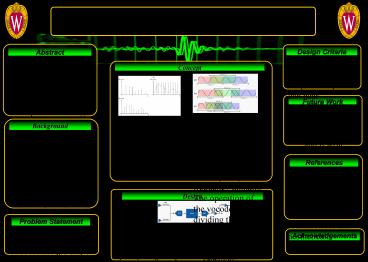
Concept
(a)
Block 2
Another method is block-based time domain pitch
shifting technique (transposition). (a) shows
input signal split into blocks (b) for a down
pitch shift, input blocks are truncated by
an integer number of periods to create a signal
of shorter duration (c) for an up pitch shift,
input blocks are overlapped and added to increase
signal duration during the calculation of the
inverse transfer function. This method could
move the frequency without changing the tempo of
a signal. Because this method does not require
calculation of frequency domain signal using
Fourier Transform, this method can modify a
signal faster.
(b)
Block 2
(c)
Time shifting of overlapping blocks (a) depicts
an input signal split into 3 overlapping blocks
(b) blocks are shifted forward in time to
increase signal duration (c) blocks are shifted
back in time to decrease signal duration
(http//www56.homepage.villanova.edu/scott.sawyer/
fpga/II_freq_domain.htm)
One way to perform this operation is resampling.
By performing a Fourier transform function the
signal is converted from the time domain to the
frequency domain. A signal in the frequency
domain could be shifted or compressed in the
frequency domain so that the all the speech
frequency range could fit within the frequency
range of a person with sensorineural hearing
loss. Shifting a signal in the frequency domain
would not cause expansion in the time domain
however, it would result in an overlap of certain
frequencies. On the other hand, compressing
within the frequency domain would not result in
an overlap of frequencies it would lead to an
expansion of the signal in the time domain.
Background
A phase vocoder method was used for the
modification of the frequency in frequency
domain. The operation of the vocoder is dividing
the original audio signal to shorter frame, and
performs manipulation in the frequency domain
using Short Time Fourier Transform (STFT), which
is the discrete Fourier transform of a short,
overlapping and smoothly windowed block of
samples. Signals in frequency domain
frequencies are modified by changing the
amplitude and phase of frequency. Then the
signal is resynthesized by converting the signal
back to the time domain using the inverse STFT,
which is the inverse Fourier transform on each
chunk and adding the resulting waveform chunks.
Conductive Hearing Loss -in middle or
outer ear -wax, infection, or foreign
object in passageway -dampens all
frequencies Sensorineural Hearing
Loss -damage to inner ear or auditory
nerve -plethora of causes, some are
more common birth defects,
loud noises, aging -loss of certain
frequency bands (usually high) -no
amount of amplification will help Current
Devices Typical Hearing Aid -works by
amplifying all sounds -unnecessary
amplification of most frequency bands
-doesnt help those with sensorineural hearing
loss Cochlear implant -works by
analyzing sound and directly stimulating the
appropriate region of the
cochlea -limited by number of
stimulators -typically poor overall
quality of sound
Design
Hearing test for frequency A LabView program
runs a quick frequency sweep from about 10 to
20k Hz, where the user pushes a button to
indicate when they can first hear the signal and
when they first cannot hear the signal. The
program is then switched to a slow detailed
mode where it does a slower and finer tuned sweep
around each of the two start/stop frequencies.
For input, we will use an electrot condenser
microphone for its tiny size. Sound signal is
received by the microphone will be connected to
the C5509a DSP chip, which has a built-in analog
to digital converter. Then the digital signal is
to be modified, in ways of compressing or
shifting the frequency, so that all the speech
frequency will be in hearing range of the person
with sensorineural hearing loss. After the
modification, the processed digital signal is
converted to an analog signal using the
TLV320DAC32 Low-Power Stereo DAC, which will send
the signal to an output, TPA6100A2 Headphone
Audio Amplifier
Acknowledgements
The authors would like to thank advisor Dr.
Thomas Yen for his continual help throughout the
semester.
Recommended

