

A man isn't necessarily what he eats or cooks: PowerPoint PPT Presentation
1 / 66
Title: A man isn't necessarily what he eats or cooks:
1
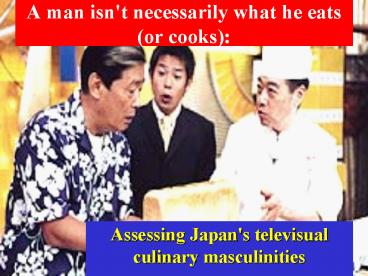
A man isn't necessarily what he eats (or cooks)
- Assessing Japan's televisual culinary
masculinities
2
T.J.M. Holden
- Department of Multi-Cultural Societies
- Graduate School of International Cultural Studies
- Tohoku University
- Sendai, Japan
3
Structure of this Paper
- Introduction
- Japanese Masculinity in the Academic Literature
- Japanese Television and Food Discourse a précis
- Characteristics of Televisual Masculinities
- Alternative Conceptions of Televisual Masculinity
- Conclusions
4
Themes Discussed
- Elements of the Dominant Discourse about men
- Power via competition
- Authority
- Masculinity as executive function
- Masculinity as profession
- Ownership (masculinity as possession)
- Japanese Masculinity the idealized version
- Status in a binary universe
- Markers of male and female identity
- The role of media institution in constructing
this dominant conception of male identity - Food as a central communication vehicle
- Masculinity as production
- The man-made world of TV
- The (de-limited) female televisual space
- Freedom masculinity as agency
- Imagined Men free of structure
- The Multiplicity of masculintity
5
I. Introduction
6
This Papers Purpose
- 1.Demonstrate the degree to which discourse about
masculinity courses through Japanese food shows - 2. Show that while there are a range of
masculinities that are depicted - 3. In the end these masculinities all generally
adhere to a hegemonic conception of masculinity - 4. And female and alternative gender identities
are subrogated or excluded - 5. These conceptions of identity are reinforced
and/or determined by the role of the media
institution
7
This Matters, because
TV has a diffusion rate of 100 Is viewed by
virtually every Japanese person every day It
outpaces other popular forms of information
processing newspapers (86) cell phones
(73) the Internet (27) Collectively, media
consumption is the third largest activity engaged
in by Japanese during the day (behind sleep and
work) It has been reported that, on average, at
least one TV set plays 7 to 8 hours a day in each
Japanese dwelling Personal viewing rates per day
approaching 225 minutes. A recent European survey
ranks Japan second worldwide in terms of daily TV
viewership.
8
TV, Food, Identity and Masculinity
- And, as I have shown in other work (Holden 2003),
TV food shows are - Ubiquitous, and
- A dominant means by which identity discourse
transpires - While masculinity is but one component of
identity, it is a major one.
9
II. Japanese Masculinity in the Academic
Literature
- To date, the discourse about Japanese masculinity
has been nearly univocal - confined to the social type salaryman
- the urban, middle class, white-collar worker
- Held as the stereotypical image from 1960s
- e.g. Vogel (1963), Plath (1964)
- Into the 1990s
- e.g. Rohlen (1974), Allison (1994)
10
Roberson and Suzuki (20038)
- The salaryman is but an idealized version of
Japanese masculinity. - Its wide currency may be explained because it
articulates with other powerful discursive
pedagogies - capitalist employee
- state taxpayer
- family provider
11
Three inclinations characterize the dominant
discourse
- (Inter-personal) authority
- Power
- Possession (especially in relation to women)
- These align easily with conceptions of men as
- Workers
- Members of power structures
- Protectors, and bread-winners.
12
No Singular Version of Japanese Male Identity
- Consistent with a general, quiet revisionism that
has transpired in Japanese studies since the
1980s - e.g Lebra and Lebra (1986), Moeur and Sugimoto
(1986), Harootunian (1989), and Befu (2000) - Japan (and Japanese identity) is not reducible
to a single class, gender, geography, ethnicity,
occupation, or generation.
13
Associating Masculinity with Particular Sites
- i.e. inside corporation or outside home.
- consistent with Hall (1994), who theorized that
identity ought to be decoded within institutional
contexts - For most researchers of Japanese masculine
identity those institutional contexts have
centered on the state, the workplace and the
school (Connell 1995). - The reverse is true for female/femininity
- Associated with the locus of home
14
Focus on Media Institution
- Non-institutional theorization of identity is an
important maneuver, but in this paper I focus on
the media institution. - -- such formal institutional sites are heavily
implicated in the gender-identity calculus - -- no different than the state, corporation or
family media (such as TV) provide the
ideational and physical context within which
masculinity is represented and through which it
is reproduced.
15
On-Message/Beyond Message
- Consistent with what has heretofore been alleged
about masculine identity in Japan, there is a
widespread hegemonic masculinity on display.
At the same time (and significantly), that
hegemonic masculinity is not played out through
the aegis of the corporate worker.
16
III. Japanese Television and Food Discourse a
précis
- Unlike other countries (in which food shows are
generally confined to specialty cable channels,
or else a particular hour on a particular day),
Japans food shows can be found on at least one
commercial station during golden time on
multiple days of the week. - Example Dochi no ryori show (Which One?!
Cooking Show) - In past years, there has been either a
food-themed show or a show with a regular food
segment every day of the week in prime time. - Example SMAP X SMAP
17
Food in an Ancillary Role
- For instance
- morning wake-up programs which discuss urban
culinary trends or local village festivals - travel shows which present the foods of target
destinations that can be consumed
18
Inadvertent Food Discourse
- Cases in which food serves as an incidental, but
prominent background feature - Present during dramas, quiz shows, newscasts,
sporting events, and the like.
19
Advertising
- Food is also pervasive in TV advertising
- Found to account for as much as 20 of all ads
broadcast in a one month period (Holden 2001).
20
Concluding about Food on TV
- All considered, it is impossible to view food
discourse as a trivial or negligible element in
Japanese televisual communication - Food is present on virtually every channel, every
hour, every day of the week, throughout the
broadcast day.
21
IV. Characteristics of Televisual Masculinities
Generally Rather than simple sets of
stereotypical differences between classes tagged
as male and female, masculinity and
femininity clearly emerge as social
constructions sets of reproduced practices and
performances that mimic and support a system of
power.
22
1. Power Masculinity as Competition
- Shows like Dochi employ a discourse of
contestation, dominance, and subordination. - They operate in the vernacular of power.
- The conflictual, competitive discourse is one
normally associated with games - not unlike Iron Chef, with its clock, rival
combatants, teams of specialists, sideline
announcer, play-by-play and color commentators,
and final judges.
23
The Link to Sport
- Competitive shows adopt the rhetoric, the visual,
contextual and practical tropes of sport - an institution created by and for men,
(Messner and Sabo, 1990) - an institution whose practices service the
reproduction of hegemonic masculinity. - Gender is cast in terms of combat conflict
- This discursive practice is not limited to 2
shows - It is found across the board
24
Pushing the Boundaries of Gender
- In keeping with the notion that gender is not
simply reducible to male/female categorizations,
there are those Japanese food shows in which
women battle one another for judges approval. - When they do, these females adopt the vernacular
of (hegemonic) male discourse
25
2. Authority (I)Masculinity as Executive
Function
- In Gender Advertisements (1976), Goffman
identified executive function as a role (of
elevated position, control and authoritative
action) that men adopt when paired in ads with
women. - This also can be found in food shows
- All activity flows through men or else beneath
their commanding gaze. - Masculine guidance can take two guises
- (1) Host
- (2) Chef
26
1. Host
- The host role is clearly defined (and
circumscribed) - hosts greet guests
- Interview them about their lives
- Solicit their opinions (about life and food)
- Ensure that attention is accorded to the chefs
(often backgrounded) work in the kitchen - Facilitate the flow between and balance these
various elements. - Important among the last is timekeeping and
scheduling - Hosts determine when final judgments will be
rendered - Also, as guardians of continuity, they verbally
validate results tendered by chefs or guests. - They exert administrative control over the
communication event.
27
Mixed Hosts Gender Ranking
- The male takes the lead the female follows his
direction - Example Chubo desu yo (This is the kitchen).
- Man is called host Woman is called Announcer
- Typical Interplay (at the end of every show)
- After eating the prepared dish with the guest,
the host says Now, Ms. Kimura - Ms. Kimura (the announcer) turns to the guest
for his or her final evaluation. - Once the guest has responded, the male host
affirms the judgment for this dish one and a
half stars! - Then the male takes the lead in a post-mortem on
the dishs preparation and success or failure in
leading to the final result
28
2. Chef
- In numerous shows the chef adopts the executive
function by instructing the host and/or guests in
the ways of food preparation. - Chubo features a short segment introducing a
resident apprentice in one of the chefs
kitchens. - Almost always these chefs-in-training are young
men in their early twenties. - In every case to date, these young men are
depicted receiving commands from elder male
employers. - Here again, then, Japans food shows cast men
and masculinity in a discourse of authority.
29
Exceptions
- Only in cases of desserts and katei ryori (home
cooking) are the featured chefs in Japans food
shows women - In short, women are associated with the
following - Sweet
- Soft
- Peripheral or de-centered (i.e. not associated
with main courses) - Less sophisticated or elaborate
- Specialists in meals served in the private
(rather than out in the public) sphere. - As a consequence, viewers are apt to perceive
chef as a male role and, logically (following
the significatory chain), see men as culinary
authorities.
30
2. Authority (II)Masculinity in Profession
- Expert knowledge is another way that the
executive function is communicated in cooking
shows. - Chefs on these shows offer opinions, advice,
explain ingredients, techniques and strategies - Like the direction of stage and culinary
activity, this is another function that is
performed predominantly by men
31
Ways in which Expert is Communicated
- Invocation of the title chef
- Deference paid by hosts to cooks on TV
- Clothes (markers of professional association)
- guest chefs never fail to appear in the starched
white aprons and toques of those who cook for a
living. - Chefs resume
- In Japan, where organizational affiliation is one
of the significant markers of legitimacy, food
shows introduce their kitchen authorities not
simply by name or age, but by schools trained in,
countries apprenticed in, and current
organization now working. - This discursive formation is framed
institutionally, in terms of economy and social
sanction.
32
Status in a binary universethe comparison with
women
- Although Butler (1990) along with Foucault
(1980) counseled us to move beyond simplistic
binaries, the structure of meaning in Japanese
televisual productions is predominantly
dualistic - Creating sign-pairs of male/chef and female/not
chef - In this way, what is present what is
communicated, what exists is - an absence of females in the role of chief cook
- the banishment of women from public kitchens
either as professional or apprentice. - All of this can produce the view that women are
not cooking authorities that chef is a male
identification, rather than a female one.
33
Women in Cooking Shows
- Women who appear in Japanese cooking shows are
most often featured in one of two ways - As talento (entertainer)
- As housewife
- In the case of former, women seldom, if ever,
offer culinary advice, and their cooking duties
are mere props to their true identity as star,
singer, sex symbol, or actress. - In the case of the latter, women prepare foods
and engage in activities associated with the
private domain of the household.
34
Example Iron Shifu (housewife)
- A take-off on Iron Chef
- This variety show features female guests, all
former entertainers, now married. - The show has a number of components
- two rounds of quizzes
- one centering on food customs
- another concerning ingredients, nutrition and
calories - a round in which kitchen skills are on display.
35
Example Iron Shifu (housewife)
- Typical Tasks
- One week, a task involved whipping cream, after
which sticky hands and quivering fingers were
made to thread three needles, in succession. - Following this ordeal, contestants were asked a
battery of personal questions regarding life with
their husbands (e.g. where was their first date,
what was the first present they received from
their husband, when is their wedding
anniversary). - Once all of these tasks are completed, the two
highest scoring guests (measured in terms of
fastest time through the obstacle course and most
correct quiz answers) are pitted against one
another in a cook-off.
36
Example Iron Shifu (housewife)
- The finalists are given thirty minutes to prepare
a meal in the katei (or home-cooking) style. - Like its namesake, Iron Chef, one featured
ingredient must be integrated into the menu. - An addition stipulation (since it is katei style)
is that one of the courses must be served with
rice. - A panel of experts (including a president of a
cooking school) serve to judge the winner
37
The Importance of Iron Shifu
- In numerous ways Iron Shifu embodies elements of
the masculine hegemonic discourse - competition,
- expert evaluation, and
- female cooks associated with private (home-made)
food. - It also casts women in overtly-domesticated roles
that differ in multiple, stereotypical ways from
those accorded to men. - In this way, patriarchal gendered discourse is
reproduced.
38
Markers of (Male and Female) Identity
- In the few shows in which women actually instruct
while they cook, they are given a different
appellation than men riyori kenkyu ka - literally food researchers.
- Effects
- this appears to undercut their status as
authority - tends to soften the impression left when a woman
is offering advice to a male announcer or host.
39
Not So in Reverse
- When women are instructed and a man is in the
tutelary role, there is no shying away from - affixing the title chef or sensei (teacher)
- providing his professional affiliation
- clothing him in professional garb
40
Example Ai no epuron 3(the love of three
aprons)
- Three young (generally sexy) talento are assigned
the task of preparing a particular dish (for
instance, apple pie) without benefit of a recipe. - The final product is then presented to a panel of
(generally) male entertainers. - The programs website explains that the women
must make the dishes for these men with love. - The bulk of the show involves generally critical
comments made by male hosts upon the three
womens food productions. - Thereafter, the dishes are assessed by a
professional (male) chef. - His comments, though generally respectful, aim at
improving the womens effort next time out - with the implicit assumption that there will be a
next time.
41
3. PossessionMasculinity as Ownership
- Since the 1950s, Japan has manifested a
succession of trinities of desired goods objects
to be possessed - In Japanese food shows, ownership is one of the
major elements of discourse - The chefs are introduced on the premises of
restaurants they have founded, manage and
maintain. - Cameras capture them either outside the door of
their business or else inside, in the dining
area. - Invariably, they proudly bow in greeting and
offer some remarks of invitation. - Viewers are treated not only to tours of their
kitchens, but are shown menus, sample the décor,
drink in the ambiance, and even watch the chef as
he prepares, then consumes his product.
42
Chef More than Cook
- The chef becomes something more than a food
preparer - host in his own right
- commander of a world of his own invention
- interviewee.
- His status as owner lends an additional power to
his countenance. - He is not only executive, not only employer, not
only expert he is also landholder, proprietor,
and business owner.
43
The Element of Class
- In Japan, for historical (social class-based)
reasons, these are quite powerful statuses to
hold. - And it goes without saying that these are roles
held almost exclusively by men at least in the
Japanese televisual universe.
44
V. Alternative Conceptions of Televisual
Masculinity
45
Departures from the hegemonic discourse of
authority, power and possession
- Masculinity as Production
- Masculinity as Agency
46
1. CreationMasculinity as Production
- Ortners (1974) famous assertion that women are
nature and men are culture is reflected in the
televisual world described here - For, the male world is made it is a world
invented, produced, rendered and controlled. - In Japans food shows, the key producers are
generally all male.
47
The Man-Made World of TV
- (Food and televisual) production transpires
within an institutional context (media) - And, within that context, a (generally)
organizational structure. - Such a structure is man-made
- it is a humanly constructed, artificial
environment, configured to confer status and
facilitate the expression of power. - Which generally is to male producers
48
The (De-limited) Female Televisual Space
- By contrast, women who are so often associated
with the natural realm have televisual roles
that are generally of nurturer or consumer. - As such, their job is to facilitate food
production (as hosts) or else serve as end-users
(as guests)
49
Explaining Exceptions
- Certainly, exceptions can be located
- as in the case of the Iron Shifu or 3 aprons
shows, described above. - In each case, however, production is for purposes
supportive of a patriarchal frame - Satisfying the dictates of male hosts or
- Proving ones capability of providing an amenable
home for a husband.
50
2. FreedomMasculinity as Agency
- It could be argued that men no less than women
-- exist within a clearly delineated, bounded
structure - The chefs are often depicted as members of
organizations (as in the case of the Tsuji
performers) - The chefs are depicted as proud possessors
(creators, owners, executives) of (man-made)
structures
51
Yet, Men are (Relatively) Independent
- This image of attachment must be counterbalanced
by images of independence often communicated by
Japanese media productions - Gill (2003145) Japanese male fantasies
frequently stress the mobile the sportsman, the
traveler, the man of action, the magically
endowed superhero.
52
Imaging Men, Free of Structure?
- For men (and presumably most TV viewers), the
majority are tied to structures of permanence
and stasis (ibid146) - They pine for an alternative model of existence
- a model offered by the television shows.
- This model is less embodied by the chefs who run
their own businesses - rather it is in the aegis of the entertainers and
guests who saunter onto the food show stage,
seemingly unencumbered free of institutional
affiliation or organizational layering.
53
An Alternative Version of Masculinity
- Although film and literature occasionally provide
such images, in general, this is a version of
masculinity that strays far from the
quintessential salaryman - The TV version views male identity in terms of
autonomy and individually-oriented existence. - Despite having little referent in reality, it is
persistently cropping up in televisual
productions.
54
Appearance versus Realitythe world beyond the
screen
- In fact, though, in Japan today, organizational
work still accounts for upwards of 70 of those
employed. - The same applies for day laborers and casual or
part-time workers. - In show after show, however, workers within or
on the margins of organizational society are
never invited to sit at the TV table.
55
VI. Conclusions
- What these discrepant versions may tell us about
contemporary Japanese society.
56
TVs Widest AngleMasculinitys Multiplicity
- Not infrequently alternative masculinities
surface on Japanese TV - This is particularly true of Food shows and food
advertising
57
Example Dochi
- On Dochi one encounters
- an obese wrestler from Hawaii
- a waif-like singer from Japans longest-running
boys band, SMAP - a forty-something producer in scruffy beard, blue
jeans, signature cowboy boots and ten-gallon hat
- a Japan-raised, blond-haired, grungy,
earring-studded Canadian - an elderly actor with assiduously trimmed goatee,
adorned in yukata (traditional male kimono).
58
So, too for Alternative Genders
- In ads and TV shows, it is not uncommon to
encounter - transgendered men
- female masculinities
59
B. The Illusion of Freedom
- The consumer-performers on food shows reproduce a
myth of masculine (and feminine) freedom that in
actuality doesnt exist. - Almost all of the food consuming-performers on
screen belong to invisible corporate structures
which book them onto these shows, not only to
reap money, but more importantly, to gain further
exposure for them, their popular cultural
product. - In its stead stands the more hegemonic,
structurated model of masculinity that pervades
almost all of Japanese society today.
60
C. The Tight Focus of Televisual Masculine
Identity
- Aside from the gender performativities mentioned
above, numerous contexts are absent from the
screen in which masculinities are generally
re/produced. - For instance, save for the simulated kitchens in
which chefs toil, workplaces are almost entirely
absent. - Missing, too, are homes where parenting occurs.
- Class also is invisible as are men who are
unemployed or else under-employed. - Not surprisingly, the homeless are non-existent.
- In short, there is so much that bears on
masculinities that televisual productions ignore,
deny, or banish from public view.
61
Whither the Sarariman?
- The discourse that does appear in these
productions serves to present, interpret,
translate and/or modify masculinities. - Absent from the frame is the one masculinity
emblematic of Japan the salaryman
62
Substitutes for Sarariman?
- In their place other figures are employed to
communicate masculine identity - tropes, codes, characters, social processes,
institutions, organizational structures, and
human agents - both visible and invisible
- The identity conveyed is consistently organized
and communicated in terms of authority, power,
possession, production, and only-seemingly
autonomy.
63
Media Effect
- In this sense the media television is
- beside the point
- but also making a point
- The message it delivers is far from the world
outside the box. - Which makes this phenomenon remarkable and worthy
of further attention
64
In Sum
- In thinking of the alternative masculinities and
the versions of freedom presented, one is tempted
to assert that the televisual reality in no way
reflects the narrow, repetitive discourse of
masculinity that pervades Japanese society - embodied by salarymen in gray suits and
conservative ties. - TVs motley mélange of free agents argues against
the profile of power wielding, authoritative,
possessive hegemonists that emerges in other of
TVs culinary corners
65
In Sum
- That said, it is important to remember
- what kind of man cooks or eats (on Japanese TV)
may have little relation to what kind of man is
generally thought to be a man
66
Thank you for your indulgence
Recommended

