

Magnetic thin films: from basic research to spintronics Christian Binek PowerPoint PPT Presentation
Title: Magnetic thin films: from basic research to spintronics Christian Binek
1
Magnetic thin films from basic
research to spintronics Christian Binek
Physics 201H
11/18/2005
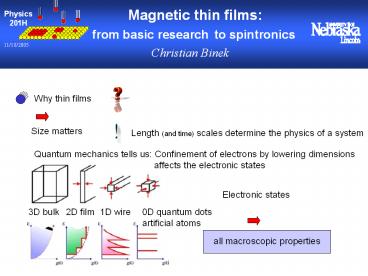
Why thin films
Size matters
Length (and time) scales determine the physics of
a system
Quantum mechanics tells us Confinement of
electrons by lowering dimensions
affects the
electronic states
Electronic states
3D bulk
2D film
1D wire
0D quantum dots artificial atoms
all macroscopic properties
2
Physics 201H
When can films considered to be thin or thin
with respect to what
d
11/18/2005
d?characteristic length
Thin in comparison with the characteristic length
scale
Examples
thickness ? correlation length
-Superconducting thin film
Length scale ? ?/4 ? 500nm/4
-optical thin film like dielectric mirrors
3
Physics 201H
-Magnetic thin films approach the ultimate extreme
11/18/2005
thickness ? quantum mechanical exchange
interaction length ? a few atomic layers
Exchange J(d)
ferromagnet
spacer nonmagnetic
ferromagnet
Spacer thickness d in of atomic layers
J(d8)gt0
J(d10)lt0
Ferromagnetic coupling
Antiferromagnetic coupling
4
How to grow magnetic heterostructures
?
gt
250 000
5
Molecular Beam Epitaxy
- Thin film growth _at_
- low deposition rate
- Ultra high vacuum condition
6
Important growth modes in heteroepitaxy
specific free energy
Layer-by layer (Frank van der Merwe)
substrate
deposited material
interface
Monolayer followed by 3D islands (Stranski
Krastanov)
3D islands (Volmer weber)
Reflection High-Energy Electron Diffraction
RHEED
Electron gun up to 50 keV
Eye camera
sample
RHEED screen
7
What are the magnetic heterolayers good for
?
Basic components of modern spintronic devices
- Conventional electronics has ignored the spin of
the electron
- Advantages using spin degree of freedom
Quantum- information
magnetic field sensors
M-RAM
Spin-transistor
8
- Impact of GMR based field sensors on magnetic
data storage
Evolution of magnetic data storage on hard disc
drives
GMR
inductive read head
9
(No Transcript)
10
(No Transcript)
11
Meiklejohn Bean uniform magnetization reversal
of a pinned FM
MFM
tFM
coupling constant J
KFM, H
MFM saturation magnetization of FM layer
Exchange bias field
12
Investigated multilayer system
Cr2O3(0001)/Pt0.67nm/(Co0.35nm/Pt1.2nm)3/Pt3.1nm
tPt1.20nm
FM thin film with
perpendicular magnetic anisotropy
tCo0.35nm
Pt
Co
Pt
Co
Pt
Co
Magnetoeletric effect of Cr2O3
U
SQUID-magnetometry _at_ T290K
electric field EU/d
Cr2O3 (0001)
Magnetization Mm/V
U
Idea
E ??M contributes to SAF
A. Hochstrat, Ch.Binek, Xi Chen, W.Kleemann,
JMMM 272-276, 325 (2003)
13
Change of the exchange bias field as a function
of the electric field at T 150K
14
Magnetoelectric Switching of Exchange Bias
2
Control via field-cooling
P. Borisov, A. Hochstrat, Xi Chen, W. Kleemann
and Ch. Binek, PRL 94 117203 (2005)
Magneto-optical Kerr measurements _at_ T 298 K
after cooling from TgtTN in ?0Hfr 0.6 T
Magnetic Field Cooling (MFC)
cooling from TgtTN in ?0Hfr 0.6 T
and Efr-500 kV/m
(,-) EfrHfrlt0
(,) EfrHfrgt0
(,-)
M a g n e t o
F i e l d
E l e c t r i c
C o o l i n g
cooling from TgtTN in ?0Hfr 0.6 T
and Efr500 kV/m
(,)
M a g n e t o
F i e l d
E l e c t r i c
C o o l i n g
The sign of the Exchange bias follows the sign of
EfrHfr
15
Ch. Binek and B. Doudin, J. Phys. Condens.
Matter 17 (2005) L39L44
V
FM 2
ME
FM 1
16
V
V
FM2
FM2
NM
NM
FM1
FM1
ME
ME
R
-He-Hi
He-Hi
H
17
Exclusive Or
V
0
0
Voltage
X
R high
x y xORy 0 0 0 0 1 1 1 0
1 1 1 0
-V
1
Input
Output
H
1
magn. field
Y
R low
-H
1
0
R
Example
V
0
-H
0
H
18
Basic research with magnetic heterostructures
generalized Meiklejohn Bean approach
J coupling constant SAF/FM AF/FM
interface magnetization tAF/FM AF/FM layer
thickness MFM saturation magnetization of
FM layer
Experimental check of advanced models
understanding the basic microscopic mechanism of
exchange bias
Exchange bias is a non-equilibrium phenomenon
new approach to relaxation phenomena in
non-equilibrium thermodynamics
19
The training effect a novel approach to study
relaxation physics
Training effect
reduction of the EB shift upon subsequent
magnetization reversal of the FM layer
- origin of training effect
- simple expression for
20
Relaxation towards equilibrium
Landau-Khalatnikov
Training not continuous process in time, but
triggered by FM loop
discretization of the LK- equation
Discretization
LK- differential equation ? difference equation
21
Comparison with experimental results on NiO-Fe
(001) compensated
22
min.
and
23
Collaborations
self-assembled Co clusters
I thermally decompose metal carbonyls in the
presence of appropriate surfactants
You want to know what I am doing?
Transmission electron microscopic image
5nm
24
Fundamental questions
Which magnetic interactions dominate the system
What kind of magnetic order can we observe
For large particle distances the dipolar
interaction will dominate
25
Here is a real fundamental question
Do dipolar systems still obey extensive
thermodynamics
What does this mean
2
Simulations suggest
Yes for a 2 dimensional array of dipolar
interacting particles
but
No for a 3 dimensional array of dipolar
interacting particles
Modifications of conventional thermodynamics
required
26
Summary
MBE is a technology at the forefront of modern
material science
magnetic heterolayers are basic ingredients for
spintronic applications
magnetism of thin films and nanoparticles
provides experimental access to fundamental
questions in statistical physics
27
(No Transcript)
28
(No Transcript)
29
Mechanical analogy
equilibrium
equilibrium
xeq
Damped harmonic oscillator
30
Solution for
with
31
also derived from integration of
0
Temporal evolution of X with increasing damping
32
384,400 km
Near earth outer space
Recommended

