

Chapter 21 Microbial Diseases of the Skin and Eyes Funga PowerPoint PPT Presentation
1 / 53
Title: Chapter 21 Microbial Diseases of the Skin and Eyes Funga
1
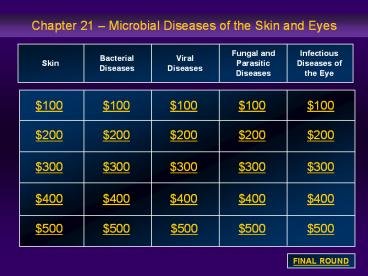
Chapter 21 Microbial Diseases of the Skin and
Eyes
Fungal and Parasitic Diseases
Infectious Diseases of the Eye
Bacterial Diseases
Viral Diseases
Skin
100
100
100
100
100
200
200
200
200
200
300
300
300
300
300
400
400
400
400
400
500
500
500
500
500
FINAL ROUND
2
Topic 1 Skin100 Question
- Many bacterial infections of the region appear as
red, scaly patches - a. stomach
- b. epidermis
- c. liver
- d. heart
ANSWER
BACK TO GAME
3
Topic 1 Skin 100 Answer
- Many bacterial infections of the region appear as
red, scaly patches - a. stomach
- b. epidermis (correct answer)
- c. liver
- d. heart
BACK TO GAME
4
Topic 1 Skin 200 Question
- The skins normal microbiota contain large
numbers of - a. Gram-positive bacteria
- b. Gram-negative bacteria
- c. Fungi
- d. Acid-fast bacteria
ANSWER
BACK TO GAME
5
Topic 1 Skin 200 Answer
- The skins normal microbiota contain large
numbers of - a. Gram-positive bacteria (correct
answer) - b. Gram-negative bacteria
- c. Fungi
- d. Acid-fast bacteria
BACK TO GAME
6
Topic 1 Skin 300 Question
- Which of these organisms is a common cause of
acne and inhabits hair follicles? - a. Propionibacterium acnes
- b. Malassezia furfur
- c. Streptococcus pyogenes
- d. Staphylococcus aureus
ANSWER
BACK TO GAME
7
Topic 1 Skin 300 Answer
- Which of these organisms is a diphtheroid and
inhabits hair follicles? - a. Propionibacterium acnes (correct
answer) - b. Malassezia furfur
- c. Streptococcus pyogenes
- d. Staphylococcus aureus
BACK TO GAME
8
Topic 1 Skin 400 Question
- Which organism stimulates a vigorous inflammatory
response when it infects skin (common cause of
Impetigo)? - a. Corynebacterium xerosis
- b. Streptococcus pyogenes
- c. Staphylococcus epidermidis
- d. Staphylococcus aureus
ANSWER
BACK TO GAME
9
Topic 1 Skin 400 Answer
- Which organism stimulates a vigorous inflammatory
response when it infects skin? - a. Corynebacterium xerosis
- b. Streptococcus pyogenes
- c. Staphylococcus epidermidis
- d. Staphylococcus aureus (correct answer)
BACK TO GAME
10
Topic 1 Skin 500 Question
- Shampoos for treating dandruff contain an
antibiotic and chemicals to treat a - a. Fungus
- b. Bacterium
- c. Virus
- d. Protozoa
ANSWER
BACK TO GAME
11
Topic 1 Skin 500 Answer
- Shampoos for treating dandruff contain an
antibiotic and chemicals to treat a - a. Fungus (correct answer)
- b. Bacterium
- c. Virus
- d. Protozoa
BACK TO GAME
12
Topic 2 Bacterial Diseases100 Question
- Which area of the body supports the largest
bacterial population? - a. scalp
- b. legs
- c. axilla
- d. pubic
ANSWER
BACK TO GAME
13
Topic 2 Bacterial Diseases 100 Answer
- Which area of the body supports the largest
bacterial population? - a. scalp
- b. legs
- c. axilla (correct answer)
- d. pubic
BACK TO GAME
14
Topic 2 Bacterial Diseases 200 Question
- Which of the following are sensitive to
penicillin? - a. Herpes virus
- b. Streptococcus viridans
- c. Chlamydia
- d. Pseudomas aeroginosa
ANSWER
BACK TO GAME
15
Topic 2 Bacterial Diseases 200 Answer
- Which of the following are sensitive to
penicillin? - a. Herpes virus
- b. Streptococcus viridans (correct answer)
- c. Chlamydia
- d. Pseudomas aeroginosa
BACK TO GAME
16
Topic 2 Bacterial Diseases 300 Question
- Which one of the following can cause toxemia, a
sudden drop in blood pressure, toxic shock
syndrome? - a. Staphylococcus aureus
- b. Chlamydia trachomatis
- c. Pseudomonas aeruginosa
- d. Neisseria gonorrhoeae
ANSWER
BACK TO GAME
17
Topic 2 Bacterial Diseases 300 Answer
- Which one of the following can cause toxemia, a
sudden drop in blood pressure, toxic shock
syndrome? - a. Staphylococcus aureus (correct answer)
- b. Chlamydia trachomatis
- c. Pseudomonas aeruginosa
- d. Neisseria gonorrhoeae
BACK TO GAME
18
Topic 2 Bacterial Diseases 400 Question
- Which organism often causes otitis externa may
produce a blue-green colored pus? - a. Pseudomonas aeruginosa
- b. Corynebacterium xerosis
- c. Mycobacterium ulcerans
- d. Streptococcus pyogenes
ANSWER
BACK TO GAME
19
Topic 2 Bacterial Diseases 400 Answer
- Which organism often causes otitis externa may
produce a blue-green colored pus? - a. Pseudomonas aeruginosa (correct
answer) - b. Corynebacterium xerosis
- c. Mycobacterium ulcerans
- d. Streptococcus pyogenes
BACK TO GAME
20
Topic 2 Bacterial Diseases 500 Question
- Which of the following is likely to spread MRSA
among athletes? - a. physical contact
- b. Whirlpool baths
- c. Shared equipment
- d. All of the above
ANSWER
BACK TO GAME
21
Topic 2 Bacterial Diseases 500 Answer
- Which of the following is likely to spread MRSA
among athletes? - a. physical contact
- b. Whirlpool baths
- c. Shared equipment
- d. All of the above (correct answer)
BACK TO GAME
22
Topic 3 Viral Diseases 100 Question
- Warts are caused by
- a. Sporothrix schenckii
- b. Papillomaviruses
- c. Microsporum
- d. Trichophyton
ANSWER
BACK TO GAME
23
Topic 3 Viral Diseases 100 Answer
- Warts are caused by
- a. Sporothrix schenckii
- b. Papillomaviruses (correct answer)
- c. Microsporum
- d. Trichophyton
BACK TO GAME
24
Topic 3 Viral Diseases 200 Question
- The vaccination for rubella
- a. is not necessary if a person has
- had an infection
- b. Is recommended for everyone
- c. Is recommended for newborns only
- d. Has reduced incidence of rubella
ANSWER
BACK TO GAME
25
Topic 3 Viral Diseases 200 Answer
- The vaccination for rubella
- a. is not necessary if a person has
- had an infection
- b. Is recommended for everyone
- c. Is recommended for newborns only
- d. Has reduced incidence of rubella (correct
answer)
BACK TO GAME
26
Topic 3 Viral Diseases 300 Question
- Which of the following is an occasional severe
complication of a viral disease? - a. Reye syndrome
- b. Toxic shock syndrome
- c. Scalded skin syndrome
- d. Tinea pedis
ANSWER
BACK TO GAME
27
Topic 3 Viral Diseases 300 Answer
- Which of the following is an occasional severe
complication of a viral disease? - a. Reye syndrome (correct answer)
- b. Toxic shock syndrome
- c. Scalded skin syndrome
- d. Tinea pedis
BACK TO GAME
28
Topic 3 Viral Diseases 400 Question
- Which of the following is cause of scabs
pus-filled vesicles on the body can later cause
shingles? - a. Human parvovirus B19
- b. Varicella-zoster virus
- c. Rubella virus
- d. Human herpesvirus 6
ANSWER
BACK TO GAME
29
Topic 3 Viral Diseases 400 Answer
- Which of the following is cause of scabs
pus-filled vesicles on the body can later cause
shingles? - a. Human parvovirus B19
- b. Varicella-zoster virus (correct answer)
- c. Rubella virus
- d. Human herpesvirus 6
BACK TO GAME
30
Topic 3 Viral Diseases 500 Question
- Newborns eyes are treated with an antibiotic?
- a. When the mother is blind
- b. When the mother has genital herpes
- c. When the mother has any disease
- d. always
ANSWER
BACK TO GAME
31
Topic 3 Viral Diseases 500 Answer
- Newborns eyes are treated with an antibiotic?
- a. When the mother is blind
- b. When the mother has genital herpes
- c. When the mother has any disease
- d. always (correct answer)
BACK TO GAME
32
Topic 4 Fungal and Parasitic Diseases100
Question
- Which of the following causes a severe infection
of a puncture wound by a fungus? - a. Microsporum
- b. Sarcoptes scabiei
- c. Papillomavirus
- d. Sporothrix schenckii
ANSWER
BACK TO GAME
33
Topic 4 Fungal and Parasitic Diseases 100
Answer
- Which of the following causes a severe infection
of a puncture wound by a fungus? - a. Microsporum
- b. Sarcoptes scabiei
- c. Papillomavirus
- d. Sporothrix schenckii (correct answer)
BACK TO GAME
34
Topic 4 Fungal and Parasitic Diseases 200
Question
- The disease thrush is caused by
- a. Epidermophyton
- b. Candida albicans
- c. Tinea capitis
- d. Tinea unguium
ANSWER
BACK TO GAME
35
Topic 4 Fungal and Parasitic Diseases 200
Answer
- The disease thrush is caused by
- a. Epidermophyton
- b. Candida albicans (correct answer)
- c. Tinea capitis
- d. Tinea unguium
BACK TO GAME
36
Topic 4 Fungal and Parasitic Diseases 300
Question
- Athletes foot is caused by
- a. Tinea capitis
- b. Tinea cruris
- c. Tinea pedis
- d. Tinea unguium
ANSWER
BACK TO GAME
37
Topic 4 Fungal and Parasitic Diseases 300
Answer
- Athletes foot is caused by
- a. Tinea capitis
- b. Tinea cruris
- c. Tinea pedis (correct answer)
- d. Tinea unguium
BACK TO GAME
38
Topic 4 Fungal and Parasitic Diseases 400
Question
- Pediculus humanus capitis is transmitted by
- a. Direct contact/fomites
- b. Blood
- c. Contaminated food
- d. Contaminated water
ANSWER
BACK TO GAME
39
Topic 4 Fungal and Parasitic Diseases 400
Answer
- Pediculus humanus capitis is transmitted by
- a. Direct contact/fomites (correct
answer) - b. Blood
- c. Contaminated food
- d. Contaminated water
BACK TO GAME
40
Topic 4 Fungal and Parasitic Diseases 500
Question
- Which disease is usually diagnosed by microscopic
examination of skin scrapings and is usually
treated with permethrin? - a. Scabies
- b. Pediculosis
- c. Candidiasis
- d. Sporotrichosis
ANSWER
BACK TO GAME
41
Topic 4 Fungal and Parasitic Diseases 500
Answer
- Which disease is usually diagnosed by microscopic
examination of skin scrapings and is usually
treated with permethrin? - a. Scabies (correct answer)
- b. Pediculosis
- c. Candidiasis
- d. Sporotrichosis
BACK TO GAME
42
Topic 5 Infectious Diseases of the Eye 100
Question
- Using a homemade saline solution for contact
lenses can result in - a. Acanthamoeba keratitis
- b. Trachoma
- c. Ophthalmia neonatorum
- d. Inclusion conjunctivitis
ANSWER
BACK TO GAME
43
Topic 5 Infectious Diseases of the Eye 100
Answer
- Using a homemade saline solution for contact
lenses can result in - a. Acanthamoeba keratitis (correct
answer) - b. Trachoma
- c. Ophthalmia neonatorum
- d. Inclusion conjunctivitis
BACK TO GAME
44
Topic 5 Infectious Diseases of the Eye 200
Question
- Which of the following diseases is acquired in
the birth canal? - a. Chlamydia trachomatis
- b. Herpes simplex type 1 virus
- c. Haemophilus influenzae
- d. Acanthamoeba
ANSWER
BACK TO GAME
45
Topic 5 Infectious Diseases of the Eye 200
Answer
- Which of the following diseases is acquired in
the birth canal? - a. Chlamydia trachomatis (correct
answer) - b. Herpes simplex type 1 virus
- c. Haemophilus influenzae
- d. Acanthamoeba
BACK TO GAME
46
Topic 5 Infectious Diseases of the Eye 300
Question
- Which organism can be treated with silver
nitrate, tetracycline, or erythromycin? - a. Neisseria gonorrhoeae
- b. Adenovirus
- c. Herpes simplex type 1 virus
- d. Haemophilus influenzae
ANSWER
BACK TO GAME
47
Topic 5 Infectious Diseases of the Eye 300
Answer
- Which organism can be treated with silver
nitrate, tetracycline, or erythromycin? - a. Neisseria gonorrhoeae (correct
- answer)
- b. Adenovirus
- c. Herpes simplex type 1 virus
- d. Haemophilus influenzae
BACK TO GAME
48
Topic 5 Infectious Diseases of the Eye 400
Question
- Which disease is thought to be the most common
cause of infectious blindness in the world? - a. Herpetic keratitis
- b. Trachoma
- c. Acanthamoeba keratitis
- d. Inclusion conjunctivitis
ANSWER
BACK TO GAME
49
Topic 5 Infectious Diseases of the Eye 400
Answer
- Which disease is thought to be the most common
cause of infectious blindness in the world? - a. Herpetic keratitis
- b. Trachoma
- c. Acanthamoeba keratitis
- d. Inclusion conjunctivitis
BACK TO GAME
50
Topic 5 Infectious Diseases of the Eye 500
Question
- What is the most common bacterial cause of
conjunctivitis? - a. Neisseria gonorrhoeae
- b. Chlamydia trachomatis
- c. Haemophilus influenzae
- d. Streptococcus pyogenes
ANSWER
BACK TO GAME
51
Topic 5 Infectious Diseases of the Eye 500
Answer
- What is the most common bacterial cause of
conjunctivitis? - a. Neisseria gonorrhoeae
- b. Chlamydia trachomatis
- c. Haemophilus influenzae (correct answer)
- d. Streptococcus pyogenes
BACK TO GAME
52
FINAL ROUND Question
- Smallpox is transmitted via the
- a. Respiratory route
- b. Skin
- c. Blood
- d. Gastrointestinal route
ANSWER
BACK TO GAME
53
FINAL ROUND Answer
- Smallpox is transmitted via the
- a. Respiratory route (correct answer)
- b. Skin
- c. Blood
- d. Gastrointestinal route
BACK TO GAME
Recommended

