

The Solar System Missions This is an image of Proteus, the PowerPoint PPT Presentation
1 / 66
Title: The Solar System Missions This is an image of Proteus, the
1
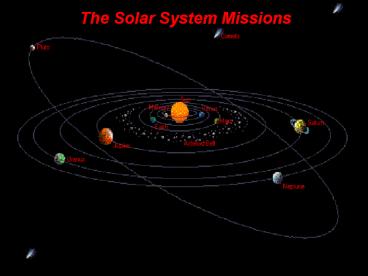
The Solar System Missions
2
(No Transcript)
3
(No Transcript)
4
(No Transcript)
5
http//www.nineplanets.org/earth.html
http//www.skyscopes.com/
6
Jupiter
Jupiter is larger than all the other planets
combined. It gives off nearly twice as much
energy as it receives. Jupiter also has the
strongest magnetic field of all the planets.
Jupiter is composed mostly of hydrogen and
helium. It has no solid surface, only layers of
gaseous clouds. The diameter of Jupiter is
142,800 kilometers. It revolves around the Sun in
11.86 Earth years.
7
Jupiter Lord of the Sky
Jupiter or Zeus in Greek, is considered the most
powerful god. He is the son of Cronus, a Titan,
along with his other brothers and sisters. After
a long war with his father, Jupiter and his
brothers Neptune and Pluto each rolled a dice to
see what area of the earth they shall rule.
Jupiter got the heavens, Neptune, the sea, and
the unlucky Pluto, the underworld. Jupiter
married his sister Hera, who was always jealous
of Jupiter and his many wives. He is the god with
the most wives. Jupiter usually fell in love with
nymphs, mortals and sometimes, goddesses. He can
transform himself into animal he wishes to kidnap
someone he loves. There are other names for
Jupiter, such as Lord of the Sky, the Rain God,
and the Cloud Gatherer. The bird sacred to him is
the eagle and the oak tree. In astrology, Jupiter
represents physical, intellectual, luck, success
and power.
8
Jupiter
Jupiter Facts Sheet Type Jovian Mass of
planet (Earth1) 317.89 Mean density
(grams/centimeter³ ) 1.33 Interior primarily
that of simple molecules such as hydrogen and
helium, which are liquids under the high pressure
environments found in the interiors of
Jupiter. Surface None Water Atmosphere
ammonia, methane, helium, hydrogen, and
sulfur. Moons gt 28
9
Jupiter
The Giant planets do not have the same layered
structure that the terrestrial planets do. Their
evolution was quite different than that of the
terrestrial planets, and they have less solid
material inside. Jupiter's interior composition
is primarily that of simple molecules such as
hydrogen and helium, which are liquids under the
high pressure environments found in the interiors
of the outer planets, and not solids. Motions in
the interior of Jupiter contribute in a very
special way to the development of the powerful
and extensive magnetosphere of Jupiter. Heat
generated within Jupiter contributes to the
unusual motions of the atmosphere.
10
Jupiter
The king of planets is aptly named because it not
only has the most dymanic atmospheric motion, but
also the most riveting cloud patterns and storms,
and the most majestic appearance of the giant
planets. The dramatic appearance of Jupiter stems
partially because the composition of Jupiter's
atmosphere includes complex molecules such as
ammonia and methane, as well as simple molecules
such as helium, hydrogen, and sulfur. The
atmosphere of Jupiter is only a narrow surface
layer, compared to the vast interior of the
planet. The three clouddecks of Jupiter are to be
found at different levels in the troposphere,
while hazes of smog can be found higher in the
atmosphere. Jupiter is not much changed from its
early evolution out of the primordial solar
nebula, and in fact, may still be evolving.
11
(No Transcript)
12
This is a three-color filter image of Jupiter and
Io. It was taken on June 10, 1979 by Voyager 2.
(Courtesy of NASA)
13
An image of Jupiter's Great Red Spot taken by the
Galileo spacecraft. (Courtesy of NASA)
14
(No Transcript)
15
This composite of the Galilean Satellites shows
images of the moons taken by the Galileo
spacecraft, as well as details from the surfaces
of the moons.
16
This is an image of Io. It is the innermost of
the Galilean moons and the third largest.
(Courtesy of NASA)(39K JPG
17
Io, taken by the Galileo spacecraft. (Courtesy of
NASA)
18
(No Transcript)
19
This is a three-color image of the satellite
Europa taken March 4, 1979 by Voyager 1. It is
the size of Earth's moon. (Courtesy of NASA)
20
(No Transcript)
21
This is a close-up image of the Europa taken by
Voyager. (Courtesy of NASA)
22
(No Transcript)
23
This is a close-up image of Europa in false color
taken by the Galileo spacecraft. (Courtesy of
NASA)
24
This is a natural-color image of Ganymede,
Jupiter's largest satellite and is the third of
the Galilean moons. (Courtesy of NASA)
25
This is an image of Ganymede taken by Voyager
showing the ancient "dark terrain". (Courtesy of
NASA)
26
This is a three-color filter image of Callisto,
one of Jupiter's satellites taken by Voyager 2.
The bright spots here are meteorite impact
craters. (Courtesy of NASA)
27
This is a close-up image of Callisto taken by
Voyager 1. (Courtesy of NASA)
28
Whats New???
A new study has evidence that Jupiter's moon
Europa is full of salt water. Previous studies
have indicated that the surface of Europa is ice.
Scientists were wondering what was underneath
this ice. With the help of the Galileo
spacecraft, we may finally have the answer. It
all started when Galileo found a magnetic pole on
Europa. NASA sent the spacecraft back for another
look, and data shows that the pole moves every
few hours. Scientists say this movement is most
likely caused by salt water. Scientists are
hoping the Europa orbiter can finally prove their
theory when starts its journey in 2003. Until
then, we will still speculate that water exists
on this cold moon. If water does exist, then
there is a good chance that life is there as
well. "After Mars, (Europa is) the most
attractive extraterrestrial environment within
our solar system in which to seek evidence of
past or present life," on scientist wrote.
29
Whats New???
The Galileo spacecraft photographed volcanoes on
the surface of Io, one of Jupiter's moons.
Scientists believe there are at least 300
volcanoes on the moon. These volcanoes are
somewhat different than those on Earth. The small
ones can erupt and then quickly turn dorment in
weeks. Other ones stay active for many years at a
time. Last month, Galileo spotted large clouds
of sulfur gas in the atmosphere and yellow snow
that precipitated down from them. Galileo will
continue to study Jupiter and its satellites,
turning next to the moon Ganymede and Jupiter's
Great Red Spot.
This shows an active volcanic region on Io. The
yellow and orange area is newly formed lava, and
the dark areas show lava that has cooled
down.Courtesy of NASA
30
Saturn
Saturn is very similar to Jupiter. It is composed
of 97 hydrogen, 3 helium and 0.5 methane.
There is no solid. Saturns diameter in
kilometers is 120,660. Its rotation period takes
about 10.2 Earth hours. Saturn completes its
revolution around then Sun for 29.46 Earth years.
31
Saturn
Saturn is also known Cronus he is one of Titans
to overthrow father sky or Uranus with a scythe
and throwing his body parts into the sea, which
created Venus, Furies, and some giants and
nymphs. Cronus and Rhea (Cronusís sister) had six
children. Cronus was afraid that his own children
would overthrow him just like his father, so he
decided to swallow them immediately, except the
child Jupiter. Rhea decided to wrap cloths around
a stone for Cronus to swallow, and put Jupiter
with two nymphs and a goat to take care of him.
When he was old enough, he thanked the two nymphs
by taking the goatís horn and turned it into a
cornicopia, (named after the goat) with fruits
inside and putting the goatís image among the
stars as the constellation Capricorn. Later, his
mother helped Jupiter take out all the children
that Cronus had eaten, Jupiter, along with his
sisters and brothers fought Cronus and the other
Titans and put them in the underworld to live
forever except his mother, Rhea as thanks. In
astrology, Neptune, is known as the grim reaper
and symbolizes responsibilities, restrictions and
limitations. He also represents peace and his
symbol represents a scythe.
32
Saturn
Saturn Facts Sheet Type Jovian Mass of planet
(Earth1) 95.18 Mean density
(grams/centimeter³ ) 0.69 Interior Saturn's
interior composition is primarily that of simple
molecules such as hydrogen and helium, which are
liquids under the high pressure environments
found in the interiors of the outer planets, and
not solids. Surface None Water Atmosphere
ammonia, methane, helium, hydrogen, and
sulfur. Moons 30
33
(No Transcript)
34
(No Transcript)
35
This is an image of a storm on Saturn taken by
the Hubble Space Telescope. (Courtesy of Reta
Beebe (New Mexico State
36
This is an image of Saturn taken by Voyager 2 on
July 21, 1981. The moons, Rhea and Dione, appear
as blue dots to the south and southeast of Saturn
37
This is a color image of Saturn's satellite Rhea
taken by Voyager 1 on November 12, 1980.
38
This is a color enhanced image of Saturn's
satellite Enceladus taken by Voyager 1 on
November 12, 1980.
39
This is a color image of Saturn's satellite Dione
taken by Voyager 1 on November 12, 1980. Some of
the bright streaks may actually be factures in
the surface.
40
This is a color image of Saturn's satellite Mimas
taken by Voyager 1 on November 12, 1980. The
circular object is a massive crater on Mimas.
41
Saturn's moon Mimas (left) compared to the
fictional 1977 Star Wars 'Death Star', (right)
which used its large depression as a 'superlaser
focus lens' to exact planet-scale revenge. Image
Credit NASA/JPL
42
This is a color image of Saturn's satellite
Tethys taken by Voyager 1 on November 12, 1980.
Its surface is heavily cratered.
43
Whats New???
Cassini's ability to remain precisely and
steadily pointed at targets, such as Saturn's
moon Mimas (seen here) yields sharp images
despite the relatively high speed at which the
spacecraft moves. Cassini was traveling at more
than 13 kilometers per second when it acquired
this view, which shows crisp detail on Mimas (397
kilometers, 247 miles across) against the
backdrop of Saturn's northern hemisphere. Shadows
of the icy rings stretch across the atmosphere
and are blurred due to spacecraft motion.. The
part of Mimas visible here always faces away from
Saturn as the moon orbits the giant planet. In
scientific language, the moon is said to be
"phase-locked." The image has been rotated so
that north on Mimas (and Saturn) is up. This
view was obtained with the Cassini spacecraft
narrow angle camera on Jan. 18, 2005, at a
distance of approximately 1.25 million kilometers
(777,000 miles) from Mimas and at a
Sun-Mimas-spacecraft, or phase, angle of 114
degrees. The image was taken using a combination
of spectral filters sensitive to wavelengths of
infrared and polarized light. Resolution in the
image is 7 kilometers (4 miles) per pixel. The
image has been contrast-enhanced to aid
visibility.
44
Whats New???
Original Caption Released with Image This
composite was produced from images returned
yesterday, January 14, 2005, by the European
Space Agency's Huygens probe during its
successful descent to land on Titan. It shows a
full 360-degree view around Huygens. The
left-hand side, behind Huygens, shows a boundary
between light and dark areas. The white streaks
seen near this boundary could be ground 'fog,' as
they were not immediately visible from higher
altitudes. As the probe descended, it drifted
over a plateau (center of image) and was heading
towards its landing site in a dark area (right).
From the drift of the probe, the wind speed has
been estimated at around 6-7 kilometers (about 4
miles) per hour. These images were taken from an
altitude of about 8 kilometers (about 5 miles)
with a resolution of about 20 meters (about 65
feet) per pixel. The images were taken by the
Descent Imager/Spectral Radiometer, one of two
NASA instruments on the probe. The
Cassini-Huygens mission is a cooperative project
of NASA, the European Space Agency and the
Italian Space Agency. The Jet Propulsion
Laboratory, a division of the California
Institute of Technology in Pasadena, manages the
Cassini-Huygens mission for NASA's Science
Mission Directorate, Washington, D.C. The Cassini
orbiter and its two onboard cameras were
designed, developed and assembled at JPL. The
Descent Imager/Spectral team is based at the
University of Arizona, Tucson, Ariz. For more
information about the Cassini-Huygens mission
visit http//saturn.jpl.nasa.gov/home/index.cfm .
45
(No Transcript)
46
(No Transcript)
47
Uranus
Its denser than Jupiter and Saturn. Uranus is
composed of hydrogen, helium, substantial amounts
of water, and some methane, ammonia, rock and
metal. The amounts of methane in its upper
atmosphere give the planet its blue-green color.
The core of Uranus is mostly rock and metal. It
rotates clockwise every 17 hours. Uranus revolves
around the Sun in 84 Earth years.
48
Uranus Father Sky
Uranus is also known as Father Sky and the son of
Gaea. He and Gaea had many children including
Cyclops, the hundred-headed, and the Titans.
Since Uranus didnít like the way they looked, he
treated them very badly and locked them deep
inside the earth. Gaea was very mad and asked one
of the Titans to overthrow their father with a
scythe. Uranus is known as the father of the sky
and sometimes the universe. He symbolizes
science, media, computers and technology. Most of
Uranusís moons are named after mythology or
Shakespearean characters.
49
Uranus
Uranus Facts Sheet Type Jovian Mass of planet
(Earth1) 14.53 Mean density
(grams/centimeter³ ) 1.29 Interior Uranus's
interior composition is primarily that of methane
ice. Surface Water Atmosphere The
uniformity of the planet's appearance confirms
that the planet's atmosphere is composed almost
solely of one element, methane gas. Moons 24
50
Uranus
The Giant planets do not have the same kind of
structure inside that the terrestrial planets do.
Their evolution was quite different than that of
the terrestrial planets, and they have much more
gas and ice inside. Uranus's interior
composition is primarily that of methane ice.
Motions in the interior of Uranus contribute to
the formation of the magnetosphere of Uranus.
Heat generated within Uranus contributes to the
unusual motions of the atmosphere.
51
This is an image of the Epsilon ring on Uranus.
52
Miranda
53
This is an image of Miranda's surface called the
chevron.
54
This is an image of Ariel. This satellite has
many craters.
55
This is another image of Ariel, showing a complex
array of valleys and impact craters.
56
This is a mosaic of Ariel created from Voyager
images
57
Neptune
Like other gaseous planets, Neptune rotates
rapidly once every 16.1 Earth hours. It takes
164.8 Earth years for Neptune to revolve around
the Sun. Neptune is composed of 74 hydrogen, 25
helium and 1 methane at the depth of the planet.
Its diameter is 49,528 kilometers.
58
Neptune God of the Sea
Neptune is the god of the sea and his Greek name
is Poseidon. His symbol is a trident or a fishing
spear. He uses the trident. He is the son of
Cronus and Rhea and brothers with Jupiter and
Neptune. Neptune ruled a beautiful palace under
the sea. Neptune had many children and lovers,
including the Cyclopes. He has a throne on Mount
Olympus. The trident he carries can create
terrible sea storms and also was used in the
battle against the Titans and is often called the
ìEarth-Shakerî. Neptune is believed to have
created the horse, and it is associated with
Neptune. In astrology, Neptune represents
spirituality, and imagination.
59
Neptune
Neptune Facts Sheet Type Jovian Mass of
planet (Earth1) 17.14 Mean density
(grams/centimeter³ ) 1.64 Interior Neptune's
interior composition is primarily that of methane
ice, just as Uranus' is. Surface
Water Atmosphere The composition of Neptune
clouds is thought to be methane crystals. Moons
8
60
Neptune
The Giant planets do not have the same kind of
structure inside that the terrestrial planets do.
Their evolution was quite different than that of
the terrestrial planets, and they have much more
gas and ice inside. Neptune's interior
composition is primarily that of methane ice,
just as Uranus' is. Motions in the interior of
Neptune contribute to the formation of the
magnetosphere of Neptune. Heat generated within
Neptune contributes to the unusual strength and
motions of the atmosphere.
61
This is an image showing crescents of Neptune and
its moon Triton taken by Voyager 2 on August 31,
1989.
62
This is an image showing the disappearance of the
Great Dark Spot taken by the Hubble Space
Telescope. The second picture was taken about 9
hours later showing the opposite hemisphere.
63
This is a closer view of the Great Dark Spot and
the Scooter. The Scooter is small and bright and
to the left of the dark spot. This image was
taken on the Voyager Mission in August 1989.
64
This is true-color image of clouds east of the
Great Dark Spot taken by the Voyager 2.
65
This is a color image of Triton taken by Voyager
2 in August 1989. Triton is Neptune's largest
satellite.
66
This is an image of Proteus, the first of six new
moons discovered by Voyager 2.
Recommended

