

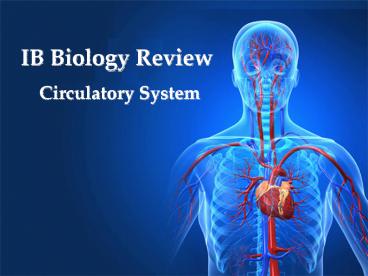
IB Biology Review Circulatory System Why do we need blood PowerPoint PPT Presentation
1 / 18
Title: IB Biology Review Circulatory System Why do we need blood
1
IB Biology Review
- Circulatory System
2
Why do we need blood circulation?
- Move blood around the body to
- Bring oxygen to cells
- Take away carbon dioxide
- Take away other metabolic waste
- Bring metabolic reactants (sugar)
- Bring water
- Bring hormones
- Bring antibodies
- Bring nutrients
- Distribute heat
- Basically, to keep our bodies doing what they do!
3
What are the components of the circulatory system?
- Heart
- Arteries
- Veins
- Capillaries
- Remember Arteries Away from heart
- Arteries have oxygenated blood
- Veins have deoxygenated blood
4
A Closer Look at the Heart
5
Identify the structures of the heart.
1
15
14
2
13
3
12
4
11
5
6
10
7
8
9
6
Be able to draw something like this.
Pulmonary veins
Atrioventricular valves
Semilunar valves
7
The Path of Blood through the Heart
- Deoxygenated blood comes from body through
superior and posterior vena cava - Enters right atrium
- Goes through atrioventricular valve
- Enters right ventricle, pumped into pulmonary
artery - Passes through semilunar valve
- Gets oxygen from lungs
- Enters left atrium via pulmonary veins
- Goes through atrioventricular valve
- Enters left ventricle, pumped into aorta
- Passes through semilunar valve
- Blood goes to rest of the body
8
How Blood Gets Oxygen
- (2) Goes from right ventricle to pulmonary artery
- (3) Goes to lungs
- (4) Comes through pulmonary vein to left atrium
- (5) Goes to left ventricle
- (6) Goes through aorta
- (7) (8) To body!
9
Which arteries help out the heart?
- Coronary arteries supply heart muscle with
- Oxygen
- Nutrients
10
How does the heart know when to pump?
- The heart beats by itself (myogenic)
- The SA node sends an electrical signal to the
walls of the atria - This causes them to contract (think about when
you get electrocuted, your hand snaps back
because your muscles contract) - SA signal reaches the AV node, which delays the
signal - AV node sends signal to ventricles, which
contract - Atrioventricular valves snap shut
- After blood leaves ventricles, semilunar valve
closes to prevent back flow
11
Composition of Blood
- Blood is made of
- Plasma
- Erythrocytes (red blood cells)
- Leucocytes (white blood cells)
- Phagocytes
- Lymphocytes
- Platelets
12
1. Which vessel carries deoxygenated blood?
(1 mark)
IB Exam Question
- A. The pulmonary artery
- B. The coronary artery
- C. The aorta
- D. The pulmonary vein
- Correct answer A
13
2. What is the function of the right ventricle?
(1 mark)
IB Exam Question
- A. Pumping blood into the pulmonary artery
- B. Pumping blood into the pulmonary vein
- C. Pumping blood into the aorta
- D. Pumping blood into the coronary artery
- Correct answer A
14
3. Draw a labelled diagram to show the internal
structure of the heart.
(6 marks)
IB Exam Question
- Award 1 for each of the following structures
clearly drawn and labelled correctly in a diagram
of the heart. - left and right ventricle
- left and right atria
- atrioventricular valves
- semilunar valves
- aorta and vena cava
- pulmonary artery and pulmonary vein
- ventricle wall thicker than atria
- left ventricle wall thicker than right ventricle
wall - Do not award marks for a diagram with only the
ventricles or atria. However, it is not necessary
to show the cordae tendinae.
15
4. Explain the relationship between the structure
and function of arteries, veins and capillaries.
(8 marks)
IB Exam Question
- (3 max for information on arteries)
- thick wall / elastic fibres to help withstand the
high(er) pressure - outer fibrous coat prevents artery from rupturing
under the high pressures - valves in aorta and pulmonary artery to prevent
back flow into ventricles in diastole - layers of (smooth) muscle to allow arteries to
contract / elastic recoil - allows the pressure to be altered
(vasoconstriction and vasodilation) - (3 max for information on veins)
- thinner wall (than arteries) since pressure
low(er) - very little muscle since not needed for
constriction - valves to prevent back flow between pulses
- (3 max for information on capillaries)
- no muscle / elastic tissue since pressure very
low - endothelial layer one cell thick to allow
permeability / diffusion of chemicals / tissue
fluid - no valves since pressure very low
16
5. Outline the control of the heartbeat in terms
of myogenic muscle contractions, the role of the
pacemaker, nerves, the medulla of the brain and
epinephrine (adrenaline).
IB Exam Question
- The heart beats by itself (myogenic)
- SA node (pacemaker) in the heart muscle produces
an electrical signal across nerves throughout
walls of atria to begin cycle - This nerve impulse causes the atria to contract
- SA signal reaches atrioventricular (AV) node
which delays the electrical signal - Electrical signal spreads across nerves, causing
ventricles to contract - Atrioventricular valves snap shut
- After ventricles are emptied, semilunar valves
close - Under certain circumstances, adrenaline carries
messages from the brain to pacemaker telling the
pacemaker to speed up the beating of the heart
17
6. State four substances that are transported by
blood. (4 marks)
IB Exam Question
- Nutrients
- Oxygen
- Carbon dioxide
- Hormones
- Antibodies
- Urea
- Heat
18
(No Transcript)
Recommended

