

Terrestrial Biological Carbon Sequestration: Science for Enhancement and Implementation PowerPoint PPT Presentation
1 / 2
Title: Terrestrial Biological Carbon Sequestration: Science for Enhancement and Implementation
1
Terrestrial Biological Carbon SequestrationScien
ce for Enhancement and Implementation
Contact Wilfred M. Post, 865-576-3431,
postwmiii_at_ornl.gov Funding DOE Office of
Science, Biological and Environmental Research
- Terrestrial sequestration using best management
practices in agriculture and forestry could
contribute to greenhouse gas mitigation in the
coming decades. Introduction of new technologies
could enhance this contribution. - Current best land management practices can be
scaled to achieve rates of 0.5 Pg C y-1 by 2040
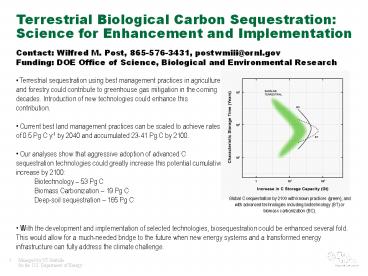
and accumulated 23-41 Pg C by 2100. - Our analyses show that aggressive adoption of
advanced C sequestration technologies could
greatly increase this potential cumulative
increase by 2100 - Biotechnology 53 Pg C
- Biomass Carbonization 19 Pg C
- Deep-soil sequestration 165 Pg C
Global C sequestration by 2100 with known
practices (green), and with advanced technologies
including biotechnology (BT) or biomass
carbonization (BC).
- With the development and implementation of
selected technologies, biosequestration could be
enhanced several fold. This would allow for a
much-needed bridge to the future when new energy
systems and a transformed energy infrastructure
can fully address the climate challenge.
2
Terrestrial Biological Carbon SequestrationScien
ce for Enhancement and Implementation
Contact Wilfred M. Post, 865-576-3431,
postwmiii_at_ornl.gov Funding DOE Office of
Science, Biological and Environmental Research
Abstract Photosynthetic CO2 capture from the
atmosphere and storage of the C in plant biomass
and in soil organic matter can be exploited for
safe and affordable greenhouse gas (GHG)
mitigation. Nevertheless, C sequestration in the
terrestrial biosphere has not been seriously
pursued since its introduction in the Kyoto
Protocol over a decade ago. Concerns have been
raised that C sequestration is not permanent,
that it is difficult to measure and monitor, and
that it distracts from the central issue of
reducing GHG emissions from energy production and
use. International accord and success in reducing
emissions from the energy system are not coming
easily, and concerns about climate change are
growing. It is time to reevaluate options that
might not be permanent yet have the potential to
buy time, bridging to a future when new energy
system technologies and a transformed energy
infrastructure can fully address the climate
challenge. Terrestrial sequestration is one
option large enough to make a contribution in the
coming decades using proven land management
methods and with the possibility that new
technologies could significantly enhance the
opportunity.
Citation Post WM, JE Amonette, R Birdsey, CT
Garten Jr., RL Graham, RC Izaurralde, PM Jardine,
J Jastrow, R Lal, G Marland, BA McCarl, AM
Thomson, TO West, SD Wullschleger, and FB
Metting. 2009. Terrestrial carbon sequestration
Science for enhancement and implementation. In
B.J. McPherson and E.T. Sundquist, editors.
Carbon Sequestration and its Role in the Global
Carbon Cycle. AGU Monograph Series No. 183. pp.
73-88.
Recommended

