

Applications for Wing in Ground Effect Vessels, a Transformational Concept PowerPoint PPT Presentation
1 / 39
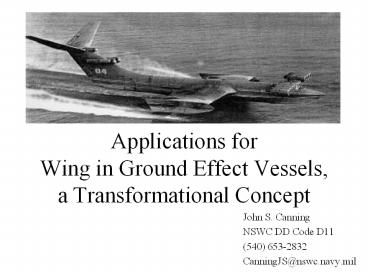
Title: Applications for Wing in Ground Effect Vessels, a Transformational Concept
1
Applications forWing in Ground Effect Vessels,a
Transformational Concept
- John S. Canning
- NSWC DD Code D11
- (540) 653-2832
- CanningJS_at_nswc.navy.mil
2
What is a WIG?
- A Wing-in-Ground effect craft (WIG) is a vessel
with wings that cruises just above the water
surface, it is floating on a cushion of
relatively high-pressure air between its wing and
the water surface. - Is also known as a WIGE (Wing-in-Ground Effect),
or a Wingship. - It is the ultimate low-drag marine craft.
- It is a very high-speed, sea-based platform.
- Some WIG vehicles have the ability to fly without
ground effect as well, but inefficiently as
compared to aircraft.
Airfisch 8 by Airfoil Development GmbH
3
Caspian Sea Monster
This is the largest WIG produced to-date Length
348 ft, Wing-span 131 ft
4
What a WIG is not.
- Although it is capable of flying, it is not an
aircraft. - WIGs are not designed or built to be aircraft.
- The Caspian Sea Monsters, for example, were built
in shipyards, using ship construction techniques. - However, they could benefit from modern aircraft
design and construction technologies, such as
integrated product models and composite
materials. - They are also not hydrofoils, hovercraft, or
surface effect ships. - Some versions have been designed that will hover.
These distinctions are blurring, however
5
Two Perceived Fundamental Uses
- Weapons Platform
- Traditional warship role
- Includes being a Mothership for unmanned
vehicles - Logistics Platform
- Falls between being a ship and an aircraft for
delivering cargo for both speed and cost.
Tendency exists to view this as an either/or
choice. Suggest that appropriate design might
lead to a RO/RO family of capabilities that could
provide both uses.
6
A Weapons Platform View
7
A Transformational Question
Is the military object to clear the minefield, or
to quickly get to the other side of the
minefield, and do something to the enemy?
Clear the minefield?
Hop over the minefield?
A WIG will travel over the top of a minefield at
very high speed, without damage, and perform its
mission on the other side.
8
A Corollary
Q If we can jump over minefields, how about
enemy submarine patrol areas?
A You bet!!!
9
OK, So What if You Really Want to Clear a Path
Through a Minefield?
MINEFIELD MINEFIELD MINEFIELD MINEFIELD MINEFIELD
MINEFIELD MINEFIELD MINEFIELD MINEFIELD MINEFIELD
MINEFIELD MINEFIELD MINEFIELD MINEFIELD MINEFIELD
MINEFIELD MINEFIELD MINEFIELD MINEFIELD MINEFIELD
MINEFIELD MINEFIELD MINEFIELD MINEFIELD MINEFIELD
MINEFIELD MINEFIELD MINEFIELD MINEFIELD MINEFIELD
MINEFIELD MINEFIELD MINEFIELD MINEFIELD MINEFIELD
MINEFIELD MINEFIELD MINEFIELD MINEFIELD MINEFIELD
MINEFIELD MINEFIELD MINEFIELD MINEFIELD MINEFIELD
MINEFIELD MINEFIELD MINEFIELD MINEFIELD MINEFIELD
MINEFIELD MINEFIELD MINEFIELD MINEFIELD MINEFIELD
MINEFIELD MINEFIELD MINEFIELD MINEFIELD MINEFIELD
MINEFIELD MINEFIELD MINEFIELD MINEFIELD MINEFIELD
MINEFIELD MINEFIELD MINEFIELD MINEFIELD MINEFIELD
MINEFIELD MINEFIELD MINEFIELD MINEFIELD MINEFIELD
MINEFIELD MINEFIELD MINEFIELD MINEFIELD MINEFIELD
Have a WIG drop and control a number of UUVs
designed to hunt/kill mines on its way over the
minefield, and have them clear the path in a
parallel effort, as opposed to starting at one
edge of the minefield and working through it in a
serial manner.
10
ASCMsAn Example for Large Ship ASUW
Utka Armed with six SS-N-22 SUNBURN missiles.
Length 242 ft. NOTE Due to ship construction
techniques used, ONI has concluded that Utka
would be difficult to destroy.
11
Sea SniperAn Example for ASW
Based on RAMICS technology could put this on a
WIG Moving Target/Moving Shooter
12
FYI Rapid Airborne Mine Clearance System (RAMICS)
http//www.onr.navy.mil/sci_tech/ocean/Info/RAMICS
/ramics.htm
Uses a 30mm Bushmaster II chain gun for shallow
water mines Stationary Target/Stationary Shooter
13
Small Boat ASUW
- Lethal
- 30 mm chain gun
- Same one for Sea Sniper
- Look down/Shoot down
- Stay out of lethal range of small boat weapons
- Other guns and/or missile systems
- Non-lethal
- Active Denial Technology
- HPM system causing intense skin pain for exposed
personnel - Running Gear Entangling System
- Specially designed boat-stopping rope
14
Active Denial Technology
http//www.de.afrl.af.mil/factsheets/activedenial.
html
The Air Force is investigating an airborne
version of this current ACTD. Whatever they
develop could be adapted to WIGs.
15
Other Examples
AC-130 Gunship w/ 105mm gun
Airborne Laser
While not WIGs, these examples indicate that
other, large weapon systems have, and are, being
integrated into airborne platforms. This could be
done for WIGs.
16
A Logistics Platform View
17
A Comparison
Australian HSV
Russian KM
- Speed - 40 knots
- Range 4000 nm _at_ 40kts
- Draft 10 7
- Length Overall - 370 ft
- Beam - 100 feet
- Weight - ?
- Cargo capacity - 1100 tons
- Operate at speed in 15 ft seas
- Speed 270 knots
- Range 930 nm
- Draft Draft? What draft?
- Length 348 ft
- Wing span 131 ft
- Weight 540 tons
- Cargo capacity ?
- Operate at speed in any seas
Direct comparisons are difficult due to
differences on how lift capability is figured
18
WIG Logistics
Do you want it there fast or do you want it
there cheap? This has always been a concern of
manufacturers, merchants and logisticians. When
the shipment is trans-oceanic, mile for mile, sea
travel is the cheapest. Air shipment is faster,
but costs five times more per kilogram of weight.
However, WIG technology can deliver large amounts
of cargo with significantly less fuel consumption
(50 more payload with 35 less fuel consumption
than similar-sized aircraft 75 less fuel than
comparable-sized hydrofoil ferries).
Quote from http//www.geocities.com/equipmentshop
/wig.htm
Russian CHDB Chaika-2
19
Comparison of Relative /lb and Speed to Move
Cargo
Aircraft
WIG
Ship
20
Implications for Strategic Mobility Capability
- Prior to the Gulf War, four separate DoD studies
concluded we didnt have enough sealift to meet
mobility demands - Olds, Bradley L. The Impact of Wingships on
Strategic Lift, Thesis for the Naval Post
Graduate School, Monterey, CA, SEP 1993 - DoDs Mobility Requirements Study Bottom-Up
Review Update (1995) indicate that the U.S. still
had an overall strategic mobility shortfall - Losi, Peter C. The Wingships Potential For
Strategic Lift, Executive Research Project for
The Industrial College of the Armed Forces,
National Defense University, Washington, D.C.,
1995 - Does that mean we need WIGs for strategic
mobility? - Depends on if a shortfall still exists when WIGs
are fielded - We are undergoing the RMA
- Forces getting smaller
- Logistics decreasing
21
Pelican Container Cargo Aircraft Boeing
Phantom Works, Air Vehicle Advanced DesignLong
Beach, California
Strategic Airlift In Support of Military CONOPS
This is a current LAND-BASED proposal
22
Why are WIGs not more Common?
- The main problem is getting out of the water,
since the required power for take-off is a number
of times higher than that required for cruising.
This is due to the high drag in the water just
before leaving the water surface, also called
"hump drag. - Ever since the very first experimental WIG craft
were built in the 1930s, longitudinal stability
has been recognized as a very critical design
factor. When not designed properly WIG craft show
a potentially dangerous pitch up tendency when
leaving (strong) ground effect. - A WIG craft that fulfills all efficiency
expectations would be extremely big, hundreds,
maybe thousands of tons. Only at this size the
relative height will be sufficiently small to be
more efficient than for example a 747 on a
trans-Atlantic route and still be clear of the
waves. - Investors for a project to develop a craft this
size will not be easy to find if the technology
has not proven itself first.
The Russians solved all but the last problem
23
Getting a WIG Out of the Water
To address the hump drag issue, Beriev produced
this WIG that incorporates a hydrofoil.
24
Addressing the Longitudinal Stability Issue
Flying wings, such as the YB-49, were inherently
unstable. This issue was solved for the B-2 by
the use of computer control. The same could be
done for WIGs.
25
A Design Challenge
- Designing a WIG craft is much more challenging
than designing a ship or an aircraft. Especially
in the preliminary design phase, many problems
have to be addressed at the same time. One cannot
isolate wing, tail and fuselage design, which is
common practice to a certain extent in aircraft
design. Rules of thumb are hardly available and
simple analytic calculation methods for
performance and stability of a WIG craft do not
exist.
Meeting this challenge would provide the Navy a
very valuable transformational capability
26
Ideal WIG Missions
- Quick response precision strike platform
- Special operations force insertion
- Mine clearing laying
- Deep sea submergence recovery
- Urgent re-supply of ships afloat
- Disaster response
Source ARPA Mission Analysis Team for 1994
wingship study
27
Projections on WIG Technology
Russian analysts consider that WIG technology is
now at the point where the U.S. can build an
ocean-skimming WIG Air-Mech craft. It would weigh
5,000 tons and carry a cargo of 1,500 tons for a
distance of 20,000 kilometers (12,420 miles) at a
speed of 400 kilometers per hour (250 miles per
hour). Such a craft could deliver 1,200 tons of
military equipment and cargo plus 2,000 Soldiers.
Russian analysts feel that, with financial
backing, they could build a 5000-ton craft
capable of lifting 1200 tons or 3000 passengers
now. It could fly at 800 kilometers per hour (500
miles per hour) with a range of 16,000 kilometers
(9936 miles).
Quote from http//www.geocities.com/equipmentshop
/wig.htm
Artists conception of a proposal to ARPA by
Aerocon, 1993 566 ft in length
28
Costs
- Estimates by Aerocon in 1994 put full-scale
development and production costs in the range of
6.5 - 8.5B, but would save billions no longer
necessary for other types of force projection,
overseas deployment operations, pre-positioning,
and support costs - Program costs of 13 WIGs estimated to total
15.2B, using Aerocon figures - Estimates by ARPA were as much as 50 - 60B just
for development, but admitted that costs were
hard to nail down - Air Force estimated 95B, but wasnt really
interested since it was sea-based - RD cost estimates, which vary considerably, are
largely unreliable because neither aircraft nor
ship parametrics apply.
Recent Boeing figures are more than Aerocons
estimates, but much less than ARPAs. Boeing is
looking at significant cost-sharing from
commercial transportation industry. DoDs share
would be negotiable.
29
Schedule
- Reported estimates from beginning of development
to IOC ranged from 10 years to over 13.5 years
(the median figure for IOC from an acquisition
Milestone I decision).
30
Risks
- Vuja De
- We aint never been here before
- Finding a U.S. builder willing to take this on
- At least one appears to be ready to address WIG
technology - Propulsion
- Large engine technology
- Differing power requirements for takeoff/cruise
- Saltwater environment
- Rough water performance
- Can it stay in ground effect?
- Does it need to stay in ground effect?
- Russian experience indicates that you can pull up
to go over rough water/obstacles - Program sponsorship
- No natural sponsor
- Falls in the cracks between the Air Force and the
Navy - Falls in the cracks between NAVSEA and NAVAIR
- Materials
- Lightweight, corrosion resistant
31
Nuclear Propulsion for Aircraft
NB-36H
Between 1946 and 1961, the Air Force and the
Atomic Energy Commission spent more than 7
billion trying to develop a nuclear-powered
aircraft. Although no airplane ever flew under
nuclear power, the Air Force converted this B-36
bomber, known as the Nuclear Test Aircraft, to
carry an operating three-megawatt air-cooled
reactor to assess operational problems (it made
47 flights over Texas and New Mexico between July
1955 and March 1957). The technicians and
scientists did their best to succeed with the ANP
program, and they did make a great deal of
technological progress. However, without guidance
their efforts were too spread out. The blame for
the failure of the ANP program cannot rest with
the technology, it belongs to the politicians and
the military. While technical objectives were
generally met by the contractors, there were
apparently no firm military requirements set by
the Joint Chiefs of Staff.
32
Thoughts on the Risk of Nuclear Propulsion
History often characterizes past civilizations
by the magnitude of the energies they harness
wood fires, coal fires, coke fires, and
combustion of oil. Currently, we have reached the
end of the chemical energy ladder with the
combustion of hydrogen. Very likely, we will be
judged by future historians by our ability to
accept the challenge and demands presented by the
use of nuclear power. The fears invoked by the
perceived risk are unreasonable. the risk of
all the nuclear power plants in the US causing
ten deaths in a one-year interval is 100,000
times less than having ten people killed in an
airplane crash. Its even 1000 times less than
the chance of ten people dying from dam failures.
Letting fear of a technology rule the course of
history for a civilization is irrational. We can
easily imagine early man finding a flaming branch
after a lightning storm. Upon returning to his
lair to show the new light to his tribe, he
accidentally burns his fingers, drops the branch
and sets fire to skins, bedding and surrounding
detritus. The conclusions by the tribe the flame
is bad, evil put it away hide in the dark. But
those who choose to conquer their fears will
progress. Those who run and hide in the dark will
not.
Are We Afraid of a Little Fire? by Dr. Stephen
D. Howe, Science Fact article in the JUL/AUG
2002 issue of Analog magazine, pg 60-61
33
Why a WIG Needs to be Large
Dr. V.V. Sokolov, Chief Designer at CHDB, told
DARPA investigators in a 16 AUG 93 interview that
the height of the wing above the level water line
is usually h H/2 0.1c where h height of
wing above level water line H average of 3
highest waves c wing chord
It is easy to see from this that for zero height,
h, there is a relation between wave height and
the minimum wing chord (the distance from leading
edge to trailing edge) required to stay above the
waters surface in a wave environment. This
relation is plotted here. Wing size quickly
becomes large for increasing sea state.
34
Annual Sea State Occurrences in the Northern
Hemisphere
Source ARPA Wingship Investigation, 1994, Vol 1,
Fig 5.4.4.1-1
35
Significant Wave Height, ftTen-Day Period, JAN
2001
36
Significant Wave Height, ftTen-Day Period, JUL
2001
37
Shared Development
- The Russians have more experience working with
this technology than any other group. - Teamed with Aerocon for ARPA effort
- Current efforts with others
- Likely worthwhile developing a teaming
relationship with them in order to take advantage
of this expertise
38
Admiral Cebrowskis Transformational Capability
Checklist
WIGs
Question
- Does it enable a new concept of operation?
- Does the new system or idea enable a difference
in kind, not degree? - Is it robust in the face of a wide range of
threats? - Does it broaden the competition more than legacy
approaches?
- Yes
- Yes
- Yes
- Yes
39
Conclusions Recommendations
- WIGs are not new, but the technology hasnt been
fully explored. - It offers significant advantages to the Navy that
can master it. - It is truly transformational.
Russian Orlyonok A90.125 Length 190 ft
Recommend we pursue WIG technology
Recommended

