

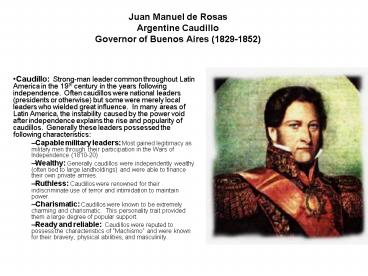
Juan Manuel de Rosas Argentine Caudillo Governor of Buenos Aires 18291852 PowerPoint PPT Presentation
1 / 2
Title: Juan Manuel de Rosas Argentine Caudillo Governor of Buenos Aires 18291852
1
Juan Manuel de RosasArgentine CaudilloGovernor
of Buenos Aires (1829-1852)
- Caudillo Strong-man leader common throughout
Latin America in the 19th century in the years
following independence. Often caudillos were
national leaders (presidents or otherwise) but
some were merely local leaders who wielded great
influence. In many areas of Latin America, the
instability caused by the power void after
independence explains the rise and popularity of
caudillos. Generally these leaders possessed the
following characteristics - Capable military leaders Most gained legitimacy
as military men through their participation in
the Wars of Independence (1810-20) - Wealthy Generally caudillos were independently
wealthy (often tied to large landholdings) and
were able to finance their own private armies. - Ruthless Caudillos were renowned for their
indiscriminate use of terror and intimidation to
maintain power. - Charismatic Caudillos were known to be extremely
charming and charismatic. This personality trait
provided them a large degree of popular support. - Ready and reliable Caudillos were reputed to
possess the characteristics of Machismo and
were known for their bravery, physical abilities,
and masculinity.
2
Argentina in the 19th Century
- Unitarios Anti-Rosas political movement based in
the countryside of Argentina. Members
(including many intellectuals) promoted a liberal
political platform and used the press to oppose
the federalist-Rosas regime prompting aggressive
censorship policies throughout the country. Many
of the Unitario intellectuals were also referred
to as the Generation of 1837 and were forced to
flee into exile as Rosass power grew. - Federales Political movement in 19th century
Argentina that backed the Rosas regime. Members
included the bourgeoisie elite, centrists and
conservatives, leaders in the Catholic Church,
gauchos, some urban workers, and some of the
rural population. The largest support base was
in the cities, particularly Buenos Aires.
Supporters of Rosas were distinguishable by their
red ribbons (blue and white of the Unitarios
would arouse suspicion and could result in
punishment). - Gaucho Argentine cowboys men whose livelihood
was tied to the large population of wild horses
and cattle in the Argentine countryside. These
men developed a strong sense of autonomy, living
outside of major urban settlements, living off
the land, and looking out for their own. Gauchos
have gained a romanticized reputation of being
brave, masculine, independent, and able. - Mazorca Force Rosass private police force who
supported the rule by terror and forced
complaince through violence during Rosass rule. - Domingo Faustino Sarmiento Anti-Rosas writer,
intellectual, and educator who was forced into
exile during the Rosas era. From Chile, he
continued to write caustic criticisms of the
Rosas regime.
Recommended

