

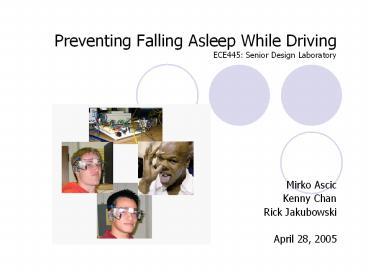
Preventing Falling Asleep While Driving ECE445: Senior Design Laboratory PowerPoint PPT Presentation
1 / 33
Title: Preventing Falling Asleep While Driving ECE445: Senior Design Laboratory
1
Preventing Falling Asleep While DrivingECE445
Senior Design Laboratory
- Mirko Ascic
- Kenny Chan
- Rick Jakubowski
- April 28, 2005
2
Introduction
- Drowsy driving is an underestimated problem
- 100,000 accidents a year
- 71,000 injuries
- 1,550 deaths
- Source National Highway Transportation Safety
Administration - Maggies Law - (2003)
- Drowsy driving is now a crime in NJ
3
Solution to Drowsy Driving
- Portable solution to detect awareness
- Low Cost
- Low Learning Curve
- Easy to implement
- Adaptable to changing conditions
- The Drowsinator!
4
Marketable Applications
- Airlines
- Car Industry
- Aftermarket
- Car Manufacturers
- Industrial Market
- Factory Workers
- Truck Industry
- Truck Stops
5
Product Overview
- Two independent components glasses and base
station - User wears glasses
- Printed Circuit Board (PCB) mounted
- Collects and sends data
- Base station receives and processes data
- Alarm placement
6
System Flow Diagram
Tilt Sensors
7
Glasses
Eye Sensor
Tilt Sensors
Power Switch
LINX Transmitter
Glasses
Battery
8
Power Sources
- 9V battery
- Energizer Industrial
- Low Cost - 1.28
- 12V source
- Simulates 12V source from car cigarette plug
9
Eye Sensor
- IR LED at 900nm
- LN175 GaAlAs Infrared Light Emitting Diode
- Shines invisible IR light on the users eye
- IR 900nm sensor
- Sharp IS489 Light Detector
- Detects reflected IR light
10
Head Sensor
- Durakool Tilt Switch
- Used to detect head position
- Work in all directions
- 3 Used for greater control of break angle
11
Eye Glass Circuit Power and Sensors
12
Eye Glass Circuit Data Transmission
- LINX Wireless Chip
- Data Encoder
- Converts bit information to serial stream for
transmission
13
Decision and Data Processing
- Data sampled every quarter second
- Alarms controlled by PIC
- Danger level determines sensitivity
- Prior history affects danger level
- User can manually control alarms
14
Base Station
LINX Receiver
ACTIVE Switch
PIC 16F877A Microcontroller
RESPONSE Switch
FOX 20 MHz Oscillator
Buzzer
15
Flow Diagram Initial Startup
16
Data Collection
17
Alarm Activation
Alarm Times Vibrator 4 sec Buzzer 6
sec Light 8 sec
18
Blink Rate Detection
- Purpose Early Warning
- Averaged number of blinks per 10 seconds over all
time - If number of blinks in last 10 seconds exceeds
average by 1.5x, then warn
19
PIC/Alarms interface
- PIC outputs 5V, max 25 mA
- insufficient to drive alarms
- amplification circuit needed
20
PIC/Alarms Interface Circuit
21
Testing and Analysis - Sensors
- White/Black paper test
- Bright room/dark room
- Different Users
- Eye sensor positioning
- Tilt sensor make and break angle
22
Results Eye Sensor
Light Conditions
Dark Conditions
23
Results Eye Sensor
Silver Object
Light Conditions
Dark Conditions
24
Results - Sensors
- Sensitivity increases with
- Less Resistance (more light output)
- Closer Sensor Placement
- Dark Conditions
- Similar Sensitivity
- Less interference
- Little reflection difference between open and
closed eyes/different skin colors
25
Sensor Issues and Problems
- Ambient Light
- Placement is very sensitive
- Must be placed quite close to the eye
- Problems with multiple users
- Hard to find a good permanent location
- Calibration with potentiometer
- Tilt sensors
- Shallow break angle
- Work in 360 degrees
26
Testing - Danger Levels
- Time inactivity to drop danger level 10 seconds
- Number of head nods or eye blinks to raise danger
level 8-12
27
First Alarm Times(in seconds)
Subsequent alarms activate 2 seconds apart
28
Testing Alarms
- Lights (five in parallel)
- Brightness
- (12 V,300 mA)
- Buzzer
- Sound intensity
- (6 V, 60 mA)
- Vibrator
- Vibration intensity
- (5 V, 30 mA )
29
Power Considerations
- Current draw on Eye Glass Circuit
- Most from transmitter and IR LED
- Can be lowered with less light output
- Use larger resistance in diode circuit
- Place sensors closer together and closer to eye
- Battery Life 15-25 hours
- Power Consumption - 124 mW
30
Packaging Problems
- 9v battery is quite heavy
- Tilt sensors and PCB package bulky
- Eye sensor must slightly block peripheral vision
31
Possible Additional Features
- Additional memory to store driver profiles
- LCD display
- Smaller/Lighter rechargeable battery
- Simple calibration for eye sensors
- Wireless Alarm Station
- More attractive package
32
Future Improvements
- Convert from Continuous to Pulsed Transmission
- Modulated LED for power saving and better
detection - Analog blink circuit for greater flexibility
33
Questions?
Recommended

