

Roman Art and Architecture PowerPoint PPT Presentation
1 / 38
Title: Roman Art and Architecture
1
Roman Art and Architecture
2
Roman Art and Architecture
- In the third and second centuries B.C., the
Romans developed a taste for Greek art. - Greek statues adorned their cities and homes.
Reproductions became popular. - Roman sculptors added realistic, even unpleasant
features to the idealized Greek forms.
3
Roman Art and Architecture
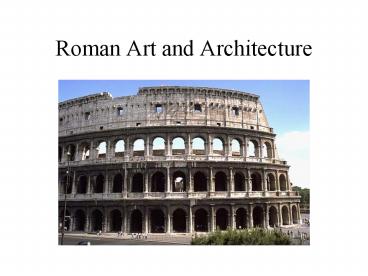
- In line with their practical bent, the Romans
excelled at architecture. - The Romans created forms based on curved lines
the dome, arch, and vault. - They were also first-class engineers who built
enduring roads, bridges, and aqueducts. - They built 50,000 miles worth of roads throughout
the empire. - The city of Romes many aqueducts supplied one
million people with water.
4
Arch
5
Arch
6
Roman Road
7
Roman Road
8
Roman Bridge
9
Roman Aqueducts
10
Roman Art and Architecture
- Horace was important Augustan poet.
- In his Satires he pokes fun at the weaknesses,
follies, and vices of the human race. - The most important prose work of this time was
Livys History of Rome. - He traced the history of Rome from its inception
to 9 B.C.
11
Roman Art and Architecture
- He celebrated Romes greatness and understood
history in terms of moral lessons. - Thus he used stories to show the virtues that
made Rome great. - He did not always get his facts straight, however
12
Hmmmmmm
- Livy believed studying history was profitable
because we could learn from the pasts good and
bad examples, making the present and future
better. - Does history show that people learn from history?
13
Roman Family
- The Roman family was headed by the paterfamilias,
the dominant male. - The household also included his wife, sons with
their wives and children, unmarried daughters,
and slaves. - Unlike the Greeks, the Romans raised their
children at home.
14
Roman Family
- All upper-class Roman children learned to read.
- Teachers often were Greek slaves because
prospering in the empire required knowing both
Greek and Latin.
15
Roman Family
- Roman boys learned reading and writing, moral
principles, family values, law, and physical
training. - Roman males ended their childhood at 16 with a
special ceremony. - They exchanged their purple-edge togas for the
white toga of manhood.
16
Roman Family
- Some upperclass girls were educated privately or
in primary schools. - At the time the boys entered secondary schools,
however, Roman girls were getting married.
17
Roman School
18
Roman Family
- Like the Greeks, Roman males believed the
weakness of women made it necessary for them to
have male guardians. - The paterfamilias usually was the guardian.
- He also arranged the marriages of his daughters.
19
Roman Family
- The legal minimum age for girls to marry was 12,
though 14 was more common. - The age for boys was 14.
- Divorce was introduced in the third century B.C.
and was easy to obtain. - Both men and women could sue for divorce.
20
Roman Family
- By the second century A.D. the paterfamilias no
longer had complete authority in the family. - For example, he could not sell his children into
slavery or have them put to death. - Women increasingly were not required to have a
male guardian. - Upper-class women could own, sell, and inherit
property.
21
Roman Family
- Outside the home women could attend the races,
the theater, and events in the amphitheater. - In the latter two places they had their own
seating section, however, and women could not
participate directly in politics.
22
Hmmmmm
- Greek and Roman men believed women needed male
guardians because of their physical weakness. - women were excluded from politics.
- What beliefs about women have historically
supported this practice?
23
Slavery
- No people relied on slavery as much as the
Romans. Before the third century B.C., even a
small Roman farmer would have one or two slaves. - The wealthy had more.
- As Rome conquered the Mediterranean area, large
numbers of war captives were brought to Italy as
slaves. - Greeks were prized as tutors, musicians, doctors
and artists.
24
Slavery
- Slaves worked in shops, kept house, waited
tables, were personal servants, and made crafts. - They built roads and public buildings.
- Conditions often were pitiful.
- One Roman writer argued that it was cheaper to
work slaves to death and replace them than to
care for them.
25
Daily Life in the City of Rome
- Rome had the largest population of any city in
the empire, close to one million by the time of
Augustus. - Rome was overcrowded and noisy.
- Wagons and carts were banned during the day, but
their noise at night made sleeping difficult. - Even though Augustus organized a police force,
Rome could be dangerous. - .
26
Daily Life in the City of Rome
- One also might be soaked by the filth thrown from
the windows of one of Romes huge apartment
buildings. - The poor lived in apartment blocks called
insulae. - As tall as six stories, these badly constructed
buildings often collapsed. - Fires were a constant threat and hard to put out.
27
Daily Life in the City of Rome
- High rents forced entire families to live in one
room. - The apartments did not have plumbing or central
heating. - These uncomfortable conditions made many Romans
spend most of their time in the street.
28
Insulae
29
Daily Life in the City of Rome
- Rome was adorned with unequaled public buildings,
such as baths, temples, theaters, and markets. - Beginning with Augustus, the citys two hundred
thousand poor received free grain from the
emperor.
30
Roman Bath
31
Roman Bath
32
Roman Theatre
33
Roman Theatre
34
- The people were entertained by grand public
spectacles and entertainments. - The most popular were the gladiatorial contests,
in which animals, slaves, and condemned criminals
would fight to the death. - Horse and chariot races at the Circus Maximus
were also popular, as were dramatic performances.
35
Ancient Roman Market
36
Circus Maximus
37
Rome and Circus Maximus
38
Hmmmmmm
- What two months of the year are named after Roman
emperors?
Recommended

