

Process groups and message ordering PowerPoint PPT Presentation
Title: Process groups and message ordering
1
Process groups and message ordering
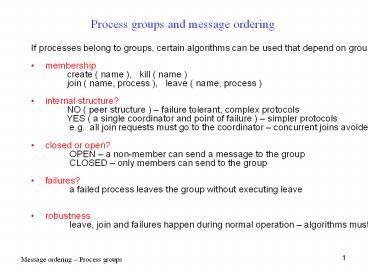
- If processes belong to groups, certain algorithms
can be used that depend on group properties - membership
- create ( name ), kill ( name )
- join ( name, process ), leave (
name, process ) - internal structure?
- NO ( peer structure ) failure
tolerant, complex protocols - YES ( a single coordinator and
point of failure ) simpler protocols - e.g. all join requests must go to
the coordinator concurrent joins avoided - closed or open?
- OPEN a non-member can send a
message to the group - CLOSED only members can send to
the group - failures?
- a failed process leaves the group
without executing leave
2
Message delivery for a process group - assumptions
- ASSUMPTIONS
- messages are multicast to named process groups
- reliable channels a given message is
delivered reliably to all members of the group - FIFO from a given source to a given
destination - processes dont crash (failure and restart not
considered) - processes behave as specified e.g. send the
same values to all processes - - we are not considering so-called Byzantine
behaviour - (when malicious or erroneous processes do
not behave according to their specifications - see Lamports Byzantine Generals
problem).
3
Ordering message delivery
application process
may specify delivery order to message
service e.g. arrival (no) order, total order,
causal order
may reorder delivery to application (on request
for some order) by buffering messages
message service
assume FIFO from each source at this level
(done by lower levels)
OS comms. interface
total order every process receives all messages
in the same order (including its own). We first
consider causal order
4
Message delivery causal order
First, define causal order in terms of one-to-one
messages later, multicast to a process group
application processes
time P1 P2
P3
m
m'
P1 sent message m provably before P2 sent message
m' The above diagram shows a violation of causal
delivery order Causal delivery order requires
that, at P3, m is delivered before m' The
definition relates to POTENTIAL causality, not
application semantics DEFINITION of causal
delivery order (where lt means happened
before) sendi ( m ) lt sendj (
m' ) gt deliverk ( m ) lt deliverk ( m')
5
Message delivery causal order for a process
group
If we know that all processes in a group receive
all messages, the message delivery service can
implement causal delivery order (for total order,
see later)
application processes, time P1 P2 P3
m
m'
application process
the message service can postpone the delivery of
messages to the application process
message service
OS comms. interface
6
Message delivery causal order using Vector
Clocks
A vector clock is maintained by the message
service at each node for each process
application processes P1
P2 P3
1,0,0
2,1,0
0,1,0
1,2,0
1,0,1
1,1,2
vector notation - fixed number of processes N
- each processs message service keeps a vector
of dimension N - for each process, each entry
records the most up-to-date value of the state
counter delivered to the application
process, for the process at that position
7
Vector Clocks message service operation
application processes P1
P2 P3
1,0,0
2,1,0
3,3,0
4,3,4
0,1,0
1,2,0
1,3,0
1,4,4
1,0,1
1,1,2
1,3,3
1,3,4
- Message service operation
- before send increment local process state value
in local vector - on send, timestamp message with sending
processs local vector - on receive by message service see below
- on deliver to receiving application process,
increment receiving processs state value - in its local vector and update the other
fields of the vector by comparing its values - with the incoming vector (timestamp) and
recording the higher value in each field, - thus updating this processs knowledge of
system state
8
Implementing causal order using Vector Clocks
application processes P1
P2 P3
1,0,0
2,2,0
1,1,0
1,2,0
message service
0,0,0
P3s vector is at (0,0,0) and a message with
timestamp (1,2,0) arrives from P2 i.e. P2 has
received a message from P1 that P3 hasnt
seen. More detail of P3s message
service receiver vector sender
sender vector decision new receiver
vector 0,0,0 P2
1,2,0 buffer 0,0,0
P3 is
missing a message from P1 that sender P2 has
already received 0,0,0
P1 1,0,0 deliver
1,0,1 1,0,1 P2
1,2,0 deliver
1,2,2 In each case do the sender and receiver
agree on the state of all other processes? If the
sender has a higher state value for any of these
others, the receiver is missing a message, so
buffer the message
9
Vector Clocks - example
application processes P1
P2 P3 P4
1,0,0,0
2,0,2,0
1,0,1,0
1,0,2,0
1,0,2,2
1,0,0,1
sender sender vector receiver receiver
vector decision new receiver vector
P3 1,0,2,0 P1
1,0,0,0 deliver P1 -gt
2,0,2,0 same states for P2
and P4 P3 1,0,2,0 P4
1,0,0,1 deliver P4
-gt 1,0,2,2 same states for
P1 and P2
P3 1,0,2,0
P2 0,0,0,0 buffer
P2 -gt 0,0,0,0 same
state for P4, different for P1- missing message
P1 1,0,0,0 P2
0,0,0,0 deliver P2 -gt
1,1,0,0 reconsider buffered
message P3 1,0,2,0 P2
1,1,0,0 deliver
P2 -gt 1,2,2,0 same states for
P1 and P4
10
Total order is not enforced by the vector clocks
algorithm
application processes P1
P2 P3 P4
1,0,0,0
3,2,2,0
2,2,0,0
1,2,0,0
1,1,0,0
1,3,2,0
m1
m3
m2
1,0,1,0
1,0,2,0
1,2,3,0
1,0,2,2
1,0,0,1
1,2,2,3
m2 and m3 are not causally related P1 receives
m1, m2, m3 P2 receives m1, m2, m3 P3 receives m1,
m3, m2 P4 receives m1, m3, m2 If the application
requires total order this could be enforced by
modifying the vector clock algorithm to include
ACKs and delivery to self.
11
Totally ordered multicast
- The vectors can be a large overhead on message
transmission and a simpler algorithm - can be used if only total order is required.
- Recall the ASSUMPTIONS
- messages are multicast to named process groups
- reliable channels a given message is
delivered reliably to all members of the group - FIFO from a given source to a given
destination - processes dont crash (failure and restart not
considered) - no Byzantine behaviour
- total order algorithm
- sender multicasts to all including itself
- all acknowledge receipt as a multicast message
- message is delivered in timestamp order after
all ACKs have been received - If the delivery system must support both, so that
applications can choose, - vector clocks can achieve both causal and total
ordering.
12
Total ordered multicast outline of approach
application processes P1
P2 P3
3
1
2
3
ACKs
P1 increments its clock to 1 and multicasts a
message with timestamp 1 All delivery systems
collect the message, multicast ACK and collect
all ACKs - no contention deliver message to
application processes and increment local clocks
to 2. P2 and P3 both multicast messages with
timestamp 3 All delivery systems collect
messages, multicast ACKs and collect ACKs. -
contention so use a tie-breaker (e.g. lowest
process ID wins) and deliver P2s message before
P3s This is just a sketch of an approach. In
practice, timeouts would have to be used to take
account of long delays due to congestion and/or
failure of components and/or communication links
Recommended

