

Sources of Structural Complexity: The Technical Core PowerPoint PPT Presentation
1 / 11
Title: Sources of Structural Complexity: The Technical Core
1
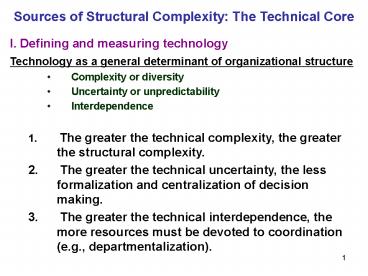
Sources of Structural Complexity The Technical
Core
- I. Defining and measuring technology
- Technology as a general determinant of
organizational structure - Complexity or diversity
- Uncertainty or unpredictability
- Interdependence
- The greater the technical complexity, the
greater the structural complexity. - The greater the technical uncertainty, the less
formalization and centralization of decision
making. - The greater the technical interdependence, the
more resources must be devoted to coordination
(e.g., departmentalization).
2
Sources of Structural Complexity The Technical
Core
- II. Technology and Structure Rational System
Views - Basic coordination mechanisms
- a. Rules and programs
- Rules and programs secure consistent and
acceptable outcomes (e.g., forms, documents,
procedural manuals) - b. Schedules
- Schedules are necessary when different types of
activities need to be carried on in the same
location. - c. Departmentalization
- Organizations group tasks so as to minimize
coordinating costs. - Organizations will place reciprocally related
tasks in the same or closely adjacent units,
sequentially related tasks in less closely
adjacent units, and tasks exhibiting pooled
interdependence in the least closely adjacent
units.
3
Sources of Structural Complexity The Technical
Core
- II. Technology and Structure Rational System
Views - Basic coordination mechanisms
- d. Hierarchy
- Higher level managers deal with unexpected and
irregular occurrences on an exception basis, and
lower level workers deal with more routinized
regular tasks. Hierarchy is also a useful
solution in that it is used to group tasks. - e. Delegation
- Organizations do not control their work in detail
but just specify the nature of the outcomes
required and delegate some autonomy to workers. - f. Microcoordination
- This refers to a coordination device to encourage
the task object such as customers or clients to
monitor and guide the services received.
4
Sources of Structural Complexity The Technical
Core
- II. Technology and Structure Rational System
Views - (2) Additional coordination strategies Reducing
information - a. Product versus process organization
- Information processing costs can be efficiently
reduced by the creation of product based
department. - b. Slack resources
- Slack resources reduce information processing
requirements by lowering standards. - Slack resources reduce the need for information
processing by reducing interdependence. Slack
resources allow looser coupling of interdependent
work systems.
5
Sources of Structural Complexity The Technical
Core
- II. Technology and Structure Rational System
Views - (3) Additional coordination strategies
Increasing capacity - a. Augmented hierarchies
- The capacity of hierarchical system can be
increased in two ways (1) by increasing the
information flows between nodes (actors) and (2)
by increasing the information processing
capacities of the nodes. - b. Lateral connections
- Lateral connections allow information to flow
more directly among participants in
interdependent departments or work groups rather
than up and over through hierarchical channel. - liaison roles, task forces, project teams, and
matrix structures
6
Sources of Structural Complexity The Technical
Core
- II. Technology and Structure Rational System
Views - (3) Additional coordination strategies
Increasing capacity - b. Lateral connections
- Liaison roles are specialized positions or units
created to facilitate interchange between two or
more interdependent departments. - A task force is a temporary group that is given a
delimited problem to solve. It allows multiple
representatives to interact intensively over a
short period of time to achieve a specific goal. - Project teams are groupings of personnel across
departmental lines that fulfill some portion of
the regular work of the organization. - Matrix structures refer to organizational
structures in which vertical and lateral channels
of information and authority operate
simultaneously. The traditional principle of
unity of command is given up, and several
different bases of authority are allowed to
jointly govern the work flow.
7
Sources of Structural Complexity The Technical
Core
- III. Technology and Structure Natural System
Views - (1) Social shaping of technology
- Technologies are socially constructed and
influenced by the social and political context. - Technologies are influenced by organizational
politics. - Social forces and cultural values have a powerful
influence over the technologies that are selected
for development as well as the ways in which
those technologies evolve.
8
Sources of Structural Complexity The Technical
Core
- III. Technology and Structure Natural System
Views - (2) The strategic connection of technology and
structure - Natural system theorists argue that contingency
theorists place too much weight on external
constraints and do not give sufficient attention
to actors and their capacity for choice
(Strategic contingency theory). - Internal politics and strategic choices of
organizations determine the structural forms, the
manipulation of environmental features, and the
choice of relevant performance standards that are
selected by organizations.
9
Sources of Structural Complexity The Technical
Core
- III. Technology and Structure Natural System
Views - (3) Reliance on informal rather than formal
structure - Inlarged roles of participants
- Internalized and peer controls
- More decentralized decision making processes
- Less formalized organizational roles
- Minimized vertical distinctions and flatten
hierarchies - More direct, face-to-face communications among
participants
10
Sources of Structural Complexity The Technical
Core
- III. Technology and Structure Natural System
Views - (3) Reliance on informal rather than formal
structure - a. Socio-technical systems (STS) Eric Trist
- Organizations are both social and technical
systems. The needs of both should be served
(joint optimization). - STS concept of work design calls for the
involvement of workers whenever possible in
planning a new or redesigned work process. - Volvo of Sweden
- the Quality Circle Movement in Japan
11
Sources of Structural Complexity The Technical
Core
- III. Technology and Structure Natural System
Views - (3) Reliance on informal rather than formal
structure - b. Clan systems William Ouchi (1980, 1981)
- Non-specialized roles and career paths
- Implicit and internalized control mechanisms
- Holistic rather than segmented concerns
- Slow and diffuse evaluation
- Long-term, often lifetime, employment
- e.g. Japanese firms
Recommended

