

Final test beam results from ATLAS electromagnetic calorimeter series modules PowerPoint PPT Presentation
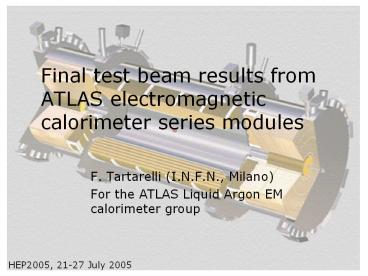
Title: Final test beam results from ATLAS electromagnetic calorimeter series modules
1
Final test beam results from ATLAS
electromagnetic calorimeter series modules
- F. Tartarelli (I.N.F.N., Milano)
- For the ATLAS Liquid Argon EM calorimeter group
HEP2005, 21-27 July 2005
2
ATLAS EM calorimeter
- Sampling calorimeter lead-liquid argon
- Accordion geometry
- Collects ionization charge
- Held into 3 cryostats (about 90 K)
- EMB barrel (hlt1.4)
- EMEC two endcaps (1.4lthlt3.2)
- Presampler for hlt1.8
- Active layer of Lar (11 mm gap in the barrel, 4
mm in endcap) - 3 longitudinal samplings
- Strips, middle and back
- Cell dimensions
- Presampler DhxDf0.025x0.1
- Strips DhxDf0.003x0.1
- Middle DhxDf0.025x0.025 (4x4 cm2)
- Back DhxDf0.05x0.025
- Larger granularity in 2.5lthlt3.2 and no strips
- ?190000 channels
- The calorimeter is located outside the 2T
tracking solenoid
3
Main Requirements
- Large acceptance hlt3.2 (precision physics
hlt2.5) - Energy resolution
- Stochastic term a10 GeV1/2
- Noise term b300 MeV
- Constant term c0.7
- Linearity 0.1 or better
- 0.02 for high precision measurement, e.g. MW
- Angular resolution s(?)?50 mrad/?E
- Particle identification capabilities
- e/jet, g/jet (in particular g/p0 separation for
isolated hi-pT p0 greater than 3) - Time resolution 100 ps
- Non pointing photons (as in some GMSB SUSY
models) - Most of the requirements come from the H?gg and
the H?4e channels and have driven the calorimeter
design
4
Test beams
- Barrel and endcap prototype modules
- 1992-1996
- Combined test beam
- Barrel EM Hadronic 1996
- Pre-series barrel and endcap module (module 0)
- 1998/1999/2000
- Test beam runs of series modules
- EMB tested in 2001/2002 4/32 modules tested.
- EMEC tested in 2001/2002 3/16 modules tested.
- Combined test beams
- Endcap EMHadronic Finished in Aug/Sep 2002.
- Endcap EMHadForward Finished in Oct 2004
- Barrel EMATLAS slice Finished in Nov 2004
Validate production Cell-by-cell scan of whole
modules energy and position resolutions, muons,
Use of final electronics FEC, RODs. Combined
studies with hadronic calo, tracking, muon
chambers. Electrons, pions, muons, photons,
Plenty of data under analysis now.
5
Energy reconstruction
- Scheme based on Geant 4 Montecarlo
- Tested with data 10-250 GeV
- Achieve good resolution and linearity at the same
time - Additional term fbrem(E) used to correct the mean
energy for brem g lost in the passive material
along the electron beam line in the test beam
set-up - Good agreement data/MC
- Additional non-simulated effects studied and have
small impact - Pion contamination
- Additional brem from material in the beam line
- NIM paper in preparation
Energy lost upstream of PS (cryo,)
Energy lost between PS and calo
Inverse sampling fraction and lateral leakage
Longitudinal leakage
h/f modulations
6
Energy Linearity
- Needed a dedicated set-up in 2002 to measure the
beam energy - Linearity is better than 0.1 in the energy range
20-180 GeV - A few caveats
- Check done at one h position
- Less material than in ATLAS
- No B field
- In ATLAS presampler only for hlt1.8
- Performance adequate for most ATLAS measurements
- Exception W mass
- if one wants to improve over LEPTevatron
- Needs a 0.02 energy scale
- Energy scale set by Z?ee
- Will need combination with tracking detector to
extrapolate from Z to W with such precision
preliminary
7
Energy resolution
- Sampling term, noise term and constant term as
expected - Energy scans at fixed position
- Constant term evaluated on single cell
ccell0.2 - Contributions to the global constant term over
the full calorimeter coverage for ATLAS precision
physics - c csr ? clr0.7
- Short range csr
- on a region of DhxDf 0.2x0.4 (440 such regions
on whole detector) - Residual f modulations, calibration, signal
reconstruction, absorber and gap thickness,... - Long range clr
- Temperature and HV variations, LAr impurites,...
- The goal is to keep csr ?0.5 by construction and
intercalibrate in situ with Z?ee events
h0.68
8
Uniformity
rms 0.62
P13 module
- Position scans of entire modules at fixed
electron energy - Set of cluster corrections applied
- Lateral leakage
- h/f modulations
- HV correction in endcap (gap varying with h
partially compensated by a stepped HV) - Corrections well reproduced with MC
- Results
- Uniformity lt0.6 in all cases
- Barrel modules for flt7 penalized by the quality
of one of the feedthrough in the test beam set-up - Hole in barrel plots in the region around h0.8
where the lead thickness changes - Correction now understood
- NIM paper in preparation
0.45
P13 module ? gt 7
0.49
4.5
P15 module ? gt 7
preliminary
0.59
0.52
0.57
9
Position resolution
- Transverse and longitudinal segmentation of the
calorimeter optimized for particle ID and angular
measurement - First sampling of h-strips
- Position reconstruction performance tested on
test beam using beam chambers to reconstruct the
electron impact point - Calculation of cluster h
- Middle linear energy weighting S-shape
correction from fit to data (depends on h and E) - Strips log energy weighting
- Results as expected in both barrel and endcap
modules - Good agreement with MC
- More info
- arXivphysics/0505127 (submitted to NIM)
Endcap 150 GeV Electrons
10
Angular resolution
Barrel E245 GeV
sZ20mm
- Calorimeter segmentation also allows a
stand-alone reconstruction of the shower
direction - Use shower position in strips and middle
compartments - Particularly important along the longitudinal
direction - LHC vertex spread sz 5.6 cm
- Measurements consistent with expectations
- In ATLAS this will allow a calorimeter-only
measure of the zpv in H?gg events with a 1-2 cm
accuracy and reduce the angular contribution to
the Higgs mass resolution - Additional precision using info from tracking
charged track fit to primary vertex, photon
conversion reconstruction
sZ5mm
11
Time resolution
- Fast signal in LAr allows an accurate time
measurement - Time resolution of the electronic readout
- Using calibration data
- Studied using the time difference between two
channels pulsed simultaneously - On middle cells with high gain
- Excellent performance comparable to test bench
measurements - Performance on physics events (Egt 50 GeV)
dominated by absolute time intercalibration
within all cells - Strategy
- Can use calibration data and knowledge of
read-out path to predict intercalibration at 1 ns
(confirmed by beam test on 300 middle cells) - Can double-check with cosmic muons at 1 ns for
online use into RODs - At the LHC start-up using the inclusive electron
trigger can measure the cell time and
intercalibrate all channels at 100 ps or better
12
Muons
- Muon signal well visible in the calorimeter
- 300 MeV in the middle (slightly varying along h)
- Good S/N measured
- Barrel S/N7-10 (middle)
- Endcap S/N7
- Good time resolution
- s 6 ns at (h0.48)
- NIM paper in preparation
- Can use cosmic muons for various purposes during
commissioning - First check of uniformity of the detector
- Timing adjustment
13
Conclusions
- Along the years test beams proved an invaluable
tool - On series modules
- Demonstrate module reproducibility
- Assess performance
- Increase knowledge of the detector
- Prepare tools, tune MC, to be ready for data
taking - Detector construction has finished
- Barrel is in the pit electronics being
installed. Will be moved to interaction point Aug
05 and start final cool down in Nov 05 - ECC completed cold test on surface and will be
lowered in the pit in Sep 05 - ECA being cooled down now on surface. Will be in
pit in Nov 05 - Getting ready for cosmic muons commissioning in
pit in 2006
Barrel
Endcap C
Endcap A
14
Back-up slides
15
Endcap results
h modulation
HV correction
slope
normalization
16
Signal Reconstruction
Physics Calibration
A
Signal sampled every 25 ns
?
Recommended

