

Introduction to the EWB Guidelines for Water Resource Evaluation and Testing PowerPoint PPT Presentation
1 / 41
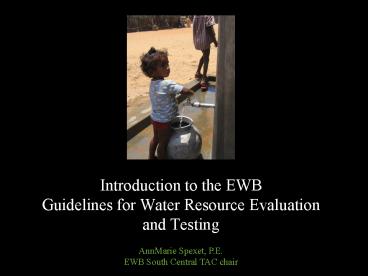
Title: Introduction to the EWB Guidelines for Water Resource Evaluation and Testing
1
Introduction to the EWB Guidelines for Water
Resource Evaluation and Testing
AnnMarie Spexet, P.E. EWB South Central TAC chair
2
Read the guidelines
www.ewb-usa.org Go to resources gt guidelines
- Design Tools
- Reference Materials
- Assessment Implementation Tips
3
- The major considerations for water projects can
be broken down into four major components
- Quantity
- Quality
- Access
- Usage/Destination
4
Water Assessment- Quantity
- Selecting a source
- Meeting the demand
- Seasonal variations
- Where is the community going?
- Who controls the water?
Solar pump, 2006 EWB project
5
How much water?
- Demand is a key technical design factor
- Minimum allowance of water 7 liters per day
(short term emergency trucking) - 20-40 liters per day for the general population
(average USA gt250 L) - varies greatly from project to project
- can change as a result of your project
- Defining water demand by the population to be
served - How people using the water value the improved
water service? - Community users making key decisions.
- Provide for services to vulnerable groups or
individuals
India water tank, 2006 EWB project
6
Consider the source
Disadvantages
Advantages
- Surface Water
- Access method is obvious
- Running water may be used as energy source
- Always requires treatment
- Never where you need it
- Inconsistent
- Quantity varies by season
Groundwater
- Not always available
- May require high levels of treatment
- Season variation and overpumping
- Can be very difficult to access
- If available, generally most stable supply
- Often the cleanest option
- Can be located at point of use
Rain Water
- Requires rain
- Requires a clean surface
- Requires storage
- Sometimes requires treatment
- Quantity varies by season
- Uses something that would otherwise go unused
- Can provide a clean supply
- Can be located at point of use
- Free water pressure
7
Consider the destination
- Drinking
- Cooking
- Bathing/sanitation
- Clothes washing
- Livestock
- Crop Watering
India water tank, 2006 EWB project
8
Water Treatment
- Point of Use vs. Community Scale
- What is appropriate technology?
- Novelty vs. sustainability
- Cost per gallon
- Capital vs. OM
- Design Considerations
- Potential Pitfalls
- Avoiding the magic box
India water tank, 2006 EWB project
9
Water Treatment Technologies
- Sedimentation
- Filtration
- Distillation
- Chlorination
- UV
- Ozone
- Reverse Osmosis
Potters for Peace
Biosand filtration
solar still
UV treatment
solar disinfection
Part 2 ???
10
Why should you test water on your first trip?
EWB Project 2006
- the Chattahoochee River Atlanta water works,
approximately 500 feet away
Shallow groundwater wellIndia fishing village-
approximately 9000 miles away
Cost to acquire datapoint - 5
Cost to acquire datapoint - 1600
11
Have a plan
- Research
- Contact the local water resource authorities
(USGS/EPA/Flooding District/USDA/Universities) - Find the applicable water quality standards
- Acquire a good map and get it into GIS
- Google earth
- Geology/Geography department
- Library GIS
- Decide Lab/DIY
- Assign team members to water
- Learn the equipment before you get on the plane
- Figure out what you need
- Time for incubation time and lab
holding/reporting - Resources ice, clean water, electricity
- Buddy system One sampler, one interviewer/recorde
r (note water assessments work nicely with the
health assessment survey) - Setup your spreadsheet or notebook before you go
on your trip Do not replace paper with a
computer!
12
Sampling Equipment
- Plastic Gloves
- ChemWipes/Alcohol
- Garbage Bags
- Buckets/Bailers
- Distilled water
- Eye protection
- Sharpies/china markers
- GPS/survey equipment
- Camera
- String
- Scissors
- Tape measure
- Stopwatch
- Adjustable wrench and screwdrivers
EWB Project 2006
13
Selecting Equipment
- Is equipment field ready?
- Letter for getting equipment into country
- Packed well
- Ready for rain
- Battery charging
- Buffer solutions and proper calibration
- Do you need additional equipment to complete
test? - Electricity
- DI Water
- Acids/Buffers
14
Preparing your Sample Containers
- Make sure your sample containers are clean
- Use sterilized containers if possible
- Triple rinse containers if they do not contain
preservative (distilled H2O, sample water) - Dry all containers thoroughly before reuse
- Add preservatives or neutralizers before sampling
15
Blank and Duplicate Samples
- Tests
- sampling technique
- handling procedure
- equipment/laboratory procedure
- Use distilled or drinking water for blanks
- Do not hold separately from the rest of the
samples - Test your sample handling procedure
- Standard notation
- TB Trip Blank
- Dup Duplicate
16
Where to get equipment
- Vendors
- Hach (EWB discount) (http//www.hach.com)
- LaMotte (http//www.lamotte.com)
- Idexx (http//www.idexx.com)
- ColiScan (http//www.micrologylabs.com)
- Hanna (http//www.hannainst.com)
- Ben Meadows (http//www.benmeadows.com)
- Forestry suppliers (http//www.forestry-suppliers.
com) - Science Kit (http//www.sciencekit.com)
- Borrowing
- Universities (Civil Eng, Agriculture, Natural
Resource) - Other EWB chapters and your region
- Local companies
- Government (USGS, local water district)
17
Physical Parameters
- Location
- GPS highly recommended, but not good for
elevation - Surveying gear (hand level, Philadelphia rod)
- Elevation changes
- Color
- Smell (Not Taste!)
- Photograph
- Soil characterization and typing
- Rope test
- Jar test
- Pocket penetrometer
- Sources of contamination
- Time of sampling
EWB India Project 2006
18
Surface Water
- Surface Water
- Width
- Depth
- Flowrate
- Sources and outfalls
- Turnover?
- Flooding and drought conditions
EWB India Project 2006
19
Describing Groundwater Supplies
- Diameter
- Construction
- Depth
- Casing type (cement/hand dug)
- Enclosed
- Slug Tests
- Well purging
- Flowrate
- Daily and Seasonal Variation
Open Well
Borewell
Spring box
20
Urban Supplies
- Source vs. point of use
- Distribution network
- Holding Tanks
- Current Treatment
- Transportation vessels
- Household testing
- Local industries
EWB Honduras project 2006
21
Chemical Parameters
- Turbidity
- Specific Conductivity/TDS
- pH
- Temperature
- Alkalinity/Hardness
- Nitrites/Nitrates/Ammonia
- Phosphates
- Dissolved Oxygen
- Arsenic
- Fluoride
- Bacteria
- Other
22
Turbidity
- Water Clarity
- Algae, suspended sediment, and organic matter
particles can cloud the water making it more
turbid. - Quantitatively measured with a meter
- Secchi discs
Turbidity meter
Secci disc
23
Salinity/TDS/Specific Conductivity
- Specific conductivity is an easy way to estimate
the amount of dissolved solids in water - High dissolved solids in water may be perceived
as tasting funny metallic, bitter, or salty. - High dissolved solids can harm fields when used
for irrigation - It may or may not be harmful for consumption
- In coastal areas, high salinity may indicate salt
water intrusion - Conductivity will vary with water source ground
water, water drained from agricultural fields,
municipal waste water, rainfall.
Conductivity meter
24
pH/Temperature
- pH
- Between 6-8.5 is considered normal for drinking
water - Dont sample lab jars, use a different container
- Electronic meters
- Often combined with a Thermometer
- Accurate
- Need batteries/charging
- Calibration
- Paper
- convenient
- not very accurate
- Temperature affects water chemistry and the
functions of aquatic organisms - amount of gases that can be dissolved in water
- Good for detecting problems in samples.
- Should be measured at time of collection, after
wells are purged.
pH paper
pH meter
25
Alkalinity/Hardness
- Alkalinity- Defined as the ability of a water to
neutralize acids. Measured by the amount of
alkaline compounds in water, such as carbonates
(CO32-), bicarbonates (HCO3-), hydroxides (OH-). - Hardness- The concentrations of metal ions in the
water, generally Calcium and Magnesium carbonates - Affected by geology
- Not generally a health problemHowever..
- Soap doesnt foam easily in hard water.
- Water will form a hard scale on pipes and
equipment, and precipitates when the water
temperature rises. - Can drive consumers to a less safe source
Hach drop titration hardness test
Pipe scaling
26
Ammonia/Nitrate/Nitrite
- Nitrogen is found in many forms in the
environment including nitrate (NO3) , nitrite
(NO2) , ammonia (NH3) , and nitrogen gas (N2). - Sources include agricultural runoff, leaking
septic tanks, animal wastes, industrial waste
water, sanitary landfills. - Even in low concentrations, it can be harmful to
humans and wildlife - Blue baby syndrome
- Algal blooms can kill off fish and other aquatic
organisms. - Consider a nitrate test when in an agricultural
region, or near a surface water source that
accepts agricultural runoff
fertilizer
Nitrogen cycle
27
Phosphates
- Phosphorus is a nutrient required by all
organisms for the basic processes of life and is
usually found as phosphate. - Phosphorus is a natural element found in rocks,
soils and organic material. Its concentrations in
clean waters is generally very low. - Used extensively in fertilizer and other
chemicals, so it can be found in higher
concentrations in areas of human activity. - High levels of phosphate, along with nitrate, can
over stimulate the growth of aquatic plants and
algae, resulting in high dissolved oxygen
consumption, causing death of fish and other
aquatic organisms. - The primary sources of phosphates to surface
water are detergents, fertilizers, and natural
mineral deposits. - Consider a phosphate test when in an agricultural
region, or near a surface water source that
accepts agricultural runoff
fertilizer
algal bloom (New York Times)
28
Dissolved Oxygen
- Defined as the amount of oxygen dissolved in
water. - Test should be performed on freshly drawn
samples, preferably after purging the well - Anaerobic environments can indicate the presence
of bacterial or naturally occurring sulfur-using
bacteria, causing a rotten egg smell. It can
also indicate the presence of decomposing
material in the water - When treated nicely, dissolved oxygen meter
electrodes will last about 6 months before the
electrolyte and dissolved oxygen meter's membrane
need to be replaced. - Make sure to keep membrane wet at all times
Hanna Oxygen meter
29
Arsenic
- Naturally occurring mineral in water
- Highly toxic, and can cause birth defects and
reproductive problems, as well as physical
symptoms such as keratosis - Iron treatment can remove arsenic
- Consider arsenic testing when well drilling, or
in a region known for arsenic contamination, or
when in the vicinity of a mining operation or
metal plating facility
Arsenic related keratosis on hands and feet
Arsenic mineral sample
30
Modeled global probability of geogenic arsenic
contamination in groundwater
reducing groundwater conditions
high-pH/oxidizing conditions where arsenic is
soluble in its oxidized state
M Amini et al, Environ. Sci. Technol., 2008
31
Fluoride
- Naturally occurring
- In low concentrations, its a common additive
used to strengthen tooth enamel - In high concentrations, it can cause fluorosis, a
disease that damages teeth and bones - Can be removed through distillation, reverse
osmosis, and activated alumina - Consider fluoride tests when drilling wells, or
in a region known for fluoride contamination
Dental fluorosis
Skeletal fluorosis
32
Global probability of geogenic fluoride
contamination in groundwater
M Amini et al, Environ. Sci. Technol., 2008
33
Bacteria
- Bacteria
- Many different types of pathogenic bacteria
- Fecal Coliform Bacteria are present in the feces
and intestinal tracts of humans and other
warm-blooded animals, and can enter water bodies
from human and animal waste. - If a large number of coliform bacteria (over 200
colonies/100 ml of water sample) are found in
water, it is possible that pathogenic (disease-
or illness-causing) organisms are also present in
the water. They are considered an indicator
species - Hydrogen Sulfide Producing Bacteria are not
harmful themselves, but can be indicators of
other problems. - They also produce H2S gas which can cause
problems with corrosion in pipes and makes the
water smell bad, and in high concentrations can
be very dangerous - New research suggests the H2S bacteria might be a
better indicator of Fecal Coliforms in tropical
countries that have high numbers of naturally
occurring coliform bacteria. - High concentrations of the bacteria in water may
be caused by septic tank failure, poor pasture
and animal keeping practices, pet waste, and
urban runoff.
34
Microbiology
- P/A Testing vs. MPN vs. Plate Count
- Quantitative vs. qualitative
- Avoiding contamination
- Create a lab environment
- Use sterile equipment
- Verify dilution water
35
Presence/Absence test options
- Many different kits
- Hach MEL kits
- Hach Pathoscreen
- LaMotte BART
- Colilert
- ColiTag
- LaMotte
36
Coliform MPN Options
- Most Probable Number
- Hach Pathoscreen (37.40/20 tests)
- LaMotte Coliform Test Kit (13.35 /1 test)
- Use clean dilution water
- MPN tests can also be used as a P/A test (just
dont dilute)
37
Coliform Quantification
- Hach MF
- Idexx Quantitray
- Idexx QuantiDisc
- ColiScan Easygel
- ColiScan MF
- 3M PetriFilm(75 for 25 tests)
38
Other Parameters
- Iron
- Lead
- Mercury
- Other Contaminants
- Consider local activities
- Mining
- Agriculture
- Manufacturing (especially metal finishing)
- Oil production
- Fueling stations
- Military
- Fishing or aquaculture
39
Reporting
- Table 1 Physical Parameters
- Table 2 Chemical Parameters
- Use your GIS data more
- Talking to the community about results
- Testing over project lifetime
- Numbers are not boring!
- TAC
- Donors
- Future project teams
40
Standards
- Location Specific
- Find the numbers before you go
- USEPA National Drinking Water Standards
http//www.epa.gov/safewater/consumer/pdf/mcl.pdf
41
Evolution/Lessons Learned
- Guidelines were created by the early project
teams - Expansion and refinement is necessary your
feedback, suggestions, and stories are welcome - Future topics for these seminars?
- Contact Meg
- aspexet_at_gmail.com
Questions?
Recommended

