

Managing Demand and Capacity PowerPoint PPT Presentation
1 / 12
Title: Managing Demand and Capacity
1
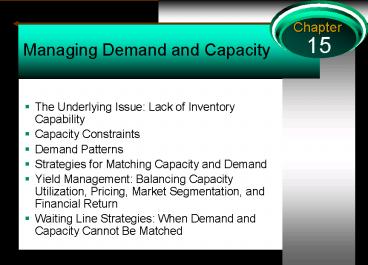
Managing Demand and Capacity
Chapter
15
- The Underlying Issue Lack of Inventory
Capability - Capacity Constraints
- Demand Patterns
- Strategies for Matching Capacity and Demand
- Yield Management Balancing Capacity Utilization,
Pricing, Market Segmentation, and Financial
Return - Waiting Line Strategies When Demand and Capacity
Cannot Be Matched
2
Figure 2.6Gaps Model of Service Quality
Expected Service
CUSTOMER
Customer Gap
Perceived Service
External Communications to Customers
COMPANY
Service Delivery
Gap 4
Gap 3
Customer-Driven Service Designs and Standards
Gap 1
Gap 2
Company Perceptions of Consumer Expectations
3
Figure 15.1Variations in Demand Relative to
Capacity
Source C. Lovelock, Getting the Most Out of
Your Productive Capacity, in Product Plus
(Boston McGraw Hill, 1994), chap. 16, p. 241.
4
Understanding Capacity Constraintsand Demand
Patterns
Demand Patterns
Capacity Constraints
- Time, labor, equipment, and facilities
- Optimal versus maximum use of capacity
- Charting demand patterns
- Predictable cycles
- Random demand fluctuations
- Demand patterns by market segment
5
Table 15.1Demand versus Supply
Source C. H. Lovelock, Classifying Services to
Gain Strategic Marketing Insights, Journal of
Marketing 47, (Summer 1983) 17.
6
Table 15.2 Constraints on Capacity
7
Figure 15.3Strategies for Shifting Demand to
Match Capacity
Demand Too High
Demand Too Low
Shift Demand
- Use sales and advertising to increase business
from current market segments. - Modify the service offering to appeal to new
market segments. - Offer discounts or price reductions.
- Modify hours of operation.
- Bring the service to the customer.
- Use signage to communicate busy days and times.
- Offer incentives to customers for usage during
nonpeak times. - Take care of loyal or regular customers first.
- Advertise peak usage times and benefits of
nonpeak use. - Charge full price for the serviceno discounts.
8
Figure 15.4Strategies for Adjusting Capacity to
Match Demand
Demand Too High
Demand Too Low
- Perform maintenance, renovations.
- Schedule vacations.
- Schedule employee training.
- Lay off employees.
- Stretch time, labor, facilities and equipment.
- Cross-train employees.
- Hire part-time employees.
- Request overtime work from employees.
- Rent or share facilities.
- Rent or share equipment.
- Subcontract or outsource activities.
9
Challenges and Risks in UsingYield Management
- Loss of competitive focus
- Customer alienation
- Employee morale problems
- Incompatible incentive and reward systems
- Lack of employee training
- Inappropriate organization of the yield
management function
10
Waiting Line Strategies
- Employ operational logic
- modify operations
- adjust queuing system
- Establish a reservation process
- Differentiate waiting customers
- importance of the customer
- urgency of the job
- duration of the service transaction
- payment of a premium price
- Make waiting fun, or at least tolerable
11
Issues to Consider in Making WaitingMore
Tolerable
- unoccupied time feels longer than occupied time
- preprocess waits feel longer than in-process
waits - anxiety makes waits seem longer
- uncertain waits seem longer than known, finite
waits - unexplained waits seem longer than explained
waits - unfair waits feel longer than equitable waits
- the more valuable the service, the longer the
customer will wait - solo waits feel longer than group waits
12
Figure 15.6Waiting Line Configurations
Source J. A. Fitzsimmons and M. J. Fitzsimmons,
Service Management, 4th ed. (New York
Irwin/McGraw-Hill, 2004), chap. 11, p. 296.
Recommended

