

Study Guide PowerPoint PPT Presentation
1 / 2
Title: Study Guide
1
Study Guide
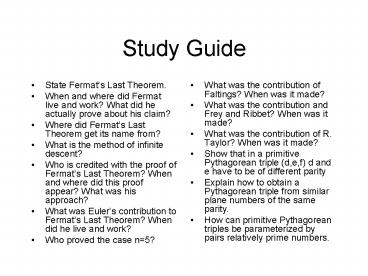
- State Fermats Last Theorem.
- When and where did Fermat live and work? What did
he actually prove about his claim? - Where did Fermats Last Theorem get its name
from? - What is the method of infinite descent?
- Who is credited with the proof of Fermats Last
Theorem? When and where did this proof appear?
What was his approach? - What was Eulers contribution to Fermats Last
Theorem? When did he live and work? - Who proved the case n5?
- What was the contribution of Faltings? When was
it made? - What was the contribution and Frey and Ribbet?
When was it made? - What was the contribution of R. Taylor? When was
it made? - Show that in a primitive Pythagorean triple
(d,e,f) d and e have to be of different parity - Explain how to obtain a Pythagorean triple from
similar plane numbers of the same parity. - How can primitive Pythagorean triples be
parameterized by pairs relatively prime numbers.
2
Sudy Guide
- What is Kummers contribution to Fermats Last
Theorem? When did he live? - What is an ideal number in the sense of Kummer.
- What is the definition of an irreducible number?
- What is the definition of a prime number in a
number system such as Zv-5 - Give a number in Zv-5 which does not have a
unique factorization. - Show that Zw23 does not have unique
factorization, where w23 is a 23rd root of unity. - Let Alt2,1 v-5gt in Zv-5. Show that AA
lt4,2(1v-5),-42v-5gt lt2gt.
- What was the contribution of Sophie Germain. When
did she do her work? - State the Theorem of Sophie Germain. What are the
Case I and Case II solutions? - What was the first step in Germains proof of her
Theorem. - Use Germains Theorem to show that there are no
Case I solutions to the Fermat equation by
showing that 3 is not a cube modulo 7 and that no
two nonzero third power residues differ by 1. - Where did Lamé go wrong? When did he make his
claims? How long did they last? Who proved him
wrong?
Recommended

