

Chapter 13 Light PowerPoint PPT Presentation
1 / 21
Title: Chapter 13 Light
1
lenses
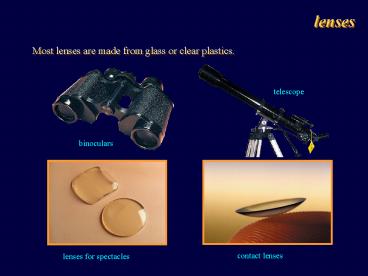
Most lenses are made from glass or clear plastics.
telescope
binoculars
contact lenses
lenses for spectacles
2
lenses
converging and diverging lenses
Lenses can be classified into two categories.
converging lens
diverging lens
converging beams
diverging beams
3
lenses
lenses
converging and diverging lenses
Lenses can be classified into two categories.
4
lenses
converging lenses
A thin converging lens is able to converge to a
point, a parallel beam of light passing through
it.
5
lenses
converging lenses
Ways to draw a ray diagram for a converging lens
converging lens
focal length
parallel rays of light
F
C
F
f
6
lenses
converging lenses
Paths of three important types of light rays
through a thin converging lens
F1
C
F2
the incident ray parallel to the principal axis
passes through the focal point, F1
7
lenses
converging lenses
Paths of three important types of light rays
through a thin converging lens
F1
C
F2
the incident ray which passes through the optical
centre, C, is not deviated
8
lenses
converging lenses
Paths of three important types of light rays
through a thin converging lens
F1
C
F2
the incident ray passing through F2 becomes
parallel to the principal axis
9
lenses
lenses
ray diagrams
Drawing a ray diagram.
X
Y
10
lenses
real images
parallel rays from distant object
F1
C
F2
11
lenses
real images
F1
C
F2
12
lenses
real images
F1
C
F2
13
lenses
real images
F1
C
F2
14
lenses
virtual images
F1
C
F2
15
lenses
virtual images
image formed appears to come from a place behind
the object itself
F1
C
F2
16
lenses
linear magnification
Linear magnification is the ratio of the height
of the image to the height of the object.
17
lenses
linear magnification
By the method of similar triangles,
height of object
distance of image from lens
distance of object from lens
height of image
18
lenses
some optical instruments
variable aperture diaphragm
converging lens
converge light from objects into a real,
inverted, diminished and sharp image
controls the aperture that allows light to pass
through
focussing ring
moves the lens to and fro
light sensitive film
shutter
captures the image
controls the length of time that the film is
exposed to light
simple camera
19
lenses
some optical instruments
screen
slide
put upside down and turned left to right
image formed is inverted laterally and vertically
lamp
condenser lenses
concave mirror
projection lens
moves to and fro until a sharp magnified image is
focused on the screen
reflects light from a quartz iodine lamp back
onto a pair of condenser lenses
direct the light through the slide to a
projection lens
slide projector
20
lenses
some optical instruments
lamp
condenser lenses
direct the light through the slide to a
projection lens
projection lens
negative film
moves to and fro until a sharp magnified image is
focused on the screen
placed upside-down and back to front in the film
holder
photographic paper
image formed is inverted laterally and vertically
photographical enlarger
21
Light
undergoes
Refraction
Reflection
obeys
obeys
Laws of refraction
Laws of reflection
apply to
explain
define
apply to
mirror
terms
Refractive index
Thin lenses
Focal length Linear magnification
Critical angle
explain
described by
calculate from
Total internal reflection
Real and apparent depth
Ray diagram
used in
application
Magnifying glass projector
Optical fibres
Recommended

