

Searching for Other Solar Systems with the MMT and LBT PowerPoint PPT Presentation
1 / 50
Title: Searching for Other Solar Systems with the MMT and LBT
1
Searching for Other Solar Systems with the MMT
and LBT
- Phil Hinz
- University of Arizona
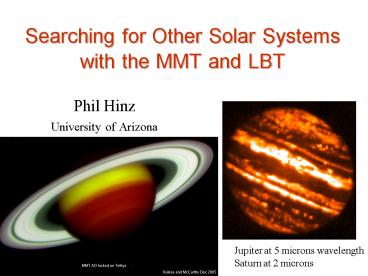
Jupiter at 5 microns wavelength Saturn at 2
microns
2
Acknowledgements
- Wilson Liu
- Ari Heinze
- Suresh Sivanandam
- Melanie Freed
- Roger Angel
- Bill Hoffmann
- Matt Kenworthy
- Doug Miller
- Guido Brusa
3
Outline
- What do we need to see other Solar Systems
- Benefits of a Deformable Secondary
- Current results with the MMT
- Nulling search for debris disks
- 3-5 micron imaging search for giant planets
- The LBT Interferometer
- Status
- Expected Performance
4
Motivation for Direct Detection
- Planets
- Extend radial velocity statistics
- Planets found by radial velocity measurements
suggests a flat to rising separation distribution - Look for long-period planets which could dominate
the dynamical environments of planetary systems - Before looking for a rocky planet we want to know
which systems have stable habitable zones - Learn about size, temperature, and composition of
planets - Most information about a planet can be obtained
from direct detection. - Zodiacal Dust Disks
- Disks are the smoking gun of a planetary system
- Material is cleared away on short timescales
requiring large planetessimal bodies as
reservoirs for transitory dust around mature
stars. - Resolving disks is crucial for understanding
grain sizes and time scales - Degeneracies between grain size and spatial
distribution makes interpreting SEDs difficult. - Map out the architecture of other planetary
systems
5
So whats the problem?
H M A Jupiter at 5 Gyr is 10-12
Lsun 10-8 Lsun A Jupiter at 0.5 Gyr is 10-8
Lsun 10-6 Lsun (Baraffe et al. 2003) Look
at younger systems! Look in the
infrared! Typical separations are 0.1-4
arcseconds for planets at 1-40 AU around stars
at 10 pc. Our Zodiacal Dust Disk is 10-4 Lsun at
11 microns
Requirements Approach Photometrically detect
planet/dust disk Large Infrared Optimized
Telescopes, Resolve planet from
star Interferometry or Large Telescopes Suppress
starlight Nulling, Adaptive Optics
6
Advantages of a Deformable Secondary
- IR observations are often limited by background
light from the telescope optics. - Typical AO systems have background emission of
20 - A deformable secondary system can have an
emissivity of 5-7. - This can translate into 3-4x speed improvement in
observations.
7
The MMT AO system
- The 6.5 m MMT has the world's first (and only)
deformable secondary. - The system is a prototype for the LBT.
- It was developed as a collaboration between
Arcetri Observatory in Italy and the Mirror Lab
at the University of Arizona
8
Adaptive Secondary
- mirror diameter 642 mm
- mirror thickness 2 mm
- membrane in-plane restraint
- 336 moving magnet actuators
- nominal air gap 45 um
- reference body 50 mm thick (kinematic mount)
- AL cold plate actuators support cooling
(7 cooling channels) fixed hexapod
9
Embedded Voice Coil Actuators
Annular Capacitive Position Sensors
Solid Glass Reference Body
MMT336 ASPHERIC SHELL
642mm diam.
2mm thick
Magnets
(12mm diameter)
10
The MMT AO System
AdaptiveSecondaryMirror
Send new position commands to the 336 actuators
- Measure aberrationsdue to the atmospherewith
WFS Camera - Calculate secondaryshape needed to
correctmeasured aberration - Apply shape to thedeformable secondary
Correct 56 modes
WFS Camera
Reconstructor Computer
Loop runat 550 Hz
12x12 Shack-Hartmann Sensor
11
The Excitement of Ridin' the Hub
12
AO in the mid-IR
Camera with cold pupil stop misaligned.
Camera with cold pupil stop aligned.
Blackbody emission From central hole in primary
Emission from sky
Emission from sky and telescope
- Images taken at 11 microns of the MMT adaptive
secondary. - Emissivity of the telescope was measured at 7.
13
Searching for Dust Disks
14
Mid-Infrared Array Camera (MIRAC) The Bracewell
Infrared Nulling Cryostat (BLINC)
- 128x128 8-25 um imager
- Nulling channel using two subapertures
- Currently completing a next generation version of
MIRAC (256x256 detector) which will be tested in
late 2006.
MIRAC4 undergoing lab tests in Oct. 2006
15
BLINC
telescope beam
10 micron detector
2 µm detector
imaging channel nulling channel
reimaging ellipsoid
beam-splitter
16
Using the MMT as a Nulling Interferometer
Constructive Destructive
Calibrator
AB Aur
The amount of flux in the nulled image is a
direct measurement of the extended dust emission.
17
Disk Sizes of Herbig Ae Stars
- Star d (pc) SpT Source Null() Disk Size(AU)
- V892 Tau 140 A6e 12 22
- AB Aur 140 B9/A0esh 21 32
- HD 98922 100 B9Ve
- HD 100546 100 B9Vne 34 26
- HD 104237 116 A4e
- DK Cha 150 Ae 6 17
- HR 5999 210 A7III/IVe
- HD 150193 150 A0/4Ve
- KK Oph 160 A5Ve
- HD 163296 122 A0/2Vepsh
- R CrA 130 A5IIesh 8 17
- HD 179218 240 B9/A0IV/Ve 5 25
- 51 Oph 130 A0Ve
18
Possible Morphology Difference
Model of Meeus et al. 2001 to explain different
SEDs of ISO observations.
- Meeus et al. separate ISO spectra of 14 Herbig
objects into Group I and Group II based on
the existence or lack of a cooler component in
the SED. - They suggest that this might be caused by the
extent of flaring in the outer disk. - AB Aur, HD 100546, and HD 179218 are Group I.
- HD104237, HD 150193, HD 163296, and 51
Oph are Group II.
Group I
Group II
19
Nulling with the MMT AO system (Liu et al. 2004)
Vega
- We have been able to set an upper limit to
zodiacal dust of 2 (3 s) of the stellar flux on
Vega (Liu et al. ApJL in press). - 3 times more sensitive than best photometric
measurements. - Corresponds to a limit of a zodiacal dust disk
- The absence of dust at this level is in contrast
to the presence of the colder dust excess seen by
Spitzer. This suggests that the dust must be
collisionally dominated or has just been created. - A survey of main sequence stars is underway,
focusing on A stars with longer wavelength excess.
20
MMT dust limits for stars at 10 pc
ß Pictoris
HR 4796A
? Lep
BLINC MMT No AO
Altair
BLINC MMT with AO
F0 star
Stellar flux
dust around an A0 star
G0 star
K0 star
Vega
Flux in nulled output of LBT (mJy)
M0 star
MMT sensitivity
Nulled stellar flux
Cloud density (zodis)
21
Comparison of Spitzer and MMT nulling
sensitivities
22
Searching for Giant Planets
23
What is the optimum wavelength?
Model spectrum from Sudarsky, Burrows and Hubeny
(2003)
Theoretical models from Baraffe et al. 2003
24
What noise sources will dominate?
- The dominant source of noise for M band
observations is the photon noise from the sky and
telescope background. - The PSF of the star can be essentially eliminated
to the extent it can be calibrated. - Atmospheric speckles average out to a halo and do
not increase the noise. - Slowly changing speckles may limit the dynamic
range achieved. Coronagraphy and speckle
suppression will help with this effect, where it
is dominant.
25
Clio
f/20 channel
3 channel system ? L (3.77 ?m) and M (4.68
?m) band channel, f/20, Nyquist
sampled _at_ L, FOV15 x 12 ? H (1.65 ?m)
and Ks (2.15 ?m) band channel, f/35,
Nyquist sampled _at_ Ks, FOV8.7 x 7 ? pupil
imager
26
Clio first light 5 micron AO observations of Vega
- The High Strehl Images at M band are dominated by
Static Aberrations which can be removed by PSF
subtraction and unsharp masking. - The 5 minute exposure is background limited
outside 1.5
PSF level
5 sigma limit after PSF subtraction and unsharp
mask
27
Observed L Exo-Jupiter limits to 1 Gyr star at 9
pc
- Observations of nearby old stars are sensitive to
5-10 Jupiter masses
- Delta magnitude versus separation limits at L
and M are comparable to NIR limits.
28
Looking for a planet around Vega
Dust model and predicted planet position From
Wilner et al. 2002
29
5 micron observations of Vega with the MMTAO
1 arcsec
fake 10 Jupiter mass planet at 20 AU
Metchev et al. (ApJ 582, 1102) using Palomar
at H band
Companion mass limit (5 sigma)
Expected Planet?
Limit from 11 minute observation at M band
Macintosh et al. (ApJ 594, 538) using Keck at K
band
Separation (arcsec)
30
Diffraction Suppression via Phase Manipulation
On-Sky Data
- PSF sidelobes are over 7 magnitudes fainter at 3
?/D away. - The pattern is stable and can be reliably
subtracted off to reach the limit of the sky
background. - PSF suppression is easier at M band where
Strehls are typically 90
31
The LBT Interferometer
32
LBT Interferometric Imaging
The LBT combines good IR sensitivity with high
spatial resolution
33
LBT compared to a single 8 m
14.4 m
10 mas/ µm
34
Observations with the LBT over -3 HAto 3 HA
Dec20 deg
Dec0 deg
35
LBT Status
- First light with LBC prime focus camera achieved
in October 2005 - Installed second primary in Fall 2005.
Aluminized in January 2006 - Dual prime focus operation planned for fall 2006.
- First Adaptive Secondary scheduled for delivery
in early 2008, second one six months later.
36
Interferometry with the LBT
37
The LBTI-UBC Optical Design
deformable secondary
deformable secondary
f/15 telescope foci
beamcombiner
8.4 m LBT primary
14.4 m separation
38
LBTI design
- Discrete cold dewars
- External Rigid Structure
- General Purpose (Universal) Beam Combiner (UBC)
- Three Camera Ports
- Integrated Wavefront Sensors
UBC
Side Camera
NIL- NOMIC
39
LBTI Parts
Parent Ellipse Mirror
vacuum bellows
rough cryostat housing
Mirror being polished
cryostat housing machined
center metering structure
metering structure edge-on
40
LBTI Components
Fast Pathlength Corrector
4 K Mech. Cooler
SiC Mirror
Systems Engineer Tom Connors checks whether we
have left enough room for the binocular eyepiece
Left UBC Cryostat
41
LBTI Structure in lab
42
Optical Alignment Preparation
43
NIL-NOMIC design
input
- Need Reflective Design for broadband (2-10 µm)
operations - Need intermediate Pupil and Focal Planes for beam
overlap and spatial filtering. - Split off NIR light after beam combination for
phase control - Multiple Dichroics in design to get right
wavelength to right detector
- Optics are dual biconic mirrors (similar to a
dual OAP design) - Cryostat area is approximately (1mx0.75m)
nulling channel
imaging channel
dichroic
phase sensor
3-5 micron detector
7-25 micron detector
44
Schedule
- Fall 2006 align and characterize UBC
- Fall 2006 finalize NIL-NOMIC and start
fabrication - Fall 2007 test the complete system in lab
- Spring 2008 ready for delivery to the telescope.
45
LBT debris disk limits
ß Pictoris
HR 4796A
? Lep
BLINC MMT No AO
Altair
BLINC MMT with AO
F0 star
Stellar flux
dust around an A0 star
G0 star
K0 star
Vega
Flux in nulled output of LBT (mJy)
MMT observations limited by vibration and
problems with phase control loop
M0 star
photometric sensitivity limit
Nulled stellar flux
Cloud density (zodis)
46
LBT planet limits
1 arcsec
fake 10 Jupiter mass planet at 20 AU
Metchev et al. (ApJ 582, 1102) using Palomar
at H band
Companion mass limit (5 sigma)
Expected Planet?
Macintosh et al. (ApJ 594, 538) using Keck at K
band
Separation (arcsec)
47
Back Up Slides
48
Could LBT Detect a Terrestrial Planet?
- If Terrestrial Planets are very common, so that
one can be detected around a very nearby star,
the LBT might have the sensitivity at L', M or N
band to detect a rocky planet.
49
Detecting a planet around Sirius
50
Summary
Recommended

