

Harmful Algal Bloom Pilot Project The Beginnings of a Proposal PowerPoint PPT Presentation
1 / 17
Title: Harmful Algal Bloom Pilot Project The Beginnings of a Proposal
1
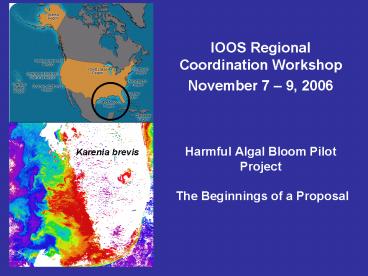
Harmful Algal Bloom Pilot Project The
Beginnings of a Proposal
- IOOS Regional Coordination Workshop
- November 7 9, 2006
Karenia brevis
2
Harmful Algal Blooms
Toxins
Hypoxia
2
3
Why the Gulf of Mexico ? Why K. brevis ?
- Of 30 toxic species, K.b. has by far the
greatest impact on health well being - Neurotoxic shellfish poisoning (NSP)
- Respiratory illness
- gt 5,000 /liter (0.05 µg /liter)
- K.b. monitored routinely since 1950
- Pigmented, surface signature
- Patches
- Regional (multi state) problem
- Occur most frequently late summer fall
- Hot spots
- Blooms of Trichodesmium spp. often precede K.b.
blooms
Karenia brevis
3
4
Workshop Reports Used to Prepare this Proposal
- Harmful Algal Blooms Observing System (HABSOS)
Workshop Report, 2000 (http//www.hpl.umces.edu/pr
ojects/HABSOS.pdf) - Action Plan for Harmful Algal Blooms and the Gulf
of Mexico Coastal Ocean Observing System, 2004
(http//www.gulfbase.org/event/view.php?eidhabsos
gcoos) - Harmful Algal Research and Response National
Environmental Strategy 2005-2015, A National Plan
for Algal Toxins and Harmful Algal Blooms
(http//www.esa.org/HARRNESS/) - 2005 IGOS Coastal Theme Report (http//ioc.unesco.
org/igospartners/)
4
5
Gulf Action Plan HARRNESS Recommend Actions
that are Particularly Relevant to an IOOS Pilot
Project on HABs
5
6
Purpose of this Report
- Identify user groups specify their data
information requirements - Suggest pilot project objectives
- Specify observing system requirements to be met
through the combined use of in situ measurements
remote sensing - Suggest RD priorities for improving operational
capabilities - Initiate a process that will lead to a pilot
project - Networks stakeholders from public private
sectors to - Implement an integrated, Gulfwide HAB monitoring
forecasting system as an integral component of
coastal IOOS - Demonstrate value added by expanding the use of
current observations made in support of other
applications
6
7
User Groups Products Well Documentedin 2000
2004 Workshops
- Federal State Agencies
- Public health
- Resource management
- Water quality
- Industries
- Tourist
- Shellfish
- At Risk Public
- Educators
- NGOs
- Weekly Nowcasts
- where when blooms are likely to be initiated
- based on environmental conditions
- Alert/Nowcasts
- location areal extent of new bloom
- followed by daily nowcasts of location extent
- Daily, 3day Forecasts
- bloom trajectories once a bloom has been confirmed
7
8
Key Stakeholder OrganizationsThat Represent
These Groups
- Gulf of Mexico Coastal Ocean Observing Regional
Association (http//www-ocean.tamu.edu/GCOOS/RA) - SE Coastal Ocean Observing Regional Association
(http//www.secoora.org/) - Gulf of Mexico Alliance (http//www.dep.state.fl.u
s/gulf/default.htm)
8
9
Suggested Pilot Project ObjectivesCollaborate
w/ key stakeholders to
- Expand/improve the efficiency of networks of
responsible State agencies for - data information exchange
- coordinated development of programs that monitor
ecosystem conditions, shellfish, fish,
waterborne pathogens Gulfwide - Expand volunteer networks of beach keepers
- Using common standards protocols for sampling
reporting - Modeled after the River Keeper program
- Predict the onset of K. brevis blooms their
movement in shelf waters with known uncertainty - Using of ensemble modeling techniques.
- Improve the cost-effectiveness of sampling
regimes and the skill of model forecasts - OSSEs OSEs
- Test beds
9
10
Minimum Set of Observations Needed
- Forcings
- Sea surface winds
- Riverine inputs
- Freshwater
- Sediments
- Nutrients
- Atmospheric inputs
- Freshwater
- Nitrogen
- Iron
- Offshore Boundary Conditions
- Ecosystem Condition
- Surface fields
- Waves
- Currents
- Temperature
- Chlorophylla
- Vertical profiles
- Temperature Salinity
- Inorganic nutrients
- Colored DOM
- Chlorophylla
- K. brevis cell density
10
11
Observing System RequirementsModified for the
IGOS Coastal Theme Report
11
12
2 Tiered Approach
- Tier 1 Continuous, Sustained Observations
Analyses - Spacebased remote sensing
- Chlorophyll-a, pigment ratios, suspended
sediments colored dissolved organic matter
(SeaWiFS, MODIS, OCM, OSMI, MERIS) - Sea surface temperature (AVHRR)
- Surface waves and slicks (scatterometry, SAR, HF
radar) - Currents (altimetry, HF radar)
- Sentinel stations transects K. brevis Hot
Spots - In situ measurements of key environmental
variables - K. brevis abundance
- Tier 2 Adaptive Sampling
- Triggered by Tier 1 observations analyses
- Focus on the domain where a bloom is likely to
occur or is occurring - Increase timespace resolution of Tier 1
observations - Add new measurements as needed, e.g., K. brevis
toxicity
12
13
Potential Adaptive Sampling Schemes
13
14
Existing Building Blocks
- NOAA HAB Monitoring Forecasting System HAB
Bulletin - SpaceBased Remote Sensing
- NASA
- NOAA
- GCOOS SEACOOS
- HF Radar
- BreveBuster
- NDBC Data Buoys, TYCOON, TABS, COMPS
- SEAKEYS, NERRS
- PORTS
- Houston/Galveston Bay
- Tampa Bay
14
15
Indicators of Research PrioritiesA Sampling of
Ongoing RD and Responsible PIs
- Remote Sensing (Bissett, Stumpf, Villareal)
- Identification monitoring nearshore HABs on the
W. FL Shelf - Detecting K. brevis blooms in the western Gulf of
Mexico - Validating remote detection of K. brevis
- In Situ Sensing Field Measurements (Campbell,
Heil, Kirkpatrick, Lohrenz, Naar, Pierce, Van
Dolah) - Eastern Gulf of Mexico Sentinel Program
- Distributed detection adaptive 3D mapping of
HABs incorporating AUVs - Optical detection assesments of K. brevis
- Detection, toxicity characterization of
brevetoxin brevetoxin metabolites - Immunoassay for K. brevis monitoring
- Structure, toxicity persistence of brevetoxins
responsible for NSP - Cellular mechanisms mediating bloom longevity in
K. brevis - Identification of molecular regulators of K.
brevis growth toxicity - Modeling Analysis (Bissett, Gross, Kamykowski,
Stumpf) - Developing methods to use satellite imagery and
in situ measurements for monitoring forecasting
HABs - Hyperspectral modeling of HABs on the W. FL Shelf
- Laboratory numerical modeling studies of K.
brevis behavior to aid in predicting blooms
15
16
Much More Needs Doing
- Assess current capabilities costs of sustaining
them - Specify requirements for DMAC modeling
- Perform a gap analysis of requirements vs
capabilities - Provide a phased plan for filling gaps with cost
estimates - Address the issue of effectively efficiently
incorporating advances in ST into the
operational system - Implement mechanisms for engaging key
stakeholders - Address training, education public outreach
needs
16
17
Hopefully This is a Reasonable Beginning
Recommended

