

Chapter 8: Fundamental Sampling Distributions and Data Descriptions: PowerPoint PPT Presentation
1 / 20
Title: Chapter 8: Fundamental Sampling Distributions and Data Descriptions:
1
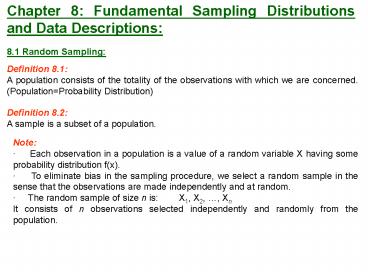
Chapter 8 Fundamental Sampling Distributions and
Data Descriptions 8.1 Random Sampling
Definition 8.1 A population consists of the
totality of the observations with which we are
concerned. (PopulationProbability Distribution)
Definition 8.2 A sample is a subset of a
population.
Note Each observation in a population is a
value of a random variable X having some
probability distribution f(x). To eliminate
bias in the sampling procedure, we select a
random sample in the sense that the observations
are made independently and at random. The
random sample of size n is X1, X2, , Xn
It consists of n observations selected
independently and randomly from the population.
2
8.2 Some Important Statistics Definition
8.4 Any function of the random sample X1, X2, ,
Xn is called a statistic.
3
(No Transcript)
4
Example 8.1 Reading Assignment Example 8.8
Reading Assignment Example 8.9 Reading
Assignment
5
(No Transcript)
6
(No Transcript)
7
Example 8.13 An electric firm manufactures light
bulbs that have a length of life that is
approximately normally distributed with mean
equal to 800 hours and a standard deviation of 40
hours. Find the probability that a random sample
of 16 bulbs will have an average life of less
than 775 hours.
8
(No Transcript)
9
(No Transcript)
10
(No Transcript)
11
(No Transcript)
12
Example 8.15 Reading Assignment
Example 8.16 The television picture tubes of
manufacturer A have a mean lifetime of 6.5 years
and standard deviation of 0.9 year, while those
of manufacturer B have a mean lifetime of 6 years
and standard deviation of 0.8 year. What is the
probability that a random sample of 36 tubes from
manufacturer A will have a mean lifetime that is
at least 1 year more than the mean lifetime of a
random sample of 49 tubes from manufacturer B?
Solution Population A Population B
?16.5 ?26.0 ?10.9 ?20.8
n136 n249
13
(No Transcript)
14
(No Transcript)
15
(No Transcript)
16
- Note
- t-distribution is a continuous distribution.
- The shape of t-distribution is similar to the
shape of the standard normal distribution.
17
Notation
- t ? The t-value above which we find an area
equal to ?, that is P(Tgt t ?) ? - Since the curve of the pdf of T t(?) is
symmetric about 0, we have - t1 ? ? ? t ?
- Values of t? are tabulated in Table A-4 (p.683).
18
Example Find the t-value with ?14
(df) that leaves an area of (a)
0.95 to the left. (b) 0.95 to the
right.
Solution ? 14 (df) T t(14) (a) The
t-value that leaves an area of 0.95 to the left
is t0.05 1.761
19
(b) The t-value that leaves an area of 0.95 to
the right is t0.95 ? t 1 ? 0.95 ? t
0.05 ? 1.761
20
Example For ? 10 degrees of freedom (df), find
t0.10 and t 0.85 .
Solution t0.10 1.372 t0.85 ? t1?0.85 ? t
0.15 ?1.093 (t 0.15 1.093)
Recommended

