

Chapter 10 Perfect Competition PowerPoint PPT Presentation
1 / 15
Title: Chapter 10 Perfect Competition
1
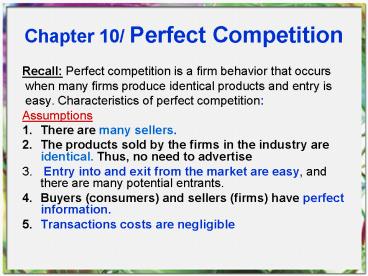
Chapter 10/ Perfect Competition
- Recall Perfect competition is a firm behavior
that occurs - when many firms produce identical products and
entry is - easy. Characteristics of perfect competition
- Assumptions
- There are many sellers.
- The products sold by the firms in the industry
are identical. Thus, no need to advertise - Entry into and exit from the market are easy,
and there are many potential entrants. - Buyers (consumers) and sellers (firms) have
perfect information. - Transactions costs are negligible
2
Profit Maximization Price Taker
- Profit is maximized when MRMC.
- If the cost of producing one more unit is less
than the revenue it generates, then profit is
available for the firm that increases production
by one unit OR if MC - If the cost of producing one more unit is more
than the revenue it generates, then increasing
production reduces profit. - Thus the firm will stop increasing production at
the point at which it stops being profitable to
do sowhen MRMC. - Graphically, this occurs where the MC curve cross
the MR curve from below. - Price Taker
- A firm in a perfectly competitive market is a
price taker because (a) the price of the product
is determined by market supply and demand
Industry, and (b) the individual firm can do
nothing to change that price. - The result is that the individual firm perceives
the demand curve for its product as being
perfectly horizontal. Thus, P MR horizontal
demand with
3
Market Supply and Demandand Single-Firm Demand
Price Taker
4
Profit MaximizationGraphical Analysis
? (P-ATC) x Q (1.00 0.87)9 1.17 Profit
5
Profit Maximization The Numbers
MRMC
6
Determining Profit or Loss
- MRMC is the profit-maximizing or loss-minimizing
output level. This rule is true regardless of
market structure (under PC, Monopoly,
Monopolistic Comp and Oligopoly) - Profit or loss is determined by finding the
quantity at which the marginal-revenue curve
equals the marginal-cost curve (i.e. MR MC) - If the demand curve (PdMR) is above the ATC
curve, the firm is making a profit. If the ATC
curve exceeds the price line, the firm is
suffering a loss.
7
Loss Minimization
Average cost of a unit of output
Market price falls
Revenue generated by a unit of output
At P2 0.70, p (P ATC) x Q (0.70 0.87) 6
-1.02 loss
8
Shutdown Price
- Minimizing Loss
- Shutdown price the minimum point of the
average-variable-cost (AVC) curve. - Break-even price A price that is equal to the
minimum point of the average-total-cost (ATC)
curve. At this price, economic profit is zero. - Recall MC above the minimum AVC is the firms
Supply Curve (S)
ATC AVC AFC
9
The Long Run
- The short run is a timeframe in which at least
one of the factors is fixed Q f (L,K) where K
is fixed. - Exit and entry are long-run phenomena.
- In the long run, all quantities of
resources/factors/inputs can be changed, Q f
(L, K) - Normal Profit in the Long Run
- Entry and exit occur whenever firms are earning
more or less than normal profit (zero economic
profit). - If firms are earning more than normal profit,
other firms will have an incentive to enter the
market Entry - If firms are earning less than normal profit,
firms in the industry will have an incentive to
exit the market Exit
10
Economic Profit in the Long Run
At P1.50, p (P-ATC) x Q (1.50-1.00) x10 5
-ENTRY
Entry
S2
S3
11
The Predictions of the Model of Perfect
Competition
- A zero economic profit (p0 )is a normal
accounting profit, or just normal profit. - Firms produce where marginal cost equals price
(PMC) - No one could be made better off without making
someone else worse off. Economists refer to this
result as economic efficiency or Pareto
efficiency.
12
Consumer Welfare Producer Surplus
- Definition of welfare
- Most people welfare government payments to
poor people - Economists welfare well-being of various
groups such as consumers and producers - Consumer surplus the difference between what the
consumers would have been willing and able to pay
for a product and the price they actually have to
pay to buy the product. We measure consumer
welfare in dollars - Easier to measure than utility
- Can compare dollars across individuals
- Measuring Consumer Welfare (CS) CS from a good
- Benefit a consumer gets from consuming it (in )
minus its price OR - How much more you would be willing to pay than
you did pay for a good - The demand curve contains this information
- The demand curve reflects a consumers marginal
willingness to pay --- the amount a consumer
will pay for an extra unit.
13
Consumer and Producer Surplus
- Producer surplus the difference between the
price firms would have been willing and able to
accept for their products and the price they
actually receive for them. - Measurement -- suppliers gain from participating
in a market - Difference between the amount for which good
sells and the minimum necessary for the seller to
produce the good OR - Minimum amount a seller must receive to be
willing to produce is the firms avoidable cost
(shut-down rule), i.e. above where P AVC
14
Producer and Consumer Surplus
15
Rent Control and Market Efficiency
Recommended

