

Ab initio Calculations of Interfacial Structure and Dynamics in Fuel Cell Membranes PowerPoint PPT Presentation
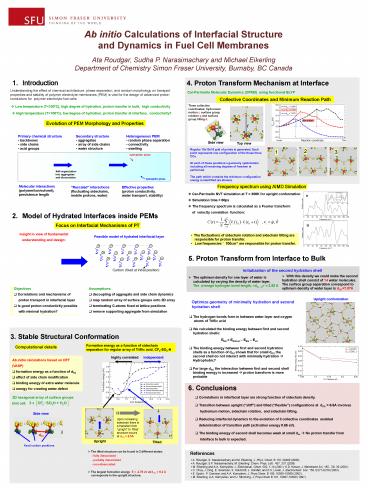
Title: Ab initio Calculations of Interfacial Structure and Dynamics in Fuel Cell Membranes
1
Ab initio Calculations of Interfacial Structure
and Dynamics in Fuel Cell Membranes Ata
Roudgar, Sudha P. Narasimachary and Michael
Eikerling Department of Chemistry Simon Fraser
University, Burnaby, BC Canada
1. Introduction
4. Proton Transform Mechanism at Interface
Understanding the effect of chemical
architecture, phase separation, and random
morphology on transport properties and stability
of polymer electrolyte membranes (PEM) is vital
for the design of advanced proton conductors for
polymer electrolyte fuel cells.
Car-Parrinello Molecular Dynamics (CPMD) using
functional BLYP
Collective Coordinates and Minimum Reaction Path
Three collective coordinates hydronium motion r,
surface group rotation j and surface group
tilting q.
- Low temperature (Tlt100C), high degree of
hydration, proton transfer in bulk, high
conductivity
- High temperature (Tgt100C), low degree of
hydration, proton transfer at interface,
conductivity?
DE 0.55eV
Evolution of PEM Morphology and Properties
q
Side view
Top view
Regular 10x10x10 grid of points is generated.
Each point represents one configuration of the
these three CCs. At each of these positions a
geometry optimization including all remaining
degrees of freedom is performed. The path which
contains the minimum configuration energy is
identified (as shown).
2
1
3
Frequency spectrum using AIMD Simulation
- Car-Parrinello NVT simulation at T 300K for
upright conformation - Simulation time 60ps
- The frequency spectrum is calculated as a
Fourier transform of velocity correlation
function
j
2. Model of Hydrated Interfaces inside PEMs
Focus on Interfacial Mechanisms of PT
q
Insight in view of fundamental understanding and
design
- The fluctuations of sidechain rotation and
sidechain tilting are responsible for proton
transfer. - Low frequencies 100cm-1 are responsible for
proton transfer.
Feasible model of hydrated interfacial layer
5. Proton Transform from Interface to Bulk
Initialization of the second hydration shell
- With this density we could make the second
hydration shell consist of 14 water molecules.
The surface group separation correspond to
optimum density of water layer is dCC7.07Å
- The optimum density for one layer of water is
calculated by varying the density of water
layer. The average hydrogen bond length,
ltdOOgt 2.92 Å
- Objectives
- Correlations and mechanisms of
- proton transport in interfacial layer
- Is good proton conductivity possible
- with minimal hydration?
- Assumptions
- decoupling of aggregate and side chain dynamics
- map random array of surface groups onto 2D array
- terminating C-atoms fixed at lattice positions
- remove supporting aggregate from simulation
Upright conformation
Optimize geometry of minimally hydration and
second hydration shell
- The hydrogen bonds form in between water layer
and oxygen atoms of Triflic acid - We calculated the binding energy between first
and second hydration shells - Ebin ESGwl
ESG Ewl - The binding energy between first and second
hydration shells as a function of dCC shows
that for small dCC the second shell do not
interact with minimally hydration ?
Hydrophobic? - For large dCC the interaction between first and
second shell binding energy is increased ?
proton transform is more probable
3. Stable Structural Conformation
Formation energy as a function of sidechain
separation for regular array of Triflic acid,
CF3-SO3-H
Computational details
independent
highly correlated
- Ab initio calculations based on DFT (VASP)
- formation energy as a function of dCC
- effect of side chain modification
- binding energy of extra water molecule
- energy for creating water defect
6. Conclusions
- Correlations in interfacial layer are strong
function of sidechain density. - Transition between upright (stiff) and tilted
(flexible) configurations at dCC 6.5Å
involves hydronium motion, sidechain
rotation, and sidechain tilting. - Reducing interfacial dynamics to the evolution
of 3 collective coordinates enabled
determination of transition path (activation
energy 0.55 eV). - The binding energy of second shell becomes weak
at small dcc ? No proton transfer from
interface to bulk is expected.
2D hexagonal array of surface groups
Unit cell
Side view
Upon increasing sidechain there is a transition
from upright to tilted structure occurs at
dCC 6.5Å
dCC
Upright
Tilted
fixed carbon positions
- The tilted structure can be found in 3 different
states - - fully dissociated
- - partially dissociated
- - non-dissociated
- The largest formation energy E -2.78 eV at
dCC 6.2 Å corresponds to the upright
structure.
References
- A. Roudgar, S. Narasimachary and M. Eikerling,
J. Phys. Chem. B 110, 20469 (2006). - A. Roudgar, S.P. Narasimachary, M. Eikerling
.Chem. Phys. Lett. 457, 337 (2008) - M. Eikerling and A.A. Kornyshev, J. Electroanal.
Chem. 502, 1-14 (2001). K.D. Kreuer, J. Membrane
Sci. 185, 29- 39 (2001). - C. Chuy, J. Ding, E. Swanson, S. Holdcroft, J.
Horsfall, and K.V. Lovell, J. Electrochem. Soc.
150, E271-E279 (2003). - E. Spohr, P. Commer, and A.A. Kornyshev, J.
Phys.Chem. B 106, 10560-10569 (2002). - M. Eikerling, A.A. Kornyshev, and U. Stimming,
J. Phys.Chem.B 101, 10807-10820 (1997).
Recommended

