

INTRODUCTION TO CHEMICAL BONDING PowerPoint PPT Presentation
1 / 24
Title: INTRODUCTION TO CHEMICAL BONDING
1
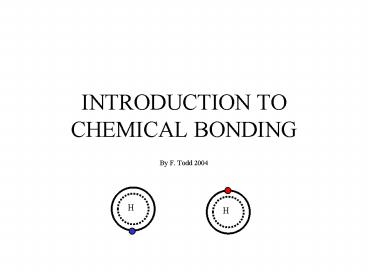
INTRODUCTION TO CHEMICAL BONDING
- By F. Todd 2004
2
1. WHERE ARE ELECTRONS PLACED IN AN ATOM?
- IN THE ELECTRON CLOUD WHICH SURROUNDS THE NUCLEUS
3
- A. ELECTRON CLOUD
- 1. THE CLOUD GIVES THE ATOM ITS
- BASIC SHAPE
- 2. IT GIVES THE ATOM ITS CHEMICAL PROPERTIES.
4
http//www.phschool.com/atschool/sci_exp_lep/physi
cal_science/Student_Area/PS_S_CHAP4_index.html
5
- B. ENERGY LEVELS
- They are layers in the electron cloud where the
electrons are located. - Level 1 holds 2 electrons K shell
- Level 2 holds 8 electrons L shell
- Level 3 holds 18 electrons M shell
- The outer most energy level is called the valence
energy level. THE VALENCE LEVEL CANNOT HOLD MORE
THAN 8 ELECTRONS
6
2. WHAT IS A MOLECULE?
- 1. SMALLEST PARTICLE OF A COMPOUND THAT HAS ALL
THE PROPERTIES OF THAT COMPOUND
7
3. WHAT IS A CHEMICAL BOND?
- 1. ATTACHMENT BETWEEN TWO ATOMS THAT JOIN THEM
TOGETHER - 2. THE ATOMS ARE HELD TOGETHER THROUGH EITHER A
SHARING OR TRANSFER OF ELECTRONS. - 3. ELECTRICAL ATTRACTIONS BETWEEN THE ATOMS HOLD
THEM TOGETHER IN A CHEMICAL BOND.
8
4. WHAT IS A STABLE ATOM?
- 1. ATOMS WHOSE VALENCE ENERGY LEVEL IS COMPLETE
OR FILLED WITH THE MAXIMUM NUMBER OF ELECTONS IT
CAN HOLD.
9
DO HAPPY/SAD ATOM WORKSHEET NOW.
10
5. WHAT ATOMS COMBINE?
- 1. ATOMS THAT COMBINE ARE LOOKING TO HAVE THEIR
VALENCE ENERGY LEVEL COMPLETE. - 2. DIATOMIC MOLECULES MOLECULES MADE OF ONLY 2
ATOMS - Ex. H2, O2, HF
11
Covalent Bonding 1. What is a covalent Bond?
- Attraction between atoms created as a result of
atoms sharing valence electrons. - This bond is usually formed between nonmetals
- In this bond, both atoms attract the shared
electrons at the same time. - Example H2, (ball example), Cl2, H2O
12
2. FORMING A COVALENT BOND -WATER MOLECULE
EXAMPLE -Conditions must be right (dance
example) -Both oxygen and hydrogen are
happy/stable
O
13
Electrons spend equal time around both Hydrogen
nuclei
14
- A. POLAR COVALENT BOND- Unequal sharing of
electrons (H2O, HF)
Electrons spend more time around the Fluorine
nuclei. Gives Hydrogen a slight charge and
Fluorine a slight - charge
15
IONIC Bonding 1. What is an Ionic Bond?
- Attraction between charged atoms called ions that
is created when valence electrons are
transferred between atoms. - This bond is usually formed between a metal and a
nonmetal. - Ion an atom or group of atoms that have become
electrically charged by gaining or losing
electrons. - Example NaCl, CaCl2,
16
2. FORMING AN IONIC BOND -NaCl EXAMPLE
Chlorine receives the 1 electron And becomes a -1
ion.
Sodium transfers 1 electron And becomes a 1 ion.
-1
1
Cl
OPPOSITE CHARGES ATTRACT!!!!
--Both Sodium and Chlorine are happy/stable
17
(No Transcript)
18
http//www.phschool.com/atschool/sci_exp_lep/physi
cal_science/Student_Area/PS_SC4_ACT_index.html
19
WATER
- Water is a compound molecule.
- Formula H2O
- Water molecules have oppositely charged ends.
This makes water a polar molecule. - Held together by a polar covalent bond.
20
- Water is cohesive Water molecules stick to each
other by hydrogen bonds
21
- These hydrogen bonds are very important.
- Allows water to freeze at 32oF (0oC)
- Allows water to boil at 212oF (100oC)
- If water did NOT have these hydrogen bonds it
would make life impossible. - Water would boil at -112oF (-80oC)
- Water would freeze at -148oF (-100oC)
22
- This cohesive property can create a rubbery
skin on the surface called surface tension.
23
- Water is adhesive Water molecules stick to
other substances by hydrogen bonds.
24
(No Transcript)
Recommended

