

Guidance and Workshops on Aggregate and Cumulative Assessments PowerPoint PPT Presentation
1 / 1
Title: Guidance and Workshops on Aggregate and Cumulative Assessments
1
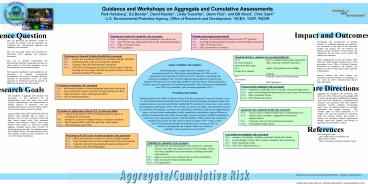
Guidance and Workshops on Aggregate and
Cumulative Assessments Rick Hertzberg1, Ed
Bender2, David Klauder2, Linda Teuschler1, Glenn
Rice1, and Bill Wood1, Chris Saint3 U.S.
Environmental Protection Agency, Office of
Research and Development, 1NCEA, 2OSP, 3NCER
Impact and Outcomes
Science Question
How can theoretical and laboratory research be
developed into feasible tools and approaches for
conducting and communicating aggregate and
cumulative risk assessment? How can assessment
models and procedures be harmonized across
aggregate and cumulative assessments? How can
we quantify environmental and physiological
interactions in aggregate exposures to a single
chemical so that those interactions can be
incorporated into risk assessment guidance? How
important qualitatively and quantitatively are
interactions- in transport, environmental
transformation, and toxicity of multiple
chemicals, especially at environmental levels?
Can tiered approaches be developed to assist risk
assessors in addressing interactions only when
needed?
Development and communication of practical
methods for conducting aggregate and cumulative
risk assessment, in the form of risk assessment
guidance and training, not only improves the
dialogue between researchers, decision makers and
stakeholders, but also leads to more accurate and
complete risk estimation. ORDs supplementary
mixture risk guidance (EPA 2000) and related
training workshops led to ORD participation in
the Office of Pesticide Programs development of
cumulative risk guidance, and inclusion of ORDs
relative potency factor approach in that
guidance. Previous criticism that EPAs mixture
risk assessments ignored synergism and antagonism
is now solved by ORDs interaction-based Hazard
Index (EPA 2000).
Chemical mixtures guidance for assessing health
risks What how to evaluate mixtures data,
approaches for whole mixtures, index chemicals
methods for groups, interactions data usage Why
update 1986 guidelines for multiple chemicals
to enhance methods Who National Center
for Environmental Assessment When 2000
(guidance)
Future Directions
Research Goals
Aggregate and cumulative risk assessments, both
fairly new to EPA, will push toward a paradigm
shift in Agency risk management. Shifting from
traditional source based risk assessments to
population based cumulative risk assessments (EPA
2003) addresses community concerns, including
environmental justice issues, of combined impacts
on susceptible communities from multiple
exposures. Risk estimates made for whole
communities or for complex sites have the
potential for tremendous health and economic
impacts thus research to improve risk assessment
methods, harmonization through Agency-wide
guidance, and training on application of such
methods is critical.
The complexity of aggregate and cumulative risk
assessments is best approached by an
interdisciplinary team that ranges from bench
scientists, epidemiologists and mathematicians to
frontline enforcers of regulations. ORD has
stimulated that activity by two main vehicles
agency risk assessment guidance and open
workshops. Agency guidance from ORD is usually
either focused guidance from individual labs or
centers, or guidelines from the Risk Assessment
Forum that form Agency science policy. Risk
assessment guidance often addresses complex
issues using methods based mainly on structured
scientific judgment, including science policy
decisions for default approaches and values. By
including Program and Regional Offices in the
authorship and review, ORD guidance usually has
broad concurrence and covers wide ranges of
application.
Workshop on Application of dioxin TEFs to fish
and wildlife What evaluate uncertainties in
TEF development and their impact in ecological
risk assessments Why animals are exposed to
complex mixtures of dioxins and furans Who
EPA Regional Offices and ORD, and Dept. of the
Interior When 1998 (workshop report 2001)
References
Risk Assessment Forum http//cfpub.epa.gov/ncea/r
af/index.cfm Office of Science Policy http//www.
epa.gov/osp/regions/cumrisk_rep.pdf
Workshop on STAR Grants- Session on mixtures risk
assessment What public presentations on
Science To Achieve Results Program Why foster
exchange between EPA scientists and STAR grant
recipients Who National Center for
Environmental Research and Region III When
October 28-29, 2004, Philadelphia
Guidelines for cumulative risk assessment What
approaches for assessing multiple route
exposures to chemical mixtures and
other non-chemical stressors from multiple
sources over
time population-based assessments, including
vulnerable
subpopulations Why address concerns about
combined risks in urban communities Who Risk
Assessment Forum Technical Panel When 2012
(guidelines)
Recommended

