

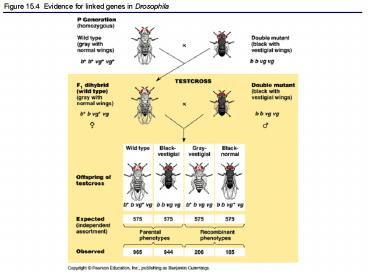
Figure 15.4 Evidence for linked genes in Drosophila PowerPoint PPT Presentation
1 / 22
Title: Figure 15.4 Evidence for linked genes in Drosophila
1
Figure 15.4 Evidence for linked genes in
Drosophila
2
Drosophila testcross
3
Figure 15.5a Recombination due to crossing over
4
Figure 15.5b Recombination due to crossing over
5
Figure 15.6 Using recombination frequencies to
construct a genetic map
6
Figure 15.7 A partial genetic map of a
Drosophila chromosome
7
Linkers
Balancers
8
Why Caenorhabditis elegans?
mouth
ovary
tail
oocyte
intestine
ovary
pharynx
intestine
oocytes
embryos
embryos
spermatheca
spermatheca
vulva
Short life cycle embryo to adult stage in 2.5
days
Transparent easy to observe the cells at
different stages of development.
Very small large number of worms can be grown
in a small Petri dish. (Adult worm is about 1
mm-long.)
Hermaphrodite both sperm and egg in a single
worm
9
Why Caenorhabditis elegans?
mouth
ovary
tail
oocyte
intestine
ovary
pharynx
intestine
oocytes
embryos
embryos
spermatheca
spermatheca
vulva
Simple anatomy 959 cells in hermaphrodites,
1031 in males
Small genome 97 Mb
Complete genome sequence first multicellular
organism to be sequenced
Reverse genetics RNA-mediated interfeence (RNAi)
10
The life cycle of Caenorhabditis elegans
adult hermaphrodite
10 hours
embryo
L4
13 hours
L1
25 hours
L2
9 hours
L3
8 hours
11
Sex determination in C. elegans
XX hermaphrodites XO males XO situation
arises by rare non-disjunction involving the X
chromosome Males can mate the hermaphrodites.
Cross progeny are usually 50 males and 50
hermaphrodites.
12
Lineage Analysis
John Sulston
13
Laser ablation Lineage analysis
- Lineage information is very useful to analyze the
phenotypes of mutants can describe
developmental defects with single cell
resolution. - Cell-cell interaction
- Developmental potentials of a single cell
- Time of commitment
14
Example The lineage of the vulva
15
Example The lineage of the vulva
16
Mutant isolation
- Self-fertilization allows quick recovery of
recessive mutations - The number of chromosome sets screened is twice
the number of F1progeny
- Ethyl methane sulfonate (EMS)
- 1 in 2000 gametes exposed to 50 mM EMS will carry
mutation in - an average gene
- Screening 10,000 gametes is usually sufficient to
recover most common loss-of-function mutations.
Suggested readings 1. Nature Reviews Genetics
vol.3, starting page 356 (2002) 2. I will put up
another article at the website soon.
17
Mutant isolation
Aim To identify genes involved in vulva formation
EMS
/
P0
Self
m/
F1
Self
F2
m/m
m/
/
Look for bags of worms
18
Mutant isolation
- By the above method, over 100 mutants were
identified. - Two general classes of phenotypes
- Multivulva (Muv)
- Vulvaless (Vul)
- Complementation
- The 100 mutants represent 20 different genes.
19
Mutant isolation
Detailed observation of the mutants using
Nomarski optics
20
Dominant mutations
- Inferring functions of dominant mutations are not
easy. - This will require further experiments to
determine the type of mutation for example,
dominant mutations can be any one of the
following three types - Hypermorphic
- Neomorphic
- Antimorphic
- Usually, isolation of recessive loss-of-function
alleles also will be required.
21
Cloning genes by mutation
Three steps 1. Correlation of the genetic and
physical maps near the gene of interest 2.
DNA-mediated transformation to identify rescuing
clones 3. Identification of DNA lesions
associated with mutation in gene
22
Cloning genes by mutation Genetic mapping
Two factor analysis
Three factor analysis
Recommended

