

The 5 causes of evolution 5 factors that disrupt HW eq. PowerPoint PPT Presentation
1 / 21
Title: The 5 causes of evolution 5 factors that disrupt HW eq.
1
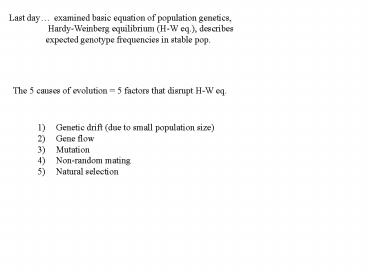
Last day examined basic equation of population
genetics, Hardy-Weinberg equilibrium (H-W eq.),
describes expected genotype frequencies in
stable pop.
The 5 causes of evolution 5 factors that
disrupt H-W eq.
- Genetic drift (due to small population size)
- Gene flow
- Mutation
- Non-random mating
- Natural selection
2
Genetic drift random change of gene frequencies
due to sampling errors in small pops.
- will cause small deviations in larger
population, can cause major changes (e.g.
allele lost) in small pops.
3
- Two specific varieties of drift, other than
usual - Bottleneck Effect Pop. temporarily reduced,
- very small, later increases again
- - by chance, only certain alleles pass through
the - bottleneck
4
e.g. Northern Elephant Seal, Cheetah
5
b) Founder Effect New population founded by
small number of colonists, do not include full
genetic variation of source population
e.g. retinitis pigmentosa on Tristan da Cunha
- in both cases, alleles may be missing or in
higher frequency - than in original population
6
2) Gene flow gene exchange between populations
due to movement of individuals or gametes
- tends to reduce differences between populations,
may - impede local adaptation
Great Tit
7
Streamside Salamanders show weaker anti-predator
adaptations if near fishless populations
8
3) Mutation change from one allele to another
due to replication error, radiation damage, etc.
- relatively rare (1 per locus per 105 106
gametes), - often reversible, so only very small effect by
- itself (but produces variation that other
factors - can work on)
9
4) Non-random mating mating with individuals
that are more similar (or more
different) than expected by chance
tendency to mate with nearby individuals or
even self-fertilize (plants) leads to
inbreeding decreases of heterozygotes
- no effect on allele frequency
- by itself (only genotype
- frequency), but may
- expose alleles to selection
10
5) Natural Selection process by which
particular genotypes consistently increase in
frequency due to their superior adaptation to
the environment (higher fitness)
Fitness relative contribution of a genotype to
the next generation, reflecting its
probability of survival its reproductive
output
11
Most successful variant fitness 1 - others
some proportion lt 1 (0.5, 0.8...)
Fitness is NOT - being physically fit - just
about survival - just about producing lots of
offspring
mayfly
12
Only natural selection can consistently produce
adaptation - most important cause of evolution
Jaguar
13
- Selection acts on pops. in 3 different ways
- Stabilizing selection average individuals
favored, - extremes selected against
14
- tends to maintain status quo, may reduce
variation
- most common form of natural selection,
maintains stability of spp.
15
2) Directional Selection favors individuals at
one extreme, acts against those at other
extreme, shifts curve
- often when environment changes
- - probably most important for
- actually producing evolution
16
(No Transcript)
17
3) Disruptive Selection favors individuals at
both extremes, selects against intermediates
- probably rare unusual to have 2 phenotypes
favored, - and hard to maintain 2 forms when inter-breeding
- e.g. Black-bellied Seedcracker
18
A very different form of selection... Skeptics
asked Darwin how Nat. Select. could account for
bright colors, beautiful songs, etc.
Darwin came up with another form of selection
Sexual Selection process which favors
individuals that have advantage in competition
for mating opportunities
Bluethroat
19
- Two main forms
- Mate choice favors traits that are preferred by
- members of opposite sex when choosing mates
- - e.g. song, bright colors of male birds
Blue Bird-of-Paradise
20
2) Intra-sexual competition favors traits that
give advantage in contests between members of
same sex (usually males) - e.g. large
size, horns
Moose
21
Darwin used sexual selection to explain sexual
dimorphism (differences in form between males
females), but sex. select. can occur in both
sexes
Red-necked Phalaropes
Recommended

