

Orphan Object (Bill) PowerPoint PPT Presentation
Title: Orphan Object (Bill)
1
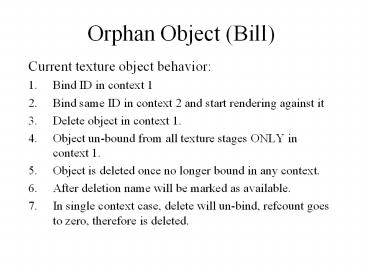
Orphan Object (Bill)
- Current texture object behavior
- Bind ID in context 1
- Bind same ID in context 2 and start rendering
against it - Delete object in context 1.
- Object un-bound from all texture stages ONLY in
context 1. - Object is deleted once no longer bound in any
context. - After deletion name will be marked as available.
- In single context case, delete will un-bind,
refcount goes to zero, therefore is deleted.
2
Orphan Object (Pat)
- Current texture object behavior
- Bind ID in context 1
- Bind same ID in context 2 and start rendering
against it - Delete object in context 1.
- Object un-bound from all texture stages ONLY in
context 1. - Object ID no longer exists. Therefore same ID is
available to create a new object. - Old object is deleted once no longer bound in any
context. (But cannot be referenced by ID anymore) - In single context case, delete will un-bind,
refcount goes to zero, therefore is deleted.
3
GLX 1.3 spec
- The results of changing a texture object while
another context is using it are undefined. - All modifications to shared context state as a
result of executing glBindTexture are atomic.
Also, a texture object will not be deleted until
it is no longer bound to any rendering context. - In general, OpenGL commands are not guaranteed to
be atomic. The operation of glEndList and
glDeleteLists are exceptions modifications to
the shared context state as a result of executing
glEndList or glDeleteLists are atomic.
Recommended

