

What You Should Know PowerPoint PPT Presentation
1 / 16
Title: What You Should Know
1
What You Should Know
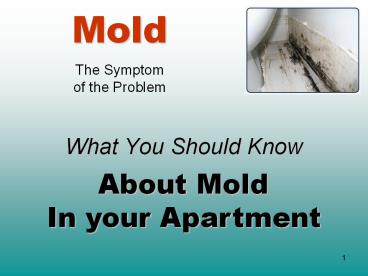
Mold The Symptomof the Problem
About MoldIn your Apartment
2
What Does Mold Need To Grow
Mold can grow at temperatures as low as -94 F
and over 122 F Most thrive at between 64 - 89
F Mold Needs moisture, a food source, and the
right temperature This makes most Apartment
buildings perfect for growing mold.
3
Mold Contamination
The presence of active growth (past or current)
of mold can impact your health If airborne mold
can be inhaled
4
Mold in buildings
Mold has found a great climate and plenty to eat
in apartment buildings Almost no competition or
predators Some types are very common indoors,
Cladosporium, Stachybotrys, Penicillium,
Aspergillus
5
How Can You Be Exposed?
- Breathing in spores from the air
- When dried mold in fabric or dust is stirred up
in your apartment. - Skin contact from handling an item that has mold
growing on it. - A tree branch, Leaves, yard tool, damp towel
- Eating without washing your hands after handling
moldy objects - Handling a pet that has been outside
- Handling the clothing of a child that has been
playing in the leaves outside. - Sticking your fingers in your mouth (smoking)
during mold cleanup or handling moldy materials.
6
Health Effects of being exposed to Mold
Allergic reaction by far the most common,
inhalation of spores or touching Asthma mold
spores can trigger or make asthma worse
Hypersensitivity pneumonitis develop after
acute or chronic exposure Opportunistic
infections invasion into an immunocompromised
host Mycotoxic fungal poisons, only anecdotal
evidence for humans Glucans Organic Dust
Toxic Syndrome (ODTS) flu-like symptoms
7
Your Landlord?
Moisture is the problem, Mold is the
symptom REPORT ALL WATER LEAKS or DAMAGE to your
landlord, or you might be responsible for the
mold damage after you move. Check for visible
water damage and report it! Look for hidden
water damage in closets, pantries, cupboards and
report it. Look for signs of Trapped Moisture,
when you move in and report it. Is the
moisture from the apartment next door or above
you? Insist on testing when Red Flags are
present
8
Sick Buildings!
- Is Your Building Sick?
- "Sick" buildings can make people sick
- Remember,
- Mold is a symptom of a moisture problem
- The Key to fungal growth is moisture!
- Moisture can be caused by
- Poor building maintenance
- Unreported leaks, (1 Cause for apartment mold)
- Leaky siding
- Moisture under the building, from bad or plugged
gutters. - Poor ventilation in bathroom or kitchen
- Wet Clothing, or laundry
- House Plants
- Pets that have the freedom to enter and leave.
9
Where is mold found?
- Front and back side of drywall
- Kitchens, Bathrooms
- Behind baseboard heaters,
- Behind furniture pressed against outside walls.
- In and under vinyl flooring, in carpet padding.
- Piles of damp or wet clothing
- Around or under house plants
- Around shaded stairways
- On sidewalks, and siding
- In Apartments
- Your mold problem could be a problem your
neighbor has.
10
Mold and Vinyl Siding
Unlike wood and masonry, vinyl siding presents
its own breed of maintenance worries. Moisture
trapped beneath the vinyl siding will accelerate
rot, promote mold and mildew, and invite insect
infestations. Roof leaks, faulty gutters, or
other sources of moisture should be repaired
without delay. Vinyl siding may not be a wise
option for older buildings with moisture
problems. http//architecture.about.com/cs/repair
remodel/a/vinyl.htm
11
Reasons for Testing
- Visible mold velvety, slimy, white, black,
green, pink, smelly - Construction defects plumbing problems, improper
venting or grading around the building. - Human sensitivity
- itchy eyes,
- burning sensation on skin,
- musty odor,
- change in breathing pattern reported by occupant
or visitors? - If you or your doctor suspect your symptoms are
fugal/mold related, call your landlord / public
housing authority and insist on a test. Do not
be intimidated and report and manipulation or
threats made by your landlord or maintenance
department to your local housing authorities or
the Housing and Urban Development field office. - http//www.hud.gov/localoffices.cfm
12
Should You! Have Your Unit Tested?
For Toxic Mold?
According to the EPA, indoor levels of many
pollutants are two to five times higher than
outdoor levels. With more than 90 of our time
spent indoors, these indoor pollutants can have a
significant impact on our lives. Mold spores,
dust mites, pollens, gases and a host of other
pollutants can be found in the cleanest of homes.
Low-income Housing Subpart G--Physical Condition
Standards (HUD) (f) The housing must have no
evidence of electrical hazards, natural hazards,
or fire hazards. The dwelling units and common
areas must have proper ventilation and be free of
mold, odor (e.g., propane, natural gas, methane
gas), or other observable deficiencies.
13
What Can You Do?
Places that are often or always damp can be hard
to maintain completely free of mold. If there's
some mold in the shower or elsewhere in the
bathroom that seems to reappear, increasing
ventilation (running a fan or opening a window)
and cleaning more frequently will usually prevent
mold from recurring, or at least keep the mold to
a minimum.
14
What Can You Do?
Cleaning the Mold If the surfaces you are
cleaning are dry, or mostly dry, you should
lightly mist them with water before cleaning the
mold. If the mold is too dry, then the mold
spores will have a much better chance of becoming
airborne while being disturbed during the
cleaning process. Once the surface is lightly
misted (if necessary), then clean the affected
area(s) with soap to remove as much of the mold
as possible, and then apply a disinfectant to
kill mold spores that are left behind. Thoroughly
clean all surfaces in the area that contain
visible mold, and even surfaces that do not have
visible mold, since mold spores are microscopic
very durable, and can remain dormant for months
or even years. Once a surface has been cleaned
and disinfected, it should be completely
dried. In which case, if mold spores are left
behind, and are introduced to moisture again in
the future, then you will have another
significant mold growth problem on your hands.
15
Mold Disinfectants
- Mold Disinfectants
- Remember, disinfectants are used AFTER the
visible mold is scrubbed off with soap. - Most common for the average person
- Hypochlorites (Chlorox Bleach)
- Bactericidal, Virucidal, Fungicidal, Sporicidal
(prolonged contact time required), and
Tuberculocidal. Use a diluted concentartion of
110 .Advantages - inexpensiveDisadvantages -
bleaching agent, toxic, corrosive, inactivated by
organic matter removes color from many interior
fabrics dissolves protein fibers (i.e. wool,
silk) has not shown to be effective against
stachybotrys spores. - Hydrogen Peroxide
- Bactericidal, Virucidal, Fungicidal, Sporicidal
(prolonged contact time required), and
Tuberculocidal. Use a diluted concentration of 3
or greater.Advantages - Relatively
stableDisadvantages - corrosive, expensive,
degrades in heat or UV light
16
Resources
http//www.epa.gov/ Additional
Resources Allergy Asthma Network/Mothers of
Asthmatics (AAN/MA) (800) 878-4403
www.aanma.org American Academy of Allergy,
Asthma Immunology (AAAAI) www.aaaai.org
American Lung Association 1-800-LUNG-USA
(1-800-586-4872) www.lungusa.org Asthma
Allergy Foundation of America (800) 7ASTHMA
www.aafa.org National Institute of Allergy
and Infectious Diseases www.niaid.nih.gov
National Jewish Medical and Research Center
(800) 222-LUNG (5864) www.njc.org
Recommended

