

KINDGOM Protista PowerPoint PPT Presentation
Title: KINDGOM Protista
1
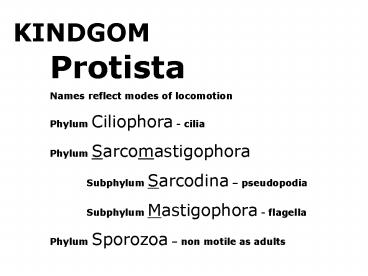
KINDGOM Protista Names reflect modes of
locomotion Phylum Ciliophora - cilia Phylum
Sarcomastigophora Subphylum Sarcodina
pseudopodia Subphylum Mastigophora - flagella
Phylum Sporozoa non motile as adults
2
Protista Facto!
- Protists are usually unicellular, but can be
colonial - Can colonize just about any moist environment
- Autotrophs (PHS), heterotrophs (phagocytosis),
parasitic (malaria) even symbionts (termite
zooflagellates mutualistic relationship) - Reproduce asexually by binary fission or by
budding - Reproduce sexually by conjugation or by syngamy
(gametes)
3
Phylum Ciliophora
Paramecium conjugating (sexual reproduction
controlled by the micronucleus (cant see!),
macronucleus (A)
4
Phylum Sarcomastigophora Subphylum
Sarcodina Foramnifera
Generally benthic they live here!
CHAMBERED, (shells bubbles) CaCO3 tests
(skeletons), extend pseudopodia through pores.
5
Phylum Sarcomastigophora Subphylum
Sarcodina Radiolaria (round)
Generally pelagic they live here!
SPHERICAL bodies, silica tests (skeletons),
extend pseudopodia through the tiny holes in the
shell
6
Phylum Sporozoa
Plasmodium vivax - blood parasite that causes
Malaria. Adults are non-motile.
Recommended

