

Photosynthesis PowerPoint PPT Presentation
1 / 36
Title: Photosynthesis
1
Photosynthesis
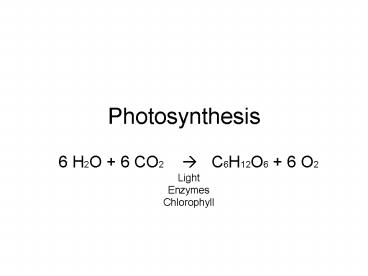
- 6 H2O 6 CO2 ? C6H12O6 6 O2
- Light
- Enzymes
- Chlorophyll
2
Review.
- Autotrophs (producers)
- Photoautotrophs
- Chemoautotrophs
- Heterotrophs (consumers)
3
Sunlight as an energy source.
- Sunlight is a form of radiant energy (travels in
waves) - Electromagnetic Spectrum
- Range of different types of radiant energy
- One portion is the Visible Light Spectrum
- 380-750 nm
- Contains colored light of different wavelengths
- Light is absorbed by special pigments in
chloroplast
4
Electromagnetic Spectrum
5
Pigments
- Molecules responsible for gathering suns energy
- Chlorophyll
- Green pigments
- Two types a b
- Absorb mostly blue and red light, reflect green
- Carotenoids (ie carotene)
- Red and orange pigments
- Absorb light in other regions of spectrum
- Xanthophylls and Anthocyanins
- Red, purple, brown
6
(No Transcript)
7
(No Transcript)
8
- Light is a form of energy, so any compound
(pigment) that absorbs light also absorbs the
energy of the light - When chlorophyll absorbs light, the energy is
transferred directly to electrons in chlorophyll,
which raises the energy level of the electrons
9
Plants are specialized for photosynthesis..
- Photosynthesis primarily takes place in leaves
- Leaf cells contain chloroplasts
- Chloroplasts contain chlorophyll chromoplasts
(contain carotenoids)
10
Cross Section of a Leaf
- Palisade layer
- Spongy layer
- Upper and lower epidermis
- How does the structure of the leaf match the
function of the leaf?
11
(No Transcript)
12
(No Transcript)
13
Structure of a Chloroplast
How is a chloroplast like a to-go order from
IHOP?
14
Photosynthesis Overview
- Photosynthesis takes place in 3 steps
- 1. Sunlight energy is captured
- 2. Light Dependent Reactions
- Light energy is converted to chemical energy (ATP
and NADPH) - 3. Light Independent Reactions (Calvin Cycle)
- ATP and NADPH power the synthesis of organic
molecules, using carbon from carbon dioxide
15
Elodea Demo
16
Chloroplast structure
Click to view animation.
17
Concept Map
Section 8-3
Photosynthesis
includes
takes place in
uses
use
take place in
to produce
to produce
of
Go to Section
18
How do the high energy electrons get transported
to different parts of the cell?
- Special carrier molecules transport electrons
(and the energy they contain) from chlorophyll to
other parts of the cell/chloroplast - Example NADP
- Accepts and holds 2 high energy electrons along
with a H ion - NADP ? NADPH
- NADPH contains sunlight energy trapped in
chemical form (as part of electrons)
19
Now we have two high energy molecules that will
be produced and used in photosynthesis..
- ATP (converted from ADP, contains high energy
bond between second and third phosphate groups) - NADPH (converted from NADP, contains high energy
electrons and a H ion)
20
Light Dependent Reactions
- Photosystems
- Clusters of pigments (chlorophyll carotenoids)
embedded within thylakoid membranes of
chloroplasts - 2 Types
- Photosystem I absorb light with a wavelength of
700 nm - Photosystem II absorb light with a wavelength of
680 nm
21
Reaction Center
- Molecules of chlorophyll a within a photosystem
where electrons are excited (boosted to higher
energy levels) after being hit with the right
amount of energy from a photon strike (sunlight)
22
Photosystem II
- First to act during light reactions
- Responsible for production of ATP
- 1. Photons of light strike a chloroplast and are
absorbed by P.S. II molecules - 2. Electrons from reaction center are excited
- 3. Excited electrons leave chlorophyll molecule
and jump to next membrane protein
23
- 4. Water molecule is split, replacing the
electrons lost by Photosystem II - H atoms (protons) used later
- O atoms immediately join to form O2 gas
(byproduct) - 5. Excited electron passed through electron
transport chain (ETC) a series of membrane-bound
protein and pigment molecules in thylakoid
membrane - 6. Energy from electrons fuels ATP production
- One ETC molecule is a proton pump uses energy of
electrons to pump protons into thylakoid space
24
- -protons build up inside thylakoid until the
pressure drives them through a specific protein
channel ATP synthase - -Chemiosmosis making ATP by forcing protons
through a membrane channel - -ATP is released into stroma of chloroplast to
be used in Calvin Cycle to make sugars
25
Photosystem I
- 1. Electrons in Photosystem I are excited
- 2. Excited electrons leave reaction center and
are accepted by a membrane protein - 3. Electrons from Photosystem II travel through
ETC to Photosystem I. - Electrons are low in energy now, replace the
electrons that have been lost from P.S. I from
sunlight
26
- 4. Excited electrons from P.S. I travel along
another ETC to a special protein in membrane that
adds hydrogens carrying high energy electrons to
NADP - 5. NADP ? NADPH and is released into the stroma
of chloroplast to be used in production of
organic molecules - NADPH still contains energy from photon strike
27
Photosystems work together..
- NADPH not produced from the action of Photosystem
I alone - Electrons continually passed from Photosystem II
to Photosystem I, which then passes electrons to
NADPH - Photosystem II electrons are replaced by
electrons extracted from the splitting of water
28
Light Dependent Reactions
Hydrogen Ion Movement
Chloroplast
Photosystem II
ATP synthase
Inner Thylakoid Space
Thylakoid Membrane
Stroma
Electron Transport Chain
Photosystem I
ATP Formation
29
Noncyclic pathway of ATP and NADPH formation
Click to view animation.
30
Cyclic pathway
Click to view animation.
31
Light Independent ReactionsCalvin-Benson Cycle
- Chemical energy of ATP and NADPH is used in
carbon fixation - Carbon Fixation Carbon atoms from CO2
incorporated into organic molecules in a series
of enzyme-catalyzed reactions - Products required from Light Dependent reactions!
32
Calvin-Benson Cycle
- Uses enzymes found in chloroplasts stroma
- Enzyme forms a cycle because they regenerate the
starting materials for further reactions - 6 CO2 molecules required to make one six-carbon
sugar
33
Process
- 1. Carbon atom from CO2 is added to a
five-carbon molecule RuBP (starting material) by
rubisco enzyme - 2. Six-carbon molecule is unstable, so it
immediately splits into two three-carbon
molecules (PGA) - 3. Energy from ATP (phosphate group) and NADPH
(e- and H atoms) is added to three-carbon
compound.
34
- 4. Energized three-carbon molecules (PGAL) may
combine to make glucose (2 PGAL) or may be used
to make other organic compounds. - 5. Other three-carbon molecules used to
regenerate the starting material the five-carbon
compound using energy from ATP - 6. Cycle begins again
35
Calvin-Benson Cycle
CO2 Enters the Cycle
Energy Input
ChloropIast
5-Carbon Molecules Regenerated
6-Carbon Sugar Produced
Sugars and other compounds
36
Light-independent reactions
Click to view animation.
Recommended

