

Institute of Laboratory Animal Science University of Zurich PowerPoint PPT Presentation
1 / 30
Title: Institute of Laboratory Animal Science University of Zurich
1
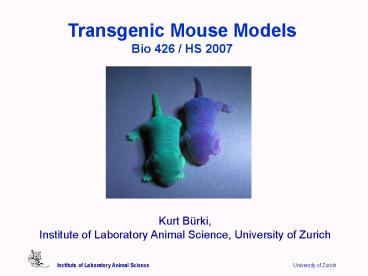
Transgenic Mouse ModelsBio 426 / HS 2007
Kurt Bürki, Institute of Laboratory Animal
Science, University of Zurich
2
Pronuclear Microinjection
- Microinjection of DNA directly into the pronuclei
of fertilized eggs - Implantation of the microinjected eggs into a
surrogate mother - Allowing the embryos to develop to birth
- Demonstrating that the foreign gene has been
stably incorporated into the host genome and that
it is heritable in at least one of the offspring - Demonstrating that the gene is expressed and
regulated correctly in the host organism
3
The Target The Zygote
- Fertilized Egg Accompanied by Usally One Polar
Body - Zona Pellucida (Glycoprotein Layer)
- Maternal (Close to Polar Body) and Paternal
Pronucleus
4
Optimal Conditions for the Generation of
Transgenic Mice via Pronuclear MicroinjectionBrin
ster et al. PNAS 82, 4438-4442 (1985)
- Strain Hybrid
- Site of Injection (Paternal) Pronucleus
- DNA Form Linear ends staggered, similar or
dissimilar - DNA Size Any few kb, BACS, YACS
- DNA Concentration 1ng/microliter (few
hundred molecules per nucleus) - Buffer 10mM Tris-HCl/0.25mM EDTA, pH 7.5
- Average Efficiency Under Optimal Conditions
- Eggs Injected 100
- Eggs Transferred 80
- Pups Born 20
- Transgenic Founders 3
5
Pronuclear Microinjection - Advantages
- Realtively simple and efficient
- Coinjection of transgenes possible
- Long transgenes possible
- Potentially all species
- Dominant effects (when transgene is expressed)
6
Pronuclear Microinjection - Disadvantages
- Random insertion
- Multiple (Tandem) copies inserted
- Several to many individual lines may have to be
tested for usefulness - Strain limitations
7
Consequences of Random Insertion
- Position effects influence transgene expression
- Insertion into endogenous genes lead to
Insertional Mutations (estimated 10 of the
founders)
8
Position Effects
- Denotes the different expression of a given gene
when trans-located in the genome to different
neighbouring chromatin. - Position effects are taken as explanations for
the often highly different expression levels and
patterns of randomly inserted transgenes.
9
Penetrance
- Denotes the failure of some animals with a mutant
genotype to express the associated mutant
phenotype. In any case where less than 100 of
genotypically mutant animals are phenotypically
mutant, the phenotype is said to be incompletely
penetrant. Incomplete penetrance is usually a
matter of chance or modifiers in the genetic
background.
10
Expressivity
- Denotes the observed quantitative difference in
the expression of a phenotype among individuals
that have the same mutant genotype. When
quantitative differences are observed, a
phenotype is said to show variable
expressivity, which can be caused by
environmental factors, modifier genes or chance.
11
Penetrance/Expressivity
12
Factors Influencing Transgene Expression/Penetranc
e
- Cis acting Factors
- Regulatory Elements (Promoter, Enhancers, Locus
Control Regions) - Copy Number
- Vector Sequences (have negative effects)
- Integration Site (Position Effects)
- Epistatic Effects of Recombined Sequences (eg.
Metallothionenein Regulatory Seq. Growth
Hormone Coding Sequences)
13
Factors Influencing Transgene Expression/Penetranc
e
- Trans acting Factors
- Epigenetic Modifications (Methylation)
- Imprinting (Germ-line dependent methylation)
- Modifier Genes (Genetic Background)
- DNA Binding Proteins
14
In vitro Functional Testing of Transgenes
- The in vitro functional testing of transgenes is
unreliable (transgenes usually are expressed) - The ultimate test is the in vivo test
15
Promoter-driven Transgenes
16
(No Transcript)
17
Enhancer-driven Transgenes
18
hGH mRNA Expression
19
Minilocus Locus Control Region
20
Transgene Expressing cDNA
21
(No Transcript)
22
hAPP Transgenes
23
mRNA Expression
24
Expression at the Cellular Level
25
Variegated Gene Expression
- Differential (heterocellular) gene expression in
given cell type of an individual - Characteristic of many transgenes
26
(No Transcript)
27
Refinements when Designing Transgenes
- BACs, (YACs)
- Targeted Transgenesis (in frame insertion of
promoterless transgene sequences in predetermined
locus expression pattern (and level) determined
by target gene)
28
(No Transcript)
29
The Inheritance of Transgenes
- Founders Usually in a Mendelian Ratio (50)
- Exceptions Frequent (lt 50 Mosaics
- gt 50 Multiple Integration Sites)
- Offspring Mendelian Ratio (50)
30
Paper to Read
- Kistner et al. Doxycycline-mediated quantitative
and tissue-specific control of gene expression in
transgenic mice. Proc. Natl. Acad. Sci. USA 93,
10933-10938 (1996).
Recommended

