

Reorientation of Vocational Education and Training (VET) in SDC PowerPoint PPT Presentation
1 / 21
Title: Reorientation of Vocational Education and Training (VET) in SDC
1
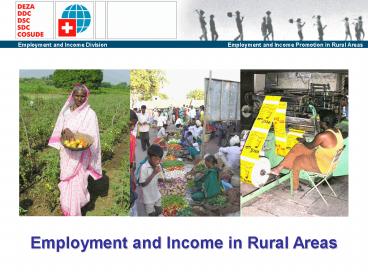
Employment and Income in Rural Areas
2
Why do we talk about employment and income in
rural areas?
75 of the 1.2 billion people in extreme po-verty
live in rural areas
Traditional agriculture not profitable enough for
rural prosperity
Little non-land use based economic opportunities
Difficult to access markets and services
Widespread overuse of, and conflicts for, natural
resources
Livelihood insecurity due to inability to acquire
assets
Interfering globalization
Out-migration or brain and workforce drain
3
Why do we talk about employment and income in
rural areas?
- Two typical situations
4
Employment and income in rural areas path out
of rural poverty
5
Pro-poor growth in rural areas
Strategic orientation, principles and practical
approaches
- How can the downward spiral process towards
marginalization be reversed?
Balance between growth and equity
- The cake has to be distributed more evenly
6
Pro-poor growth in rural areas (ctd.)
Strategic orientation, principles and practical
approaches
- Pro-poor growth requires an allocation of
resources to
Sectors in which the poor work
Efforts that reduce inequality
Production factors that the poor own
Outputs which they consume
Areas in which the poor live
Back to challenges
7
Strategic orientation, principles and practical
approaches
Equal opportunities for women
- In rural areas especially women face manifold
obstacles in accessing employment and income
opportunities - limited access to education and training
- limited access to land and other productive
resources - conflicting field of traditional role and
economic activities - limited power of decision
- Interventions are to be designed from the very
beginning towards a more balanced access of women
and men to employment and income opportunities
Back to challenges
8
Strategic orientation, principles and practical
approaches
Skill Development in Rural Areas
- Skill development in rural areas needs to cope
with - remoteness
- low basic education levels
- inappropriate skills to cope with globalized
economy - scarcity of qualified trainers
- out-migration
- scarce and centre based training supply
- In the past the focus was on formal schools and
centres in towns, long-term training, and people
were expected to go where training is offered.
9
Strategic orientation, principles and practical
approaches
Skill Development in Rural Areas (ctd.)
- Newer approaches to skill development in rural
areas are - modular curricula
- work with mobile units
- focus on skills allowing people to improve
incomes and livelihoods (market-orientation) - tip the balance towards practice (without
neglecting theory) - training along value chains
- Emerging of market-oriented as well as
community-based approaches - Access to and sustainable financing of skill
development in very remote areas remain big
challenges
Back to challenges
10
Rural Finance
Strategic orientation, principles and practical
approaches
- Households and rural enterprises demand
- safe and flexible saving products
- short and long-term credit for farming and
non-farming production - payment services
- insurance products
- Rural areas are hardly served by financial
institutions due to - high transaction costs (low population density,
lack of infrastructure etc.) - risk handling ( high and co-variant risk)
- lack of qualified staff
11
Strategic orientation, principles and practical
approaches
Rural Finance (ctd.)
- lack of effective legal systems rural areas
- building up of financial institutions is time
consuming and costly - Opportunities
- decentralized systems (e.g. saving and credit
groups, NGO's, village banks, co-operatives)
linked to commercial or development banks - innovative approaches as mobile units, self
management of decentralized units, bundled
service provision, information technology etc.
Back to challenges
12
Strategic orientation, principles and practical
approaches
Rural enterprise development
- Rural enterprises mainly include
- agricultural, other natural resource-based and
non-farming micro and small enterprises - medium enterprises often located in local towns
- Rural enterprises face specific constraints
- low local purchasing power
- lack of access to business and financial services
- lack of access to markets
- competitiveness for products which are also
produced in other places - low education and skill level of entrepreneurs
and employees
13
Strategic orientation, principles and practical
approaches
Rural enterprise development (ctd.)
- Opportunities for rural enterprises and their
promotion are - linking of rural enterprises to local, national
or international markets (integration into value
chains) - local processing of agricultural and other
natural resource products (enhancing of local
value added) - enterprises which bridge distance (transport, in-
and outbound trade, marketing of local products,
information and communication) - cluster development to reduce transaction cost
and strengthen business linkages - market creation for products with high utility
for the poor
14
Strategic orientation, principles and practical
approaches
Rural enterprise development (ctd.)
- A major proportion of the poor rural people
depend on agriculture and other natural resource
based activities (as farmers, tenants or
labourers) - A shift from traditional small-scale agriculture
with occasional surplus sold on the market to a
market oriented high-value and cash-crop
production is required for sustainable income
poverty reduction - Challenges in high value and cash-crop production
for (small) farmers are - producing the right quality, at the right time
and getting the produce to the right place - coping with risks and increased dependency on
outside actors - access to production means and financial and
non-financial services
15
Strategic orientation, principles and practical
approaches
Rural enterprise development (ctd.)
- access to markets
- Opportunities in high-value and cash-crop
production - integration of small farmers in local, national
and international value chains - marketing links to supermarkets (including
production planning, quality control, adequate
packaging etc.) - market creation and supply chain development for
quality equipment and inputs (pumps, drip
irrigation, seed, fertilizer etc.) - delivery contracts between small producers and
processing or trading enterprises
Back to challenges
16
Strategic orientation, principles and practical
approaches
Access to services
- Non-financial services for employment and income
in rural areas include - services for agriculture and other natural
resource-based enterprises - business development services
- Distinction between agricultural (extension
services) and business development services
becomes increasingly blurred - Main challenges
- demand orientation of services (quality of
services) - sustainable financing mechanisms for services in
remote areas (market-based approaches, subsidies) - market distortion through publicly financed
services - differentiation of beneficiaries of services
(public or private good)
17
Strategic orientation, principles and practical
approaches
Access to services (ctd.)
- Opportunities for improved and sustainable access
to quality services in rural areas - service market development
- financing mechanisms based on cost sharing
- embedded services (services closely linked to
business transactions) - services provided by producer, value chain or
business associations - small-scale local private service providers with
backstopping services - establishment of service provider training and
backstopping institutions - bundled service provision
- collective delivery and consumption of services
Back to challenges
18
Strategic orientation, principles and practical
approaches
Rural-urban linkages
- The strengthening of rural urban linkages is
important for the economic development of rural
areas - key sales markets for rural produce
- provision of services (financial and
non-financial) - access to job and education opportunities
- access to innovation
- etc.
Back to challenges
19
Strategic orientation, principles and practical
approaches
Cooperation between private and public sector
- Cooperation between public institutions and
private enterprises in the form of Private Public
Development Partnerships (PPDP) - Cooperation with private enterprises in common
projects along value-added chains - utilization of synergies towards a win-win
situation - activation of additional resources for
development (financial as well as competencies) - Challenges
- Transparency on interests and objectives
- Clear distribution of responsibilities
Back to challenges
20
Strategic orientation, principles and practical
approaches
Rural organizations and interest groups
- Rural people have a better chance to make their
voice heard or to represent common interests
through well-organised lobbying or interest
groups - Lobby or interest groups may be short-term
informal groups or sustainable formal
organizations with common interests in - exerting influence on policy decisions
- improving competitiveness and market access (e.g.
business membership organizations, producer
organizations etc.) - Major challenges in supporting rural
organizations are sustainability (financial and
operational) and inclusiveness
Back to challenges
21
Strategic orientation, principles and practical
approaches
International trade
- Currently high discrimination of mainly
agricultural products from developing countries
in the frame of international and regional trade
regimes (WTO and other regional agreements) - limited access to international markets due to
high import tariffs, non-tariff trade barriers
and export subsidies - ruin of domestic production in case of
unprotected domestic markets - Opportunities for supporting developing countries
with regard to increasing trade globalization - national and international advocacy for
non-discriminating trade regimes - support of developing countries in negotiations
on trade agreements - support of producers in developing countries to
adapt to increasing globalization
Back to challenges
Recommended

