

Bay Area Screening Center BASC and Center for Chemical Diversity CCD PowerPoint PPT Presentation
1 / 15
Title: Bay Area Screening Center BASC and Center for Chemical Diversity CCD
1
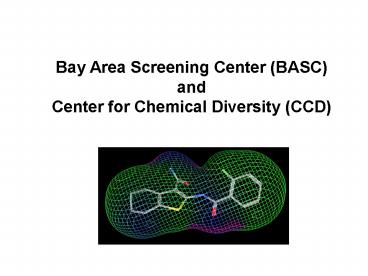
Bay Area Screening Center (BASC) andCenter for
Chemical Diversity (CCD)
2
BASC/CCD Mission
- Identify novel bioactive chemical entities
- Educate and train students in state-of-the-art
drug discovery research practices - Enhance university-corporate partnerships for
scientific and economic benefit
3
Current Research Foci
- Target Classes
- Nuclear Hormone Receptors
- Ion Channels
- CFTR Cl- channel antagonist progressing to clinic
- Viral Parasitic Targets
- Anti-Chagas protease inhibitor in clinic
- HIV, KSHV, SARS
- GPCRs,
- Disease Area Clinical Medicine Collaborations
- National Cancer Center
- Cardiovascular Research Institute
- Gladstone Institute, Virology
- ADME/Toxicity Profiling
- Technology Development
4
Workflow
5
Lead Op Workflow
6
Current Library Holdings
- Fully available internal collection of 220,000
small molecules - Culled based on ADME properties
- Library continually expanding through purchase
synthesis - Functionally diverse target-focused
- Natural products, peptidomimetics, novel
scaffolds linker design, etc. - Compound library curation
- Industry academic resource, currently 225k
7
Executing a Screen
LC/MS
8
Post-Screen Informatics
9
Reiterative Design from Hits
10
Large Scale - Low Parallel
lt10 g
lt100 g
16 Channels Load to 30 g
11
Small Scale - High Parallel
- Spatial array of reactors
- Varying diversity
- 96 x 1.5 mL (mg)
- 6 x 50 mL (g)
- Temp control -40 to 240 C
- Inert atmosphere or gas reagents
- Manual addition of reagents for smaller
libraries (up to 100s) - Robotic Addition of reagents for larger libraries
(up to 1000s)
12
Small Scale Highly Parallel Purification
Compound Purification
Structure Verification
- Current Procedures
- Fully Automated Chromatography
- Automated ESI/APCI/MS
- Automated Fraction Pooling
- 100 to 300 samples per day
- 100 mg loading
Evaporation
13
Hit to Lead
- Hit Characteristics (H compounds, requiring 1 mg)
- 1. Hit at 2.5 µM in cells with XX assay
- 2. Dose response in cells with XX assay EC50 lt 5
µM - 3. Confirmation of structure and purity gt85 by
LC/MS - Validated Hit Characteristics (L0 compounds,
requiring 1 mg) - 1. Good score on computational ADMET prediction
(less than 5 of 13 possible violations) - 2. Good score on computational REOS (rapid
elimination of swill) model (less than 10 of 93
possible violations) - 3. No evident cytotoxicity in 4 human cell lines
at dose of 10 µM or 10 fold above EC50, whichever
is higher - 4. Desired An evident SAR from analog by
catalog studies - 5. Desired Best EC50 in 1 µM to 100 nM range
- Lead Characteristics (L1 compounds, requiring 20
mg) - 1. A scaleable synthetic route has been developed
that allows access to wide range of analogs and
used to produce first round of designed analogs - 2. An evident SAR from a combination of ABC and
LO library compounds - 3. Equivalent potency and efficacy for best
compounds in short circuit analysis with human
tissue model to activity exhibited in cell model - 4. Good performance of at least one active
compound in rat/mouse microsome model - a. T1/2 in range of 15 to 60 min in standard
model - 5. At least 10 fold selectivity for activation of
XX transporter relative to activation of MDR and
SUR
14
Lead Op
- Validated Lead Characteristics (L2 compounds,
requiring 650 mg) - 1. Significant improvement in potency and/or
efficacy relative to initial hit at least ten
fold ideally 100 fold or more (less than three
cycles of chemistry to meet progress more
requires reassertion of commitment by core
management group) - 2. Good performance of active compounds in dog
and human microsome models - a. T1/2 greater than 30 min in standard model
- 3. All active compounds positive in CaCo-2
permeability assay Papp gt 50 nm/sec - 4. Good performance of best active compounds in
series in Rat PK model (Cassette Dosing, 4
compounds, disappearance of parent) - a. T1/2 (iv) greater than 2h
- b. Vdss 0.5-5L (standard for easy to apply drugs)
- c. BA greater than 30
- 5. Good performance of best actives in Rat pilot
toxicity study (po, No pathology, clinical
observations) - a. MTD at least 10 fold higher than dose needed
to obtain plasma level equal to EC50 in cellular
model - 6. Good performance in Rat PK model (non-Cassette
Dosing) - a. Cmax (po at MTD) at gt 10x the C(ED50) CL int
lt 150 mL/min/kg, CL 0-8h lt 50 mL/min/kg - b. Linearity of Cmax to the dosing amount.
- 7. All compounds negative in p450 inhibition
assay at 10 fold above EC50 minimally 3A4, 2D6,
2C9, isoforms.
15
Lead Op
- Late Lead Characteristics (L3 compounds,
requiring 10 to 100 g) - 1. Acceptable profile in rat general toxicology
and pharmacology model (oral route dosing
determined by MTD/EC50) - a. Effects on heart and respiratory rates
acceptable - b. Effects on metabolism
- c. No gross body weight loss
- d. Food uptake normal
- e. Urinary excretion normal
- f. Fecal excretion normal
- g. Activity level normal
- h. No significant unmanageable changes in
clinical chemistries -- particularly pancreatic,
liver enzymes normal - i. No clear liver or kidney damage in
histopathology - j Tissue toxicities (gut? pancreas renal with
tobramycin?) - k. Long QT or other specific toxicity mechanisms,
according to patient population. - 2. Negative in Ames II genotoxicity assay and not
inducing chromosome abnormality - 3. All compounds negative in hERG assay
- 4. All compounds acceptable levels of P450
up-regulation (defined as per co-TX and pt.
Population). - 5. Reasonable profile in ion channel panel
(defined per scaffold) - 6. Reasonable profile in GPCR panel (defined per
scaffold) - 7. Soluble in water (pH7) 100 to 10 µg/mL.
Recommended

