

Term Structure of Interest Rates: Relationship with the Business Cycle PowerPoint PPT Presentation
1 / 13
Title: Term Structure of Interest Rates: Relationship with the Business Cycle
1
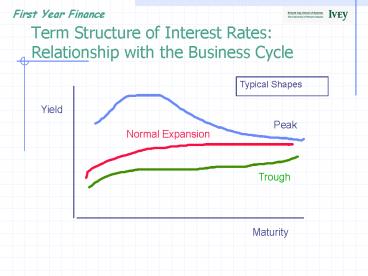
Term Structure of Interest RatesRelationship
with the Business Cycle
Typical Shapes
Yield
Peak
Normal Expansion
Trough
Maturity
2
Short-Term Interest Rates Examples
- t-bill yield, e.g., 91-day rate ? issued by
government - bank rate ? central bank rate lending to banks
- bankers acceptance (BAs), e.g., 3-month ?
guaranteed by chartered banks - commercial paper, e.g., 3-month ? corporate
borrowing (typically unsecured) - prime rate ? chartered bank lending to best
customers - typically move together (but not lockstep)
- . . . Problem 1 and 3
3
Bonds Nomenclature
- A COUPON BOND is a combination of an annuity (the
annual or semi-annual coupon payments) and a zero
coupon bond (with face value due at maturity). - Example
- 15 year bond with 8 coupons (paid semi-annually)
and 1000 par value. - This coupon bond pays to the holder, 40 every
six months for fifteen years - At the end of fifteen years, the principal amount
of 1000 is repaid with the final coupon payment
of 40.
4
Zero Coupons Bond
- A ZERO COUPON BOND, only pays the holder the
principal or face value at maturity - No interim payments (or coupons) are due prior to
maturity, - At maturity the entire face value is repaid
- The holder will typically have purchased this
zero coupon bond for less than the face value - Quite simply, a zero coupon bond is a
- ZERO COUPON BOND
5
Zero Coupon Bonds Pricing
Price P (1r)T
- Where P is the bonds principle (or par value) due
upon maturity, r is the required return and T is
the time to maturity - Example 91-day T-bill with 100 par value. The
required return is 2 over this (one) 91-day
period
Price 100 98.04 (10.02)
6
Zero Coupon Bond Yields
- The yield to maturity (YTM) on a bond is simply
the IRR for the bond - Example
- The average bid price on 91-day T-bills is
98.352 (i.e., this is the price today for the
bills that will provide a cash flow of 100 in 91
days) - what is the YTM or IRR or T-bill rate?
7
Zero Coupon Bond Yields contd.
- NPV 0 -C0 C1/(1r)
- 0 -98.352 100/(1r)
- (1r) 100/98.352
- r 1.0168 1
- r .0168 or 1.68 which is a 91-day rate
- Using a spreadsheet
- RATE(1, 0, -98.352, 100) 0.0168
8
Zero Coupon Bond Yields contd.
- What rate would be quoted?
- By convention, annualize (using simple interest)
- 1.68 x (365/91) 6.72
- What is the effective annual rate of return?
- (1.0168)365/91 1 0.0691 or 6.91
9
Coupon Bond Pricing
Example 15 year bond with 8 coupons (paid
semi-annually) and 1000 par value. Suppose, the
required return is 5 every six months
Price 40 x 1- (1.05)-30 1000
846.28 0.05
(1.05)30
10
Coupon Bond Yields
- What is the YTM of a 2-year bond which has a
price today of 100 and pays semi-annual coupons
of 5 (i.e., has a coupon rate of 10)? - NPV 0 -C0 C1/(1r) C2/(1r)2
C3/(1r)3 C4/(1r)4 PRINC/(1r)4 - 0 -100 5/(1r) 5/(1r)2 5/(1r)3
5/(1r)4 100/(1r)4 - r 5
- Excel rate (4, 5, -100, 100) or Goalseek
- Quoted Bond yield (annualized) 10
- Effective annual rate 1.052 -1 .1025 or 10.25
11
Bond Chart Example
- Issuer coupon maturity ask
price ask yield - US Govt 6.00 Oct 08 99.0625 3.33
- Problems 5 6
current price ()
coupon rate is 6 of 100 face 3 paid every 6
months
current YTM ()
final coupon and 100 face paid then
12
Term Structure of Interest RatesInterest Rate
Forecasting
- . . . Problem 4 (equivalent)
- Assume the 2 year rate is 1 higher than the 1
year rate and you have a two year horizon. - You have 2 strategies
- 1. Put a 1000 into a bond with a 2 yr. maturity
- 2. Put a 1000 into a 1 year bond, which you will
roll over at the end of one year?
13
Key Learning Points
- Term structure of interest rates
- Expectations hypothesis and forward rates
- Real and nominal interest rates
- Inflation
- Real and nominal cash flows
- Bond yields
- Yields are inversely related to bond prices
- Long maturity bonds are most sensitive to changes
in yields
Recommended

