

The Writing Process PowerPoint PPT Presentation
1 / 14
Title: The Writing Process
1
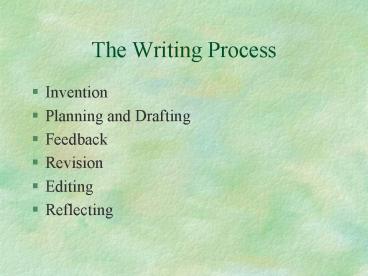
The Writing Process
- Invention
- Planning and Drafting
- Feedback
- Revision
- Editing
- Reflecting
2
The Writing Process
- Invention
- fast-writing
- clustering
- brainstorming
- ignore the editor in your brain at this point in
the process get ideas on paper as quickly as
possible - focus on one issue at a time
3
Natalie Goldbergs Rules for Invention
- Keep your hand moving
- Dont cross out
- Dont worry about spelling, punctuation, grammar
- Lose control
- Dont think. Dont get logical.
- Go for the jugular.
4
Planning and Drafting
- At this stage, you take your invention work and
write the first full draft. - A draft is a full paper with a beginning,
middle, and end. It is not one or two paragraphs
that is only a beginning. - As with invention work, try to write the first
draft as quickly as possible, trying to get your
ideas on paper with little interference from the
editor.
5
Suggestions for Drafting
- Choose a time and place where you can complete a
full draft in a single sitting. - Use a computer to make revision easy or write on
one side skipping lines. - Be satisfied with less than perfection
- Experiment
- Follow Digressions
- Guess at Words, Spelling, Facts
6
Feedback
- From peers
- From Learning Center
- From teacher
7
How to Give Critical Feedback
- Read the entire piece first
- Start with the positive
- Start with big questions move to small
- Offer advice, but dont rewrite
- Your role is to read carefully, to point out what
you think is or is not working, to make
suggestions and ask questions. - Leave the revising to the writer.
8
Why do we do Peer-Revision?
- When you read someone elses writing critically,
you learn more about the decisions writers make,
how a thoughtful reader reads, and the
constraints of particular kinds of writing. - In other words, you will become a better critic
of your own work. - You embody for the writer the abstraction called
audience. By sharing your reaction and analysis
with the writer, you complete the circuit of
communication.
9
Revision
- Reviseto see again
- Try to view the draft objectively.
- This means that you must do much more than simply
correct errors you must see the paper again from
a new perspective and be willing to make big
changes, including cutting sections, adding
sections, or moving sections around.
10
How to revise your work
- Start by looking at the piece of writing as a
whole. - Fix big problems first
- Does the essay achieve its purpose?
- Are the paragraphs in a logical order?
- Look at each section
- Is the beginning effective?
- Are all paragraphs unified and coherent?
11
Editing
- At this point, you correct all errors in grammar,
punctuation, and mechanics. - Nonstandard language distracts and lessens your
credibility as a writer. - You need to read your paper slowly and carefully
at this point. - It is wise to have someone else whom you trust
proofread for you someone else will see errors
that you cannot see because you know the work too
well.
12
Some Editing Strategies
- Read aloud to yourself. If your writing doesnt
sound good aloud, it probably wont read well
either. - Check each sentence, one-at-a-time, beginning at
the last sentence. - This will allow you to read for grammar,
punctuation, and mechanics, and not for meaning.
13
The Process is Recursive
- The writing process is not linear.
- At any stage in the process, you may need to
return to the Invention or Drafting stages. - Invention doesnt stop when drafting begins it
continues throughout the process.
14
The Last Step Reflection
- After you have submitted your final draft, you
should reflect on the process - What have I learned from writing this paper?
- What worked well for me this time?
- What didnt work for me?
- What should I have done differently?
- What are my goals for my next piece of writing?
- What would I like to try that I havent tried yet?
Recommended

