

History of Computers PowerPoint PPT Presentation
1 / 6
Title: History of Computers
1
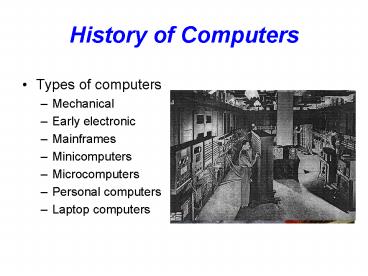
History of Computers
- Types of computers
- Mechanical
- Early electronic
- Mainframes
- Minicomputers
- Microcomputers
- Personal computers
- Laptop computers
2
Computer Architecture
- Inside a computer
- CPU
- Central Processing Unit
- Memory
- Instruction/data bus
- Input devices
- Keyboard, card reader
- Output devices
- Monitor, printer
- Storage devices
- Disk, CD/ROM, Flash drive
3
Programming Languages
- Growth of programming languages
- Machine code
- Octal or hex codes corresponding to the bit
pattern for each instruction - Assembly language
- Mnemonics for each code, names for memory
locations - Early languages and structured programming
- BASIC, COBOL, FORTRAN, PL/1
- Variables, operations, flow of control
- Modern object-oriented languages
- Ada, C, Java
- Objects with attributes (data) and methods
(operations)
4
Data Storage
- Storage Units
- Bits (binary digits), bytes (8 bits), words (2,
4, or 8 bytes) - Data Representation
- Decimal Base 10, the numbers used by modern
humans - Binary Base 2, only uses digits 0 and 1
- Each bit position is a power of 2 (010011012
64841 77) - Octal Base 8, uses digits 0-7, coded as groups
of 3 bits - Each bit position is a power of 8 (1158 6485
77) - Hexadecimal Base 16, uses 0-9 and A-F, groups
of 4 bits - Each bit position is a power of 16 (4D16 6413
77)
5
C Data Types
- Integer data
- Integer values can be stored in a byte, word, or
long word - In C the values can be signed or unsigned
- Negative numbers are stored in twos-complement
form - To get a negative integer, invert each bit of the
positive value and add one - Character data
- C uses the ASCII character set
- The character 0 is stored in memory as 30 hex,
or decimal 48 - Floating point data
- C uses two sizes depending on precision
required - float 4 bytes, range 10-38 to 1038 ,
accurate to 7 places - double 8 bytes, range 10-308 to 10308, accurate
to 15 places
6
C Control Structures
- Arithmetic
- Standard arithmetic operations
- , , , /, and (mod)
- Sequential
- A series of statements executed in order
- Conditional
- Decide what to do based on data in the program
- Looping
- Repeat processing based on some loop condition
while (condition) sequence_of_statements
do sequence_of_statements while
(condition) for (initialize condition
increment) statements_to_repeat
if (condition) sequence_of_statements else
some_other_statements
int myNumber 1 myNumber myNumber
myNumber 4
Recommended

