

Pauli exclusion principle: wave function for identical fermions must be antisymmetric PowerPoint PPT Presentation
1 / 17
Title: Pauli exclusion principle: wave function for identical fermions must be antisymmetric
1
16.451 Lecture 13 Isospin and symmetries
Oct. 21, 2004
1
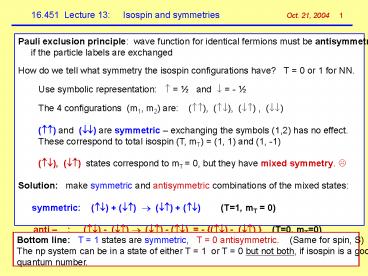
- Pauli exclusion principle wave function for
identical fermions must be antisymmetric - if the particle labels are exchanged
- How do we tell what symmetry the isospin
configurations have? T 0 or 1 for NN. - Use symbolic representation ? ½
and ? - ½ - The 4 configurations (m1, m2) are
(??), (??), (??) , (??) - (??) and (??) are symmetric exchanging
the symbols (1,2) has no effect. - These correspond to total isospin (T, mT)
(1, 1) and (1, -1) - (??), (??) states correspond to mT 0,
but they have mixed symmetry. ? - Solution make symmetric and antisymmetric
combinations of the mixed states - symmetric (??) (??) ? (??) (??)
(T1, mT 0) - anti (??) - (??) ? (??) - (??)
- (??) - (??) (T0, mT0)
Bottom line T 1 states are symmetric, T
0 antisymmetric. (Same for spin, S) The np
system can be in a state of either T 1 or T
0 but not both, if isospin is a good quantum
number.
2
2
Isospin selection rules for strong interactions
Consider the deuteron, 2H (np) bound state
(d) Quantum numbers mT 0, T 0 J?
1 (S 1, L 0, ? (-1)L ) How do we
know it has T 0 ? Isospin selection
rules The reaction 1) d d ?
? 4He occurs, but isospin
analysis (T 1 deuteron also works)
2) d d ?
? 4He does not isospin
analysis (only T 0 prevents this!)
Bottom line T is conserved by the strong
interaction. Energy depends on T but not on mT
3
News flash from Indiana University
3
Tour-de-force experiment http//www.cerncourier
.com/main/article/43/5/4
4
4
- isospin-forbidden reaction since T 0 for the
d, 4He, and T1 for ? textbook case - (technically speaking, this reaction breaks
charge symmetry which is the symmetry - under reversal of all up and down quarks in
a wave function, or equivalently a quark - isospin flip. The pion wave function is
CS odd the others are CS even) - Charge symmetry is broken by the
electromagnetic interaction up-down quark mass - difference, and their electric charge
differences - reaction could proceed with very low cross
section compared to isospin-allowed cases, - but there was never any convincing evidence
published until a couple of weeks ago - compare similar cross-sections at reaction
threshold - p d ? 3He ? ? 13 ?b (Isospin
allowed) - d d ? 4He ? ? 13 ? 2 pb
(forbidden, new result)
5
5
Cooler CSB
the search for dd?ap0
p0
slides courtesy of Dr. E. Stephenson, Indiana
University
Ed Stephenson Physics Colloquium 9/24/03
full set http//www.iucf.indiana.edu/Experiments
/COOLCSB
6
CHARGE SYMMETRY BREAKING
6
7
7
Observation of the Isospin-forbidden dd ? 4Hep0
Reaction near Threshold
d d ? 4He p0
isospin 0 0 0 1
CHARGE SYMMETRY says that the physics
is unchanged when protons and neutrons are
swapped, or when up and down quarks are swapped.
8
Threshold Energy
8
m3 - mn
m1
m2
For a reaction to occur in a fixed target
experiment, m1 has to hit m2 with enough energy
to make the particles in the final state.
The minimum kinetic energy required is called the
threshold energy
9
Experimental approach
9
Search just above threshold (225.5 MeV) (No
other p channel open for dd.) Capture
forward-going 4He. Pb-glass arrays for p0 ?
??. Efficiency on two sides 1/3.
Insensitive to other products
(?beam 0.51)
Pb-glass measures photon energy via Cerenkov
light from high energy e- produced in a shower
initiated by high energy photon collisions
Target density 3.1 x 10¹⁵ Stored current 1.4
mA Luminosity 2.7 x 1031 /cm2/s
6? bend in Cooler straight section Target
upstream, surrounded by Pb-glass Magnetic
channel to catch 4He (100 MeV) Reconstruct
kinematics from channel time of flight
and position.
Expected rate 5 /day
10
10
g
cone angle
a
p 0
.
d
d
g
For a fixed target experiment just above
threshold,
- a particles emerge within a narrow cone about
the 0-degree line. - (Spectrometer with small forward acceptance
will catch every a.)
- low-energy p0 quickly decays into two photons
which emerge nearly back to back in the lab.
Therefore, the apparatus must identify a forward
a in coincidence with two photons that have a
large opening angle between them.
11
scintillators measure flight time (ToF) ?
velocity ? momentum
- COOLER-CSB MAGNETIC CHANNEL
- and Pb-GLASS ARRAYS
- separate all 4He for total cross section
measurement - determine 4He 4-momentum (using TOF and position)
- detect one or both decay gs from p0 in Pb-glass
array
Scintillators DE-2 E Veto-1 Veto-2
Pb-glass array 256 detectors from IUCF and ANL
(Spinka) scintillators for cosmic trigger
Scintillator DE-1
Focussing Quads
MWPC
MWPCs
Target D2 jet
228.5 or 231.8 MeV deuteron beam
20? Septum Magnet
Note MWPC multiwire proportional chamber
gives tracking information for trajectory
angles
Separation Magnet removes 4He at 12.5? from beam
at 6?
11
12
12
p0 ? gg from pd ? 3Hep0
LEFT
RIGHT
Pb-glass Hit Patterns
beam goes into X
cosmic ray muon
color scale red gt pink gt blue
13
Missing Mass measured with proton beam
14
- conservation of energy
- W ? Ep Ed E(3He) m?
- Ep from beam energy
- deuteron at rest in target
- E(3He) from energy
- and momentum measured
- with the magnetic channel
- calculate W from data,
- should find a peak at the
- pion mass for reaction at
- threshold.
- then check in Pb glass
- array to see if pion was
Mass (Mev/c2 100)
14
SEPARATION OF ap0 AND agg EVENTS
12
IDEA Calculate missing mass from the
four-momentum measured in the magnetic channel,
using time-of-flight for z-axis momentum and
MWPC X and Y for transverse momentum. Should
see a peak for ?? reaction and a broad
background from ???
Need very good resolution so that the peak is
detectable!
MWPC spacing 2 mm
Y-position (cm)
Monte Carlo simulation for illustration.
Experimental errors included.
ap0 peak sTOT 10 pb
MWPC1 X-position (cm)
agg background (16 pb)
needed TOF resolution sGAUSS 100 ps
missing mass (MeV)
Background d d ? ? 2?
Time of Flight (?E1 - ?E2) (ns)
.
15
RESULTS (measured at two different beam
energies)
15
228.5 MeV 66 events
Events in these spectra must satisfy correct
pulse height in channel scintillators usable
wire chamber signals good Pb-glass pulse
height and timing
sTOT 12.7 2.2 pb
First ever convincing observation of both the ??
and ??? reactions!
231.8 MeV 50 events
sTOT 15.1 3.1 pb
Peaks give the correct p0 mass with 60 keV error.
?
missing mass (MeV)
Bottom line time to revise all the textbooks!!!
16
Isospin for nuclei
16
- Nucleon T ½, mt ? ½. For a nucleus, by
extension mt ½ (Z - N). - If neutrons and protons are really identical
as far as the strong interaction is concerned,
then nuclei with the same mass number but (Z,N)
interchanged ought to be very similar. These are
called mirror nuclei, e.g. 11B (5,6) and 11C
(6,5) - Energy spectra line up after correction for
Coulomb energy difference in the ground state. ?
evidence for charge symmetry of nuclear force
17
17
implications of isospin symmetry
- pp and nn systems are always T 1
- np system is (??) , ie it can be partly T 1
and partly T 0 - for a nucleus, mT ½ (Z-N) and T mT, ie
lowest energy has smallest T - (consistent with the deuteron being T 0)
- Example isobaric triplet 14C, 14N, 14O
evidence for charge independence of the nuclear
force
14O Z 8, N 6 mT 1, T 1
14C Z 6, N 8 mT -1, T 1
14N mT 0, T 0 (g.s) and T 1 (8 MeV)
Recommended

