

Results of 226Ra 48Ca Experiment Yu'Tsyganov, Yu'Oganessian, V'Utyonkov, Yu'Lobanov, F'Abdullin, I'S PowerPoint PPT Presentation
1 / 9
Title: Results of 226Ra 48Ca Experiment Yu'Tsyganov, Yu'Oganessian, V'Utyonkov, Yu'Lobanov, F'Abdullin, I'S
1
Results of 226Ra48Ca ExperimentYu.Tsyganov,
Yu.Oganessian, V.Utyonkov, Yu.Lobanov,
F.Abdullin, I.Shirokovsky, A.Polyakov,
V.Subbotin, A.Sukhov, R.Sagaidak, A.Voinov and
JINR (Dubna), LLNL (Livermore), TUM (Muenchen),
INS Vinca (Belgrade) collaboration
Yu.Tsyganov 07 Apr. IOP-2009 Birmingham, UK
- Content
- Introduction
- Synthesis of 269-271Hs by TUM group
(briefly, properties) - 2) Experiment at U-400 cyclotron using DGFRS
- a) The Dubna Gas Filled Recoil Separator,
detection module, experiment motivation... - b) Parameters of experiment
- c) Results and discussion
- 3) Summary
- Nearest future experiments , predictions of
cross sections
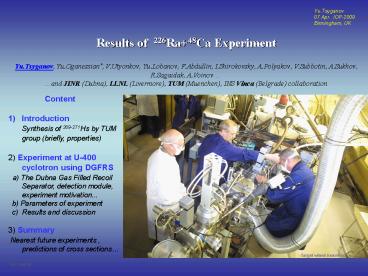
Target wheel mounting
Sci. leader
2
270
271
New isotopes
3n/4n ratio ?
3
Experimental setup of TUM group (discovery 270Hs
)
Transport time 3 s
Transport time 1 s
No T1/2 value for 270Hs can be measured, because
of missing of EVR signal !
Slide by Dr. Alexandr Yakushev (TUM )
4
The Dubna Gas Filled recoil Separator (JINRLLNL
since 2001)
226Ra target design ( six sectors, form-
RaO) Foil 1.5 mcm Ti.
GSI, RIKEN
.
.
.
Experiment 226Ra48Ca?270Hs4n
DGFRS, 2008
- Why?...
- to check decay properties 270,271Hs discovered by
TUM group - to measure cross sections of 3,4 n reaction
channels ( a) by itself b) as a parameter for
any extrapolations/corrections to Z117-120 )
5
DGFRS Detection module
6
position windows corresponding to two position
resolutions (?2.35 standard deviations,
confidence level (c.l.) 0.98).
E?9.02?0.08 MeV, T1/27.6?4.92.2 s, the
half-life of the daughter spontaneously
fissioning isotope is 0.28?0.90.08 s in
agreement with TUM group results (E?8.88?0.05 MeV
for 270Hs and TSF0.36?0.250.10 s for 266Sg).
233.2 ? 2.8 projectile energy Excitation energy
40.0 ? 2.2 MeV Target 0.23 and 0.36
mg/cm2 (two runs) Beam dose 4.11018 Cross
section 8.3 ? 6.73.3 pb
ltEEVRgt13.0?0.77 MeV Calculated 13.2 MeV
7
Background level
Time intervals between ? particles and all
preceding ER-like events observed within two ER-?
or ER-SF position resolutions (?2.35 standard
deviations) are shown. Time intervals for the
nearest ER events assigned to implantation of
270Hs in detectors are shown by arrows. Dash
line shows distribution dN/d(lg10 t) for
T1/27.6 s. Dash-dot line shows linear fit for
random ER-like events.
8
But..3n?! (they give max channel)
9
Summary
Yu.Tsyganov IOP-2009
1) Cross section for the 226Ra48Ca?270Hs4n
reaction was measured as about 8.3 pb ( beam
dose 31018 part. ) Decay properties of 270Hs
measured by TUM group are confirmed (in
principle) 2) Both 3n and 5n channel decays
were not detected for the beam doses 6.21018 (
?4.2 pb if T1/24s) and 2.31018 ( ? 5.0 pb ),
respectively. 3) Calculations by Adamyan at al.
(PRC 69 (2004) ) do not reproduce in principle
the maximum reaction channel number (3n, except
for 4n measured in our experiment) ---------------
--------------------------------------------------
------------------------------------- 4) Cross
section values for the future 243Am 50Ti and
249Cf 50Ti reactions may have of greater values,
than ones, predicted by W.Greiner V.Zagrebaev
calculations
V.Zagrebaev and W.Greiner calculations
Recommended

