

Marine Operations Using Space Transportation PowerPoint PPT Presentation
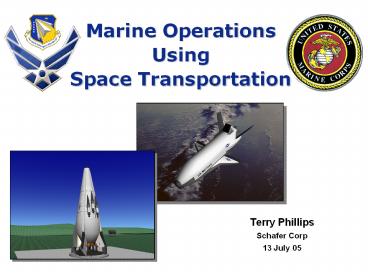
Title: Marine Operations Using Space Transportation
1
Marine OperationsUsingSpace Transportation
- Terry Phillips
- Schafer Corp
- 13 July 05
2
ICD for Small Unit Space Transport and Insertion
(Sustain)
- Defines Capacity for JFC to Rapidly Transport
Strategic Capabilities to Any Point on Globe - Addresses Rapid Employment of Tailored
Expeditionary Forces from CONUS Including Use of
National Security Space (NSS)
- Material Approaches
- Increased Forward Presence
- Evolutionary Improvements to Conventional Assault
Support - Revolutionary Improvements to Terrestrial
Aviation Capabilities - Space Insertion-Terrestrial Extraction
- Space Insertion and Extraction with Refueling
- Space Insertion and Extraction without Refueling
Marine BGen Richard C Zilmer, Commander 29 Palms
Training Command We briefed the Pentagon,
Congress, USSOCOM, and the NSC and were never
thrown out. 25-30 years from now the idea is to
move a squad-sized unit of Marines to any place
on Earth in less than two hours.
3
HOT EAGLE Incrementally Addresses Multiple
Capabilities
- Affordable, Reliable Spacelift
- Global or Theater ISR
- Space to Space ISR
- Space Interdiction and Control
- Force Application to Space
- Force Application to Globe
- Space Insertion of Personnel
- Global Insertion of Personnel
4
Multiple Options Evaluated
- Space Insertion Terrestrial Extraction
- Forward Deployment Space Insertion and
Extraction - Limited Range Space Insertion and Extraction
Without Refueling - Near Space Revolutionary Improvements to
Terrestrial Aviation Capabilities - Revolutionary Improvements to Terrestrial
Aviation Capabilities Limited Range and Space
Insertion and Extraction - Space Insertion and Extraction With Refueling
- Space Insertion and Extraction Without Refueling
5
CAV-Based Marine Space Transportation
OptionsSpace Insertion Terrestrial Extraction
- Common Aero Vehicle (CAV) Resupply
- Maneuvering reentry vehicle
- GPS guided parafoil final descent
- CONUS launch
- 1000 lb payload currently
- CAV-Based RV Team Insertion
- 20 Klb class CAV-like vehicle
- Capacity Marine squad plus equipment
- Trajectory optimized for low g with resulting
light weight structure - Integral life support
- 2 hours maximum from launch to insertion
- Stealthy insertion
- Multiple Team Extraction Concepts
Light Weight Structure Evolution
6
Team Extraction Approaches
- Self Extraction Hike Out
- Leave crew capsule behind
- Aircraft/Helicopter/Ship
- Osprey / C-17 / C-130
- Leave crew capsule behind
- Crew Capsule Pick Up Via Aircraft/Helicopter
- CAV crew capsule separates from aeroshell and
life support - Crew compartment pick-up via balloon cable and
C-17 - Pick up crew capsule via C-17
7
Bimese RLV Marine Space Transportation
OptionsForward Deployment Space Insertion
Extraction
- Use Bimese VTVL RLV
- Bimese both stages same size
- Upper stage has 24,000 fps ?V ideal
- Forward Deploy Upper Stage Only
- Bimese can launch from CONUS, recover upper stage
globally - Refuel and Launch Upper Stage
- Upper stage inserts team
- Arrival not stealthy
- Recover Upper Stage
- Team performs mission, moves to pick-up location
- Upper Stage Picks Up Team
- Out of Box Team Extraction Idea
- Upper stage rejoins with C-17 which tows stage
home - Stage is released for independent landing
Single Bimese Stage Range
8
Bimese RLV Marine Space Transportation
OptionsForward Deployment Space Insertion
Extraction (cont)
- Both Bimese Stages Could Forward Deploy
- With identical stages, 2 CONUS launches forward
deploy - Alternatively ship or aircraft could transport
one stage - Stages Mated and Fueled at Forward Location
- Upper stage inserts team
- Recovers in theater
- Portable LOX generation, JP-8 fuel, portable
mating gear, bare pad launch possible with VTVL
stages - Range Increases 50-100 Using Two Stages
Bimese RLV Range
Bimese Technology Implications High Mass Fraction
Stages Required High AoA Reentries Useful for
Stealthy Ingress Operability Technologies for
Forward deployment
9
Heavy Lift RLV Marine SpaceTransportation
OptionGlobal Insertion Limited Range
Extraction without Refueling
- Heavy-Lift Vehicle Many Options
- Launches Full-Propellant RLV Upper Stage
- CONUS to Global Locations
- Traditional modular approaches
- Or Revolutionary technologies (DE, CCE, etc.)
- RLV Uses Only Landing Propellant during Insertion
- Landing propellant only 10-12 of propellant load
- Limited Stealth
- Insertion sonic boom can be minimized via high
alpha reentry - Rocket engine ignition 2-3 min prior
to landing not stealthy (but
throttle is low) - Most propellant reserved for extraction
- Integral DE fire support possible
- RLV extracts team
- Recovers in-theater
- 500-1000 nm range
Technology Implications Very High Mass Fraction
Upper Stage Needed
Close to Desired Marine Capability No CONUS
Direct Return Possible Initially Mass Fraction
Improvements could Enable Longer Range Returns
10
Heavy Lift RLV Marine SpaceTransportation
OptionGlobal Insertion Limited Range
Extraction without Refueling
- Supports SOCOM Space Enabling
- Concept Requirement, 18 Mar 04
- UNS Marine Requirement, 13 Jul 02
- Stealthy, Survivable Transport of 13 Troops
Equipment Launch on Demand Unrefueled
transport No overflight restrictions VTVL
One CONOPS
HTV-3 Technology
Multiple Boost Options
Multiple Stage Options
High AOA
High Altitude Reentry over Target
Minimizes Overflight Noise
Booster RTLS
VTVL Egress Option Suborbital Hop
First Order Assessment Insertion Very Viable
Egress Requires Very High Mass Fraction
11
High Mass Fraction Lander Notional Design
Concept Weights
Strap On Drop Tanks Augment performance if
Required
Composite LOX Tank
Avionics Rack/Low Cost GNC
Payload Bay (9 x 14)
Composite JP-8 Tank
Control surfaces for high AOA flight
Modified Production RD-0124 Engine
12
Team Extraction ApproachesPowered Options
- Self Extraction Powered
- Limited Range of 300-1000 nm Initially
- Insertion Vehicle Pick Up Via Aircraft
- Boost to aircraft rendezvous snag and tow
- Boost to parasail glide snag and tow
- Deploy balloon from ground snag and tow
13
Upper Stage Landing Vehicle Release Marine Space
Transportation OptionLimited Range Space
Insertion Extraction
- RLV Upper Stage Releases Aerodynamic Descent,
Parafoil Final Descent, Landing Vehicle - Upper Stage Recovers to Forward Location for
Refueling - Parafoil Makes Final Descent and Landing
- Stealthy insertion
- Expendable landing vehicle
- Upper Stage Extracts Team
- Recovers in-theater
- High L/D upper stage for extra range
- 1000 nm radius
Technology Implications Very High Mass Fraction
Upper Stage Needed High L/D Upper Stage
Needed Very Lightweight Landing Vehicle Needed
Landing Vehicle Gives Flexibility Aerodynamic
Cross-Range Useful Stealthy Arrival Good Radius
of Action Do Not Have to Defend Landing Vehicle
14
Hypersonic Airbreathing Marine Space
Transportation OptionsNear Space Revolutionary
Improvements to Terrestrial Aviation Capabilities
- Hypersonic Cruise Vehicle (HCV)
- Mach 10-12 HTVL airbreather
- Launch from CONUS or Forward Deployment Base
- Diego Garcia, Guam possibilities
- 9000 nm Round Trip
- 1 hr flight time including acceleration,
deceleration - Segments can be optimized for scenario, ROE
- Insert Team
- Approach not stealthy
- Remain with Team or Depart to Safe Area
- Potential integral DE fire support
- Extract Team
- Limit on extraction range likely T/W for vertical
landing and T/O
Technology Implications High Mass Fraction
Needed High L/D Needed Advanced TPS
Needed Efficient Propulsion Needed
HCV is Really Fast Aircraft
15
Hybrid Airbreathing-Rocket Marine Space
Transportation Options
Revolutionary Improvements to Terrestrial
Aviation CapabilitiesLimited Range Space
Insertion and Extraction
- HCV with RLV Upper Stage
- RLV VTVL
- HCV Flies by or Over Target Area
- Strategy determined by politics and threat
- RLV Stage Separates and Lands
- Short range flight preserves RLV propellants
- RLV Remains or Departs to Safe Location
- Integral DE fire support possible
- RLV Extracts Team In-Theater
- Extraction range 1000 nm
- Out of Box Extraction Idea
- RLV rejoins with another HCV for extraction
Technology Implications High Mass Fraction
Needed High L/D Needed Advanced TPS
Needed Efficient Propulsion Needed
Hybrid Airbreathing and Rocket Stages
16
On-Orbit Refueling Marine Space Transportation
OptionSpace Insertion Extraction With Refueling
- TSTO Orbit-Capable RLV with VTVL Upper
- Stage
- Upper Stage Refueled On-Orbit
- Could also add external/conformal propellant
tanks on-orbit - Short On-Orbit Loiter of 24-72 hrs Possible
- Upper Stage Deorbits and Inserts Team
- Only landing propellant used during insertion
- Integral DE Fire Support Possible
- Upper Stage remains and Extracts Team
- Only landing propellant used during insertion
- External/Conformal Tanks Burned First and
Jettisonned - Range 2-4000 nm, Possibly Intercontinental with
Evolved High Mass Fraction Upper Stage - Space Basing a Possibility
- Physiological effects on Marines need studying
Technology Implications High Mass Fraction stages
Needed High L/D Upper Stages Needed
On-Orbit Refueling Offers Several Advantages
17
SSTO CONUS-CONUS Marine Space Transportation
OptionSpace Insertion Extraction Without
Refueling
- VTVL SSTO RLV
- Rocket Powered or Combined Cycle Airbreathing
- CONUS Insertion, CONUS Extraction
- Round trip 1-4 hours flight time
- Noise and Other Signature Reductions
- Stealthy ingress and egress
- Integral DE Fire Support
- Lasers, EM weapons
- Stun technologies
- Other non-lethal techniques
- Non-lethal picket fence protection
- Requires Much Better Propulsion and/or Structures
than exist today - Limited duration space basing is possible
Technology Implications Revolutionary Propulsion
or Ultra-Lightweight Structures Needed
Evolutionary Changes Lead to Development of
Revolutionary Technologies
18
Stepping Stones to Marine Capability
- CAV Being Developed by DARPA Falcon Program and
AFSPC - HCV Being Developed by DARPA Falcon Program,
AFRL, and NASA (X-43, etc.) - RLV First Stage Being Developed by AFSPC/SMC/AFRL
Advanced Reusable Spacelift (ARES) Program - RLV Upper Stage Program Could be DARPA/AFRL Hot
Eagle Program - Recommendation
- Corps Support for Falcon, ARES, and Hot Eagle as
Initial Stepping Stones to Capability to Place a
Marine Squad Anywhere on the Globe in Two Hours
Stepping Stone Programs All Funded ExceptHot
Eagle Reusable Upper Stage Program
19
Hot Eagle Recommendation
- Biggest Common Technology Need for Upper Stages
is High Mass Fraction Airframe / Structure - High Mass Fraction Stages Enable Bimese,
Heavy-Lift, Hybrid Airbreathing and Eventually
SSTO Concepts - DARPA/AFRL Hot Eagle RLV Upper Stage Program
Should Emphasize High Mass Fraction - High Mass Fraction Gives Higher Performance,
Larger Payload, Longer Extraction Range for
Marine Applications - High Mass Fraction Allows Smaller and Less
Expensive Upper Stages to Provide Same
Capabilities as Larger, More Expensive Lower Mass
Fraction Stages
High Mass Fraction Benefits All Space Concepts
Recommended

