

CHEMICAL REACTIONS PowerPoint PPT Presentation
1 / 14
Title: CHEMICAL REACTIONS
1
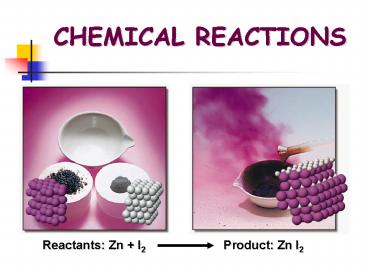
CHEMICAL REACTIONS
Reactants Zn I2
Product Zn I2
2
Chemical Equations
- Their Job Depict the kind of reactants and
products and their relative amounts in a
reaction. - 4 Al (s) 3 O2 (g) ---gt 2 Al2O3 (s)
- The numbers in the front are called
- coefficients
- The letters (s), (g), and (l) are the physical
states of compounds.
3
Introduction
- Chemical reactions occur when bonds between the
outermost parts of atoms are formed or broken - Chemical reactions involve changes in matter, the
making of new materials with new properties, and
energy changes. - Symbols represent elements, formulas describe
compounds, chemical equations describe a chemical
reaction
4
Parts of a Reaction Equation
- Chemical equations show the conversion of
reactants (the molecules shown on the left of the
arrow) into products (the molecules shown on the
right of the arrow). - A sign separates molecules on the same side
- The arrow is read as yields
- Example
- C O2 ? CO2
- This reads carbon plus oxygen react to yield
carbon dioxide
5
Chemical Equations
- Because of the principle of the conservation of
matter, an equation must be balanced. - Balanced means it must have the same number of
atoms of the same kind on both sides.
6
Balancing Equations
- When balancing a chemical reaction you may add
coefficients in front of the compounds to balance
the reaction, but you may not change the
subscripts. - Changing the subscripts changes the compound.
Subscripts are determined by the valence
electrons.
7
Subscripts vs. Coefficients
- The subscripts tell you how many atoms of a
particular element are in a compound. The
coefficient tells you about the quantity, or
number, of molecules of the compound.
8
Chemical Equations
- 4 Al(s) 3 O2(g) ---gt 2 Al2O3(s)
- This equation means
- 4 Al atoms 3 O2 molecules produces---gt
- 2 molecules of Al2O3
9
Steps to Balancing Equations
- There are four basic steps to balancing a
chemical equation. - Write the correct formula for the reactants and
the products. DO NOT TRY TO BALANCE IT YET! You
must write the correct formulas first. And most
importantly, once you write them correctly DO NOT
CHANGE THE FORMULAS! - Find the number of atoms for each element on the
left side. Compare those against the number of
the atoms of the same element on the right side.
10
Steps to Balancing Equations
- Determine where to place coefficients in front of
formulas so that the left side has the same
number of atoms as the right side for EACH
element in order to balance the equation. - Check your answer to see if
- The numbers of atoms on both sides of the
equation are now balanced. - The coefficients are in the lowest possible whole
number ratios. (reduced)
11
Helpful Hints
- Take one element at a time, working left to right
except for H and O. Save H for next to last, and
O until last. - IF everything balances except for O, and there is
no way to balance O with a whole number, double
all the coefficients and try again. (Because O is
diatomic as an element) - (Shortcut) Polyatomic ions that appear on both
sides of the equation should be balanced as
independent units
12
(No Transcript)
13
Balancing Equations
2
2
- ___ H2(g) ___ O2(g) ---gt ___ H2O(l)
What Happened to the Other Oxygen Atom ? This
equation is not balanced! Two hydrogen atoms from
a hydrogen molecule (H2) combines with one of the
oxygen atoms from an oxygen molecule (O2) to form
H2O. Then, the remaining oxygen atom combines
with two more hydrogen atoms (from another H2
molecule) to make a second H2O molecule.
14
Balancing Equations
2
3
- ___ Al(s) ___ Br2(l) ---gt ___ Al2Br6(s)
Recommended

